
Translated material
Harry Kasparov: Free elections are a threat to a corrupt Kremlin structure of power
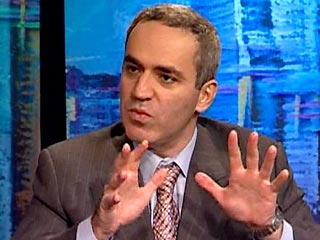
On March 14, the Russian people made their choice - Vladimir Putin scored more than 70% of the vote. It’s time, the world of the world in chess Harry Kasparov believes, to ask a question about how far the country should go along the road of authoritarianism before the West does something more than simply raising the eyebrows and voiced concern.
President Putin does everything in his power to destroy the nascent democratic institutions in Russia. And the inaction of Great Britain, the United States and other Western democracies that claim the role of the defenders of these ideals, only indulges him, writes Kasparov on Sunday in the British newspaper The Daily Telegraph (translation on the website inopressa.ru ).
No need to walk far behind fresh examples, illustrating how freedom and democracy are sacrificed to the altar of political benefits.
So, the West was somewhat “concerned” with the recent elections in Iran, in which at the last moment the thousands of candidates-reformers were banned. At the Islamic Conference, the Prime Minister of Malaysia uttered the anti-Semitic tirade, and in response, the European Union only expressed "deep regret", since France laid a veto on a more significant censure.
And at the same time, the dictators of North Korea are greeted with open arms for the fact that after decades of hostility and open violence, he makes symbolic conciliation gestures.
You can imagine that Putin just shakes with fear at the sight of such anger!
However, in relation to countries that are not so lucky or militarily lucky, concern can turn into actions much faster. When the Ukrainian administration took steps to change the constitution in order to preserve its power grip, the EU strictly and without delay condemned it.
The current offensive on the democratic foundations in Russia is much more seriously, it will certainly result in dramatic long -term consequences for the region and the world. And if this happens, then these consequences will destroy the remnants of trust to the West in the field of support for democracy abroad.
Here is a proposal for the West. If you do not condemn what is happening in Russia, then just stay away. If you, “expressing concern” and without doing anything, silently approve of Putin’s actions, then you can openly openly congratulate him on the election, imprisoning his critics and establishing control over the media.
In this newspaper, writes Kasparov, there is not enough space for listing all the actions of the Kremlin, aimed at centralizing power and suppressing the opposition, so we will limit ourselves to only a few chosen examples. In the end, Putin’s regime is a new type of police state in which both old and new anti -democratic mechanisms are mixed.
One of the old methods described in textbooks is the use of fear and anxiety for their safety to intimidate citizens. It's about Chechnya. Not many Russians support the continuation of hostilities or approve of how Putin acts there. However, this does not reduce the effectiveness of statements about the impending threat.
There are serious fears that state security forces can be involved in the violence of recent months in order to incite a new fear. Or should we believe in an equally alarming assumption that the numerous apparatus of federal security is not able to achieve progress in the fight against a gang of poorly funded terrorists?
The establishment of control over the media can also hardly be called a new trick, but this time the original style is felt here. Instead of closing television channels or newspapers that dare to pronounce something except the compliments of the Putin administration (or even worse - pay attention to the opposition), offenders are replaced by loyal journalists. The packaging remains the same, but its contents are changing.
This censorship in the Putin style at least attracted the nominal attention of the West. European observers in the December parliamentary elections were stunned: as they say in their report, in every (news) issue there were attacks on all opposition parties, Kasparov writes. Let us hope that these observers came to their senses for the presidential election, which take an even more exaggerated form. Is it not true that some efforts will be required to increase the appearance of voters in Chechnya, since the last time it was already more than 100%. As Comrade Stalin said: those who vote do not solve anything. Everyone is decided by those who consider voices.
Another key moment in the program of Mr. Putin to pacify the disagreements and centralization of the authorities is the systematic persecution of everyone who refuses to stand in his ranks and fill his pockets. First of all, the whole large business was obliged to make deposits to the Kremlin projects - without taking into account and under the table. If you try to pay your taxes to the state instead of filling its secret bins, you will find soon that your company is under investigation and is about to be closed.
Since these corruption transactions began, the Kremlin uses the threat of investigation to keep the corporations in obedience. If anyone is trying to break out of this vicious circle, it is punished. The best example of this outstanding scheme is the fate of the owner of the energy company Yukos Mikhail Khodorkovsky, and the word "example" in his case is even too accurate.
While many of his oligarch colleagues bought yachts, estates and foreign football clubs, Khodorkovsky made efforts to turn Yukos into a truly modern international corporation. Yukos was already the most transparent energy company in Russia.
Khodorkovsky did not hide his political mood and spent millions of dollars on educational and charitable programs in Russia. Now he languishes in the dungeons. We can assume that buying a yacht or, possibly, Arsenal would be a safer investment.
If there is something that the current Kremlin regime does not survive, it is transparency. At that moment when they will no longer be able to use the threat of persecution for illegal methods of doing business against the country's financial leaders, they will lose control and stable income that this threat brings. Those in power can commit any offenses, until they remain the loyal supreme leader and his interests.
That is why Khodorkovsky posed such a threat. He did not expect merits from the state and could not allow the Kremlin to blackmail him. He wanted to break out of the shadow world, but this Putin regime could not endure. In order to literally throw Khodorkovsky from the business, the Prosecutor General and various ships committed major violations of Russian law and procedures.
I understand that all this should sound quite ridiculous for the western ears, Kasparov writes. A rich man is in prison because he no longer wants to participate in corruption, because he wants to pay his taxes to the state. Khodorkovsky wanted to be free from pressure, from the threat of persecution of the president’s whim. He wanted to be a loyal law, not the ruler, and for this he was thrown into prison.
If you are free from the system, you can put on display its dark sides and destroy it. It was impossible to allow Khodorkovsky to serve as a bad example for the rest, and therefore he now serves as a clear example of what is happening if you try to shed light on the dark lair of nomenclature.
Understanding the nature of the Russian state bureaucracy is the key to understanding Putin's actions. The real power in these institutions does not depend on the general elections, and everything possible is done so that it goes further.
The current Byzantine system of power is based on devotion to the leader, and everything should participate in it, or they are threatened with punishment. The promotion is initiated inside the system, and not determined by the elections.
Free and fair elections, therefore, is a threat to the corrupt Kremlin structure of power. That is why in January the Committee "Free Choice - 2008" was created in Russia. We are trying to attract world attention to the disaster that occurs in Russia.
The committee collaborates with various non -governmental organizations both in Russia and beyond, in order to document the abuses of the Putin regime, because there is still time to get rid of them.
The main call of the committee is the holding of the legal elections of the Russian president in 2008. We are trying to prevent any changes in the constitution that would allow the current president to remain in power. The Committee hopes to create a movement in support of universal, free and fair elections. Without such elections, there will be no protection of the rights of minorities, and the rapid rolling to a complete authoritarian rule will only accelerate.
The Free Choice - 2008 Committee also analyzes numerous violations that were committed during the December elections. We meet for their consideration in Russian courts and, if necessary, we will reach the Supreme Court.
We understand the grandeur of the task and ask for the help of Western countries, which are so often declared that they are ready to protect democracy everywhere, where it is in danger. It is worth noting that European parliaments more openly condemned Russia's failures than the leaders of these countries who preferred silence.
The participation of countries such as Great Britain and the USA is important not only to avoid accusations of hypocrisy. At stake is a moral imperative. As Gladstone said in 1879 in relation to Dizraeli's foreign policy: "Remember that the inviolability of human life in the mountainous villages of Afghanistan among winter snow is as unshakable in the eyes of the Almighty God, as well as the integrity of your own life."