
Translated material
Bush and Blair discussed the situation in Iraq
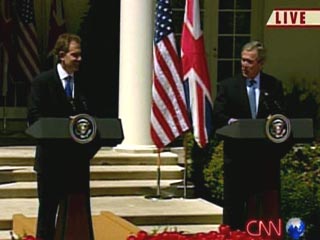
US President George Bush confirmed today that Iraq's sovereignty will be restored on June 30. Plans for the transfer of power to Iraqis by this time remain in force, he said at a joint press conference with the Prime Minister of Great Britain Tony Blair, which took place in the pink garden of the White House following the results of their negotiations. "This will show the Iraqi people that our coalition is not interested in the occupation of Iraq," the head of the administration said.
Nevertheless, he admitted that even after June 30, when the temporary occupation administration will cease to exist, the coalition forces will remain in Iraq in order to "help the new government," ITAR-TASS reports.
Bush supported the proposals of the special representative of the Secretary General of the UN Lahdara Brahimi to restore statehood in Iraq, noting that their implementation will establish the legal power in Iraq, acceptable for most citizens of the country.
According to Brahim’s proposals, on June 30, the political sovereignty of Iraq will be restored, the American occupation administration and the Provisional Managing Council will be abolished, and temporary president, two vice presidents and the Provisional Government will come to power. "Our coalition partners will continue to work together with the UN to prepare for nationwide elections, according to which the new Iraqi government will be formed in January 2005," the US president added.
Bush admitted that in the last few weeks, coalition forces have encountered serious difficulties in Iraq. According to him, these difficulties are created by "extremists and terrorists trying to seize power in Iraq." “The British Prime Minister and I made their choice,” Bush said. “Iraq will be free and independent.”
One of the British journalists asked Blair whether he was ready to admit that the United States and Great Britain were misleading the world community, affirming before the start of the war about the presence of weapons of mass destruction and the connection of the Hussein regime with terrorists.
The British prime minister, in fact, left the answer, limiting himself to general discussions about the threat that Saddam Hussein represented for the whole world.
Blair stated at a joint press conference that a new resolution of the UN Security Council should be adopted to promote the political process and ensure security in Iraq.
Blair assured that the paramount task, which should and will be fulfilled, is the transfer of power in Iraq to the legally formed Iraqi governing bodies, scheduled for June 30.
"We hope that the UN will play the central role, as now, in the development of the program and the mechanism of political transition to full -scale democracy in Iraq," the Prime Minister said.
He also highly appreciated the work of the UN specialist in Iraq Lahdara Brahimi and said that during yesterday’s meeting with the United Nations Secretary of the CoFi Annan, he found “general approaches” to Iraqi settlement. “Details (transfer of power) will need to be discussed with Iraqi representatives,” Blair noted.
According to him, "the goal of the military action in Iraq was to ensure a safe atmosphere to achieve political goals."