
Translated material
Scientists have discovered the most young planet known to humanity in the universe
American scientists said on Thursday about the possible discovery in the universe of the youngest planet known to humanity. The planet-boy, whose age is less than 1 million years, was opened by the NASA Spitzer space telescope.
According to the astronomer, Dan Watson, the Material Planet was discovered in orbit around the Coku Tau 4 star, located in 420 light years from the Earth in the constellation Taurus. The age of this star is about 1 million years, so the age is even less planet, reports Reuters.
One light year is about 6 trillion miles, the distance that the light overcomes during the earth's year.
Scientists have currently discovered more than 100 so -called "off -season" (located outside the solar system) planets, but, as astronomers suggest, the age of these celestials is from 1 billion years or more. The Earth and its neighbors on the solar system are also relatively elderly - they appeared about 4.5 billion years ago, by cosmic standards, this is an average age.
The possible location of the planet was discovered when the telescope watched the dusty disk around the Coku Tau 4 star, in which scientists found an annular clearance. This young planet pulled dust and garbage to her, forming this void in the ring. The alleged planet may have been formed from the concentration of this dust, scientists said at a press conference at the NASA headquarters.
“This body is only a million years old,” said Watson. “Perhaps this is the youngest planet that is known to people. It is so young that most theories of planets are questioned.”
It from the theories of planetary education says that planets arise when small objects known as planetosimali, collide and stick to each other, gradually forming a planetary mass. Another theory of the origin of planets suggests that they are formed from dust and cosmic garbage around the star for several billion years.
The Spitzer telescope also discovered a significant amount of ice organic matter in the gas -pipe ring surrounding other stars. This discovery can give the key to the riddle of the origin of comets.
Some astronomers believe that comets could bring water to the Earth, along with other substances necessary for life. Molecules of organic substances were previously met in space, but this is the first time they were found in dusty disks around the star in which planets form.
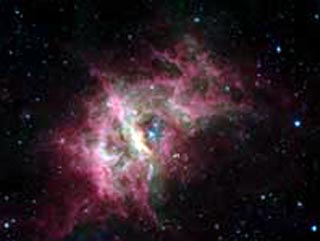
Spitzer also discovered more than 300 newborn stars, a whole "star kindergarten" of the universe, in the accumulation of RCW 49, where stars arise. It is located in 13,700 light years from the Earth in the constellation Centaurus.