
Translated material
Delay from the army will become much less
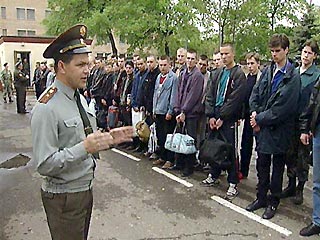
The working group led by Presidential Assistant Igor Shuvalov, on behalf of the president, took up the reform of the draft system for military service. Experts are now working on two options for changes.
According to the first option, since 2008, the deadline for compulsory service will be reduced to one year, but the grounds for freeing or deferred from the draft will become much less: they will not be allowed only to sick people or the only breadwinner in the family, the Vedomosti newspaper reports on Wednesday.
The second option even implies a reduction in the service life of conscripts to 6-9 months with minimal grounds for benefits and delay. According to reformers, in this case, the army should transform into an educational institution and guarantee additional skills and preferences that have served: modern weapons, computer literacy, as well as free higher education and the possibility of entering the civil service.
The developers of these scenarios from the Shuvalov group refused to talk about them, because "these are only working options that can still seriously change." But a source in the presidential administration explained the logic of the transformation discussed: "You can’t talk about the defense capacity of the country, in the army of which are mainly sick and uneducated."
In his opinion, the situation where children of wealthy parents have the opportunity to avoid calling, having entered the institutes, and children of poor and dysfunctional families are sent to serve, leads to the decline of the army and enhances social stratification.
A source at the Ministry of Defense suggested that the reduction in the service life of to 6-8 months, even if deferred, is unlikely to appeal to the military.
The expert of the Center for Defense Information Ivan Safranchuk recalls that now the concept of military reform implies a gradual transition from calling to contract service. "If the call is preserved, then the contract system will most likely be distributed only to the sergeant -Starshin positions or certain categories of elite troops," he says.
And the rector of the Institute of Educational Policy of Eureka, Alexander Adamsky, is outraged by the prospect of canceling a deferment of the army for students and graduate students: "In the current conditions, the service is a lost time, a moral breakdown, and if the army will interrupt the learning process, this will lead to intellectual degradation."
True, the Shuvalov Group recognizes that for such changes, the base should be “prepared” - this is the eradication of hazing and decent funding. “Otherwise, the proposed measures will not lead to the proper effect,” says one of the developers. A source in the presidential administration agrees that "the movement must be oncoming." Society must create civilian institutes of army control, and the state should restore order in the army and create normal conditions of service.
According to the General Staff, in 2003 only 10% of the total number of persons of draft age was called up. Release for health reasons received 30% of conscripts, but health problems were also found in 50% already called up. The Ministry of Defense notes the low educational level of conscripts - 40% of them were from dysfunctional families.