
Translated material
UN Secretary General does not want to give Pentagon immunity from criminal prosecution
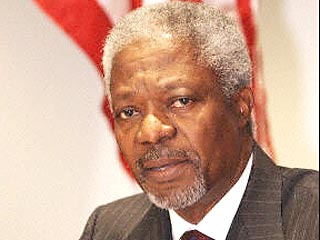
The UN Secretary General COFI Annan resolutely spoke out against the extension of immunity from persecution by the International Criminal Court, which in 2002 and 2003, the Security Council provided the American military personnel participating in peacekeeping operations, RIA Novosti reports.
Commenting at the request of the journalists an offer of the United States to adopt a similar resolution in the Security Council this year, the Secretary General said that he considers him "rash."
“The last two years I spoke quite decisively against immunity and I believe that against the backdrop of cruelty to the prisoners in Iraq, it would be unreasonable to insist on his extension,” Annan said. “As for the Security Council, it would be even more unreasonable for him. This will lead to discrediting the Council and the entire UN, which defends the rule of law.”
As the Secretary General emphasized, he does not claim that the facts of cruel treatment of Iraqi prisoners in the Abu Graib prison should be considered by the MUS, but it is precisely taking into account these facts that the Security Council should not be supported by the US requirement to extend immunity.
The term of the previous resolution of the Security Council on the release of peacekeepers from countries that are not members of the 1998 Roman Statute on the creation of the Court on July 1. At the end of May, the security Coal has postponed for an indefinite time the consideration of the project submitted by the American delegation to the issue.
In 2002, a resolution on the withdrawal from the jurisdiction of the Musa of military personnel from the Roman status of states that did not ratify in the Security Council unanimously. Last year, when voting under a similar resolution, Germany, Syria and France, according to which the Mus have the necessary mechanisms, abstained in order to weed out affairs with a political background.
Then Annan warned that the transformation of this procedure into an annual formality will lead to undermining not only the authority of the court, but also the legitimacy of the peacekeeping activity of the community of nations.
This year, the delegations of Brazil, Germany, Spain, Romania and France have already stated on the intention to refrain from voting on the renewal of immunity. As Annan emphasized on Friday, this question will "share the Council", which is more necessary than unity.
The United States, along with other 134 countries, signed the Roman statute under President Bill Clinton. However, under George Bush Washington withdrew this signature and concluded bilateral agreements with 89 states, according to which they pledged not to pursue the American military and diplomatic representatives. At the moment, 94 of 193 countries of the world were ratified by the Roman Statute.