
Translated material
Mendeleev table will be replenished with five new elements
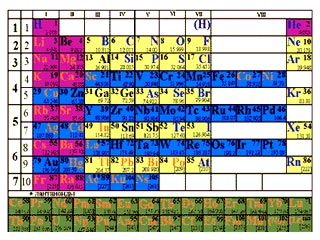
The Mendeleev table will be replenished with five new elements. This was announced by the academician of the Russian Academy of Sciences, the supervisor of the laboratory of nuclear reactions of the United Institute for Nuclear Research Yuri Oganesyan.
He was one of the scientists to whom Vladimir Putin handed the Order for Merit to the Fatherland of the Third degree, RIA Novosti reports.
"The Mendeleev table that we taught at school will be replenished with five new elements. This is the work that we did in five years," the scientist said during the awards ceremony.
Earlier it was announced that Russian and American scientists managed to create two new "superheavy" elements that will take places at the very end of the periodic system of chemical elements.
Several atoms of the "new" elements 113 and 115 were obtained on an accelerator of heavy ions and existed throughout a second of a second. They are an unusual form of matter, which in its properties differs from all other 92 elements found on Earth, writes The Washington Post .
The experiment was conducted as part of research carried out by the Academician Oganesyan group in the nuclear reactions laboratory named after Flerova, together with a group from the Liverrand National Laboratory.
Scientists argue that superheavy elements are formed as a result of explosions of supernova stars. According to another version, super -heavy elements formed in the first seconds of the emergence of the universe.
On Earth, tiny particles of super -heavy elements that are formed in the accelerator will not be able to find any practical application. However, scientists believe that their “birth” can add very interesting details that will help create a unified theory explaining the physical forces that affect the behavior of matter.
Officially, the opening of 113 and 115 elements of the Mendeleev table was announced in September 2003. The discovery in 1940-1941 of the first artificial elements - Neptunius and Plutonium - was the beginning of a new direction of nuclear physics and chemistry in the study of the properties of transaran elements and their use in many areas of science and technology.
Since then, the question of the existence of the upper boundary of the table of the elements of Mendeleev is of great interest for the fundamental science about the structure of matter and its transformations. Similar studies are conducted in many large scientific centers in Germany, the USA, Japan, France, as well as at the United Institute of Nuclear Research in Dubna.
As a result of long-term and intensive work, 17 new elements were synthesized until the 112th physicists. It was found that with an increase in the atomic number of the element, its lifetime drops sharply. So, if Uranus, having an atomic number 92, lives about 1 billion years, then the 112th element - only 0, 00002 seconds.