
Translated material
Patriarch gave an interview "NG religions"
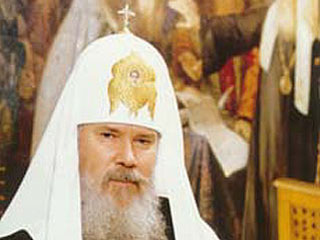
The Russian Orthodox Church (Russian Orthodox Church) recently solemnly celebrated the fourteenth anniversary of the entry into the patriarchal throne of Alexy II . This year, this date coincided with the celebration of the 75th anniversary of the Patriarch of Moscow and All Rus'. With the name of Alexy II, many associate the process of the spiritual revival of Russia and the Church. In an interview with the responsible editor of NG-religion, Mark Smirnov, which the newspaper published today , the Patriarch talks about his high-reading ministry, which was at the turning point of Russian history. He also evaluates the processes that are taking place in society now. The Primate of the Russian Orthodox Church paid considerable attention to the answers to the problems of spiritual education in the country, as well as the coverage of the life of the Russian Orthodox Church in the Russian media.
According to the Patriarch, the changes that have occurred over the past and a half decades of our lives are not subject to unequivocal assessment. “Of course, the people of Russia gained political and economic freedoms, which in itself has a great positive importance for the country and its citizens. But at the same time, millions of our compatriots found themselves behind the poverty line, having lost the simplest and most pressing human rights, among which the right to work and its worthy reward, the right to social security and professional demand, the right to affordable high -quality health care and education,” the one believes. Primate of the Russian Orthodox Church.
According to the Patriarch, "the cause of such social imbalances in most cases is not at all the lack of a desire or ability to work, but the lack of social component of urgent economic reforms, which are often, unfortunately, are carried out without proper accounting of Russian traditions and realities."
“Gratifying,” notes Alexy II, “that now there is a significant adjustment of the course that did not justify folk hopes.”
Today, the Patriarch believes, “the church and state power support a constructive dialogue in a wide range of problems of modern life. Our cooperation with the state in a number of areas, significant for both society and the service of the Church, has been successfully developing. Visible successes have been achieved in the field of mercy and charity, in the spiritual and moral education of soldiers, in the stupid of prisoners, in the opposition of the spread of the prison alcoholism, drug addiction, children's homelessness. "
At the same time, Alexy II expressed regret on that "that not all church initiatives that have significant social potential and serious public support are properly assessed by some secular authorities." First of all, this concerns the problems of spiritual education of youth.
“Until now,” notes the Primate of the Russian Orthodox Church, “at various levels, there are facts of rejection of the idea of teaching the ideas of the“ Fundamentals of Orthodox Culture ”in Russian schools. At the same time, the arguments cited by opponents of this cultural discipline turn out to be far -fetched, having nothing to do with the real interests of children and their parents.”
According to Alexy II, “the concepts of freedom, separation of the church from the state, the secular nature of training, multinationalism and polycond and polyconction are interpreted at the same time formally, unilaterally and slyly from the standpoint of agnosticism, atheism, or“ religious reformation ”to the detriment of the interests of the future country and the rights of its young citizens. As a result, it turns out that the younger generation of Russia is losing the possibility of mastering the development cultural, historical and national-spiritual tradition of their people. "
All this leads, according to the Patriarch’s conviction, to such “inexplicable and paradoxical situations”, which are clearly visible in the example of Moscow, “where there are a number of public schools with an ethnocultural component: Ukrainian, Tatar, Jewish and so on, but there is no teaching of the“ foundations of Orthodox culture ”.
Alexy II believes that theological seminaries and the Academy should receive a license for educational activities from the state. “It is quite obvious that only in this way it is possible to eliminate the existing discrimination of the diplomas of theological seminaries and academies, recognizing their equal dignity with documents issued by secular educational institutions,” the Patriarch is convinced.
“So far,” he explained, “the difficulties of an organizational and legal nature interfere with this, which are associated, in particular, with the fact that the legal status of religious educational institutions in modern Russia remains largely controversial.”
The preoccupation of the Primate of the Church is also caused by "some changes in tax and land legislation, which jeopardize the further development of social programs," developed by the Russian Orthodox Church.
In his conviction, the reason for such phenomena lies not only “in an unhealthy atheistic past”, but also in the fact that the church today “often encounters attempts to supplant religion from the sphere of public life into the field of private, purely private interests of a person.”
“In the modern world, where liberal -searular standards are increasingly affirming itself, this trend is comprehensive, global in nature,” the patriarch believes, “from whether society will be harmonized by humanistic civilization, for example, in the field of human rights, with the cultural and religious domestic tradition, the historical future of Russia and the fate of its peoples will ultimately.”
Answering the question of his impressions of the coverage of the life of the Russian Orthodox Church in the Russian media, Alexy II noted that the church cannot complain about the lack of attention from the media.
“In general, we are grateful to journalists for their sincere desire to present to society an objective picture of church life, to understand the essence of the tasks facing the church, to help solving its problems. Fortunately, responsible professionals, people of Russian cultural tradition are among journalists who write about the church, the vast majority,” the patriarch believes. However, he noted with regret, “there are authors that make the subject of their speeches exclusively negative phenomena, which inevitably take place in the life of each public institution. Often this is multiplied by the rejection of the church as such, by addiction and incompetence, and sometimes there is a frank execution by the journalist of the social order of anti -church forces, and then the image of Russian is distorted in public consciousness. Orthodoxy ".
Nevertheless, the church belongs to "such injustice quite calmly" and does not enter "in barren polemic with blasphemers," because it is well known "that the Church of God was persubid and humiliating it with enemies from the first days of its existence."
By the deep conviction of the Patriarch, "the almost two thousand -year -old history of the church and our life confirm the correctness of such a position." “Despite the attacks of some anti -church media, confidence and interest in the Church in our society does not fall, but it increases steadily. And this cannot help but see the sign of God's goodness to the works that our Church pursues in pursuance of the saving mission entrusted to it by the Lord,” said Alexy II.