
Translated material
The language of the Russian diaspora in modern Lithuania
The emergence of new sovereign states in the post-Soviet space, which have chosen a new political, economic and national-value orientation, most directly affected the language situation in these countries. The position of the Russian language in Lithuania has changed noticeably. After the restoration of the independence of the Lithuanian state, accompanied by large-scale socio-political and economic transformations in 1991, the status of languages functioning in Lithuania became fundamentally different. The Lithuanian language was declared state, and Russian is the language of the national minority. The space of the Russian language is narrowed in the socio-political life of the republic, its functions as a literary language are weakened. The active influence of the Lithuanian language contributes to the strengthening of some specific features in the Russian language. This article discusses the regional features of the language of the Russian diaspora in Lithuania in recent decades-from the 90s of the twentieth century to the present.
Sociolinguistic features of the Russian language in Lithuania
The Russian population of Lithuania is characterized by multiplicity, heterogeneity. This variegation is due to various factors: historical, territorial, socio-cultural (professional, age, family, educational), individual characteristics of native speakers of the Russian language, etc. The Russian diaspora was formed in Lithuania for many centuries. On the one hand, it includes indigenous Russians who have been living here for more than a century: in particular, since the 17th century, compact settlements of Russian Old Believers have existed in Lithuania, which have not been assimilated, preserved their native language and national self -awareness. On the other hand, Russians also live in Lithuania, who fell into it several decades ago as a result of various migration processes. Today, Russian Lithuania are people of different generations, different social status, various levels of education and culture, varying degrees of integration into Lithuanian society, with different levels of ownership of the state language and various culture of native speech.
Intensive language contacts are characteristic of Lithuania since time immemorial: along with Lithuanians in this country, people of other nationalities have always lived. According to the Department of Statistics of the Republic of Lithuania, reflecting the last census of the population, on April 6, 2001, 3,483,972 people lived in Lithuania [1] . Modern Lithuania is one of the most mononational states in Europe: Lithuanians make up 83.45% of the country's population. Among the nation minorities - Poles, Russians, Belarusians, Ukrainians, Jews, etc. Russians make up 6.31% of the population of Lithuania - these are 219,789 people. The number of Russians in Lithuania has significantly decreased in the last decade. In the first five years after the restoration of independence of the republic, most of the emigrating were the Russians - 58%; In 1993, for example, 16 thousand Russians emigrated, and 10 thousand to Russia [2] .
It should be noted that, on the one hand, the Russian language is not a native language for all Russians: 13,954 Russians are considered by Lithuanian language, 389 - Polish, 77 - Belarusian, 91 - Ukrainian, etc. On the other hand, the Russian language is recognized by people of other nationalities - Poles (22,439 people), Belarusians (22,386 people), Ukrainians (11,737 people), people) Jews (2,411 people), Tatars (1,448 people), as well as Lithuanians (7,837 people), etc.
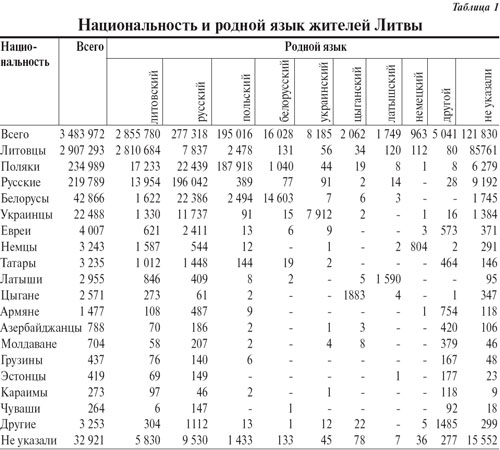
The modern resettlement of Russians is characterized by territorial unevenness. 89.7% of Russians live in cities: Vilnius, Klaipeda, Visaginas; More compact residence of Russians is observed in Eastern Lithuania.
According to a survey of the early 90s [3] , the sociolinguistic “portrait” of Russian residents of Lithuania looks something like this. Russians have been living in Lithuania for a long time: 46% - indigenous people, 41% live for more than 10 years; Most Russians (59.5%) consider Lithuania to be their homeland. Russians are mainly family people (69.7%); The composition of a typical family is four people (36.7%) or three people (29.9%). According to the early 90s, the level of education is as follows: the secondary specialized is 26.9%, the highest is 26%, the total average is 23.1%. Social status: employees prevail - 40.1% and workers - 28.3%. According to the sociological data of recent years, to the question of social security, 52% of the Russians replied that there are no unemployed in their family, but 21% fears to be left without work (first of all, this applies to the inhabitants of Visaginas). Further, to the question "How do you assess the change in your social status over the past ten years?" A significant number of Russians - 44% - replies that they fell along the steps of the social hierarchy, 24% remained in the same place, and 30% rose. Among the factors contributing to the promotion of the social ladder, Russian Lithuania is the first place in the first place (73%), and in the second - ownership of the state language (64%) [4] . The Russians are not characterized by isolation in communication, and to the question "Do you have friends of a different nationality?" 93.9% of Russians respond positively [5] . Among the Russians, the family mixed in the national composition are common. According to fifteen years ago [6] , 18% of marriages in Lithuania - mixed; Most often, the Poles and Russians enter into mixed marriages: the most common Russian-Polish, Russian-Belarusian and Russian-Lithuanian marriages. The number of Russians entering mixed marriages has increased in recent years. There are noticeable changes in the cultural traditions of the Russian population. The attitude of the Russians to the modern assimilation processes is difficult: with the thesis “we live in Lithuania, and this means that we must adapt to the lifestyle of the Lithuanians” 40% of Russians agreed (the answer “rather, yes” did not agree - 49% (the answer is rather no ”) [7] . The level of ownership of the state Lithuanian language has increased. According to the beginning of the 90s, 22.8% of Russians speak freely in Lithuanian, 26.2%-good, 34.7%-weakly; do not speak in lightly at all 13.8% [8] .
In recent years, the situation has changed dramatically. Russian children often visit Lithuanian kindergartens and schools, then study at universities with the Lithuanian language of learning. At the same time, the number of subject hours in the Lithuanian language in school and universities is much increasing. The younger generation seeks to become part of the Lithuanian society as soon as possible; The most important condition for achieving this goal is the ownership of the priority state language. Thus, bilingualism is characteristic of Russian Lithuania. A special linguistic situation is formed in Vilnius, where a significant part of the population is residents of Slavic nationalities. In some areas (for example, in Eastern Lithuania), Russian inhabitants are three -speaking: they speak Russian, Lithuanian, Polish or Belarusian, as well as their dialects. In recent years, the attitude to the study of the Russian language as a native has been significantly changing, the status of the subject “native language” at school is changing. If in Russia this is a priority item, then in Lithuania - pushed to the position of an additional one; In particular, the Russian language exam is not among the mandatory exams for the maturity certificate, it is chosen from five alternatives. In 2004–2005, among 1,750 secondary schools in Lithuania (536 120 students), there were only 54 Russian schools and 39 mixed schools with Russian classes; In Russian schools and classes, 27,026 students studied, which amounted to 5.04 % of all students of Lithuania - these are the data from the interview with the Minister of Education and Science of Lithuania R. Motuzas (LC [9] . 2005. No. 8). For comparison: in the 1990/1991 academic year, among 2,040 secondary schools in Lithuania (501,740 students) there were 85 Russian schools and 103 mixed schools with Russian classes, 76,038 students were studying in Russian, which amounted to 15.1% of all students. Thus, over 14 years, the number of students in Russian schools has been declining three times. The tendency to a further reduction in the number of Russian schools is obvious, which is explained by a number of reasons: the birth rate falls in Lithuania; the number of Russian inhabitants is reduced; Some of Russian children study in Lithuanian schools, etc.
Nevertheless, the Russian language in Lithuania continues to serve as a means of communication between people of different nationalities. According to the results of the 2001 census, more than 60% of all residents of Lithuania are fluent in the Russian language; In second place in popularity is English, which is owned by 17% of Lithuania residents are mainly young people.
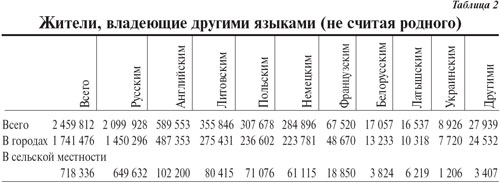
The Russian language in Lithuanian secondary schools is studied as a second foreign language since the 6th grade. The Russian language as a foreign language has recently become more and more popular, it has been studied by almost 67% of students attending Lithuanian schools. In 2002, 83% of Lithuania residents indicated that of all foreign languages they know the Russian language best (Luke 2005. No. 8). However, the spheres of the functioning of the Russian language are gradually narrowing. This is understandable, because the Russian language becomes the language of the national minority. In addition, some socio-psychological factors play a negative role: for a certain part of the population, the Russian language is associated not so much with Russian science and culture as with the former political system.
In general, in Lithuania and, above all, in Vilnius there is a large infrastructure of Russian communication. Russian is used as a language of learning and is the subject of study; This is the language of the media, science and culture. Along with Russian schools, there are Russian kindergartens; The editorial offices of television and radio programs, magazines and newspapers in Russian, departments of the Russian language and literature in universities, the Russian theater, churches, etc. are valid. There are Saturday and Sunday schools of the Russian language as informal formations, which are visited by children who are studying in non-Russian schools for one reason or another.
Under the influence of language contacts, the Russian language in Lithuania acquires specific features. It is influenced by Lithuanian, as well as, in a number of areas, the Polish and Belarusian languages, but the degree of this influence is not the same: the social status of contacting languages plays an important role.
The influence of the Lithuanian language on Russian
Due to the prestige and social activity, the greatest influence on the Russian language is certainly laid down by Lithuanian. The interaction of the Russian language with Lithuania takes place in all spheres of the functioning of the Russian literary language: household, socio-political, scientific and, to a certain extent, official business. At the same time, there are:
-activation of the lexical and semantic processes associated with the use of Lithuanian words in Russian speech, and above all those that reflect new realities that have no analogues in Russian reality: Sennas Shnipishkes decided to restore at least the minimum order in this very neglected area of the capital (LR. 1999. No. 1)-Lit. Seniu - Nas "Starost"; The Council of Veterans of the Second World War with Syanameche Syanyania Vilnius (Eh. L. 1998. No. 254) (Seniu - Nija - “Starry”, “The District in which the Elder conducts affairs”); Go to Savivaldib (Savivaldybe · - “Self -Government”); They gave you Pashalpa (PAS.alpa - “Money Building”) (PP) - the transfer of approximate;
-activation of lexical and semantic processes associated with the expansion of the meaning and compatibility of words (often-internationalism): a share-30%. From August 15 to September 15-sewing a demi-winter coat-with a 30% discount (Ec. N. 2002. No. 36)-cf. lit. akcija (in one of the meanings) "Action associated with a decrease in prices, discount" [10] ; Now he leads the center of the studios of globalization of Yale University (Luke 2001. No. 50) (here - “Study”) - cf. lit. Studija (in one of the meanings) “course, academic discipline”;
- activation of internationalism; This is due to the fact that the Lithuanian society is more oriented to the Western way of life: according to the recognition of the founders themselves - the Ministry of Culture and the Lithuanian Culture Fund - the Institute was created in a hurry (advance 1999. No. 22) (Fundatorius “Founder”, “Creator”, “Sponsor”); Do you have this or half-story? (Etatas "state") (PP);
- semantic and phraseological tracing is a hidden, or translated borrowing through approximate copying of foreign samples: beautiful weather; Beautiful day - by analogy with lit. Graz.us "1. Beautiful; 2. Good ”; Unsuitable (first -hand), in good condition ... goods from wealthy people from Germany (Ec. N. 2001. No. 4) - lit. IS. pirmu - ranku - “little -advisable”;
- The widespread use of Ltualism in word formation: “Sa. Ju - DIS ”(lit. name of the national movement) - Sayudist, Sayudist; Sodra (lit. abbreviation "Social insurance") - Sodrovskaya book (PP);
- activation of syntactic tracing: we thank you for your participation (radio, 02/11/1993); There is no reason to doubt the words of the general (TV, 12/12/1992); a mixture of semantically close prepositions, for example, with instead of B - write and read with glasses (lit. SU akiniais "in glasses"); Go into a room with shoes (lit. SU Batais "in shoes") (PP);
- activation of a number of grammatical forms (for example, forms of the genitive case instead of the vinative in literary Russian): the nature of such things came up with; There was no point in learning another language (PP);
- The spread of errors in stress, often in internationalism: do you also have allergies on cats? (PP); The store has a large selection of linoleum (TV, 2003, advertising) - Linoleumas; The regal should be not only for the Sejm (radio) - reglamentas.
Inter -oid interaction is also manifested in written speech, affecting graphics and spelling. For example, the transmission of the Lithuanian sound E - Gediminas and Gyadiminas is not unified; Sound J - iodcrant and iodcrant (two options for writing in the same newspaper on the same page - obs. 1999. No. 24). Spelling errors in words that have a phonetic-orphographic similarity in Russian and Lithuanian, but not an identity: inziner-inz.inierius, magnetophone-magnetofonas, hollow-kopu-stai, etc. Thus, the influence of the Lithuanian language extends to various systemic levels of the Russian language, to various forms of its functioning- oral and written.
Polish-Belorussian influence in Russian
In a number of areas, especially in Eastern Lithuania, the Russian interacts with closely related languages - Polish and Belarusian (most often in their local dialectic varieties). This interaction is limited: a) territorial (primarily the Vilnius district and Vilnius); b) functionally (characteristic mainly of Russian extraovitate vernacular and manifests itself in socially insignificant situations). Polish-Belorussian influence, like Lithuanian, is observed at all language levels.
Lexical innovations are mainly common in the household sphere: before, the farbes were natural (white farba, floor Farba "Paint"); I will sew falseters at the very end (Bel. Falbon, Paul. Falbana "Carbeling"); They brought a piece of Kumpyak (Bel. Kumpyak, in the local Polish dialect of Kumpiak "HORRK"). Borrowing, indicating people, mainly expressive names with a negative assessment are also frequent: oh I am not notable, I left milk on the stove! (Bel. Nyadol “Woe, misfortune”, Paul. letter. Niedola “Evil Fate”); Well, you are a ramp! (Bel. "Black"). The borrowed names of kinship are actively used in Russian expansion: a mop with a mop yesterday came up (Bel. Schwagger, Svaparka, Pol. Szwagier, Szwagierka “Boil, Homestic); You must go to the brotherly (Bel. Bratov, Pol. Bratowa "brother's wife"); I have a good test (Bel. Tsestsev, Pol. Tes.ciowa "mother -in -law"); Also the uterus, Old Man (Bel. Deb. The uterus is “mother”, Batskka “Father”) and others.
There is an activation of adjectives and adverbs with the prefix, in the meaning of “too”: the hostess says that I am a silent girl; Tagging tea; a coat, etc. (Bel. Zatsihi, Zagarachi, Zavuzki).
Among the morphological phenomena, we note special forms of the family: the dog has a large run (Bel. Sabaka - m. Rod; also - Pol. Pies); Forms of the case: walked with a bin and a vitk; We talked with Kole (PP); Special phrases - there is no one to come “nobody” (bel. Nyama Kama; Pol. Niema komu; lit. ne · rau kam); There are no people to call "none"; There is nothing to buy “for nothing”; there is nothing to read "nothing"; A mixture of prepositions on - in: we have on Lithuania like this (Pol. Na Litwie, white on Light); Was in the village (Pol. Na WSI, Bel. On Vestsi); We went to Belarus (Pol. Na Bial ~ Orus.); Sister at the company works (white on FIRMA).
Syntactic tracing is reflected in a number of designs: I have trouble, not a step behind me (white mee, half. Mam biede. Went for a walk in rain (white, in local Polish dialects - Deszczem); Such a day they do not eat ice cream (white in the afternoon).
Despite the fact that the main area of the Polish-Belarusian influence in the Russian language of Lithuania is a vernacular, in some cases borrowings penetrate into literary speech. Examples from the media: Dear Schvager Nikolay! Happy birthday to your birthday! (Luke 2001. No. 21) - lexical borrowing (Pol., Bel.); The newspaper "Kurier Wilen.Ski" is looking for agents to distribute newspapers in Vilnius and areas. We deliver newspapers to an agent (Luke 1999. No. 42) - a phrase characteristic of the Polish language; The performance of Ksephenza (TV, in the speech of the leading information program "Bulletin of Lithuania") is an emphasis corresponding to the Polish language. Similar phenomena are found in oral colloquial speech of people who own the literary norm, for example, in the speech of Russian students: no, I am not Russian, I am interfering (white meat "mixed"); Yesterday I was stolen when the computer did not turn on (word -forming tracing paper from Bel. Znavavatsza “nervous”); в речи преподавателя-русиста в непринужденной обстановке: Режем лимон на маленькие дольки, скибочки (бел. скiбачка, пол. skibka). В некоторых бытовых ситуациях при наличии русских эквивалентов доминируют полонизмы. Например, покупая филейную вырезку на рынке (где обычно торгуют мясом жители Вильнюсского района, часто белорусы или поляки), русские называют ее полендвица (пол. pole.dwica), а грудинку — бочек (пол. boczek) (наряду с литовским словом s.onine·).
Культура речи русских в Литве
Результаты взаимодействия русского языка в Литве с окружающими языками трудно оценить однозначно. С одной стороны, этот процесс способствует развитию языков. Многие заимствования необходимы как единственный способ кратко и однозначно обозначить местные реалии. См. выше примеры употреблений, характерных только для русского языка Литвы и воспринимаемых на данной территории как нечто заведомо нормативное, — seniu–nas, seniu–nija. Подобные заимствования — способ достижения такой точности, которая была бы недоступна при использовании русских аналогов. Попытки перевода существуют, но, судя по двуязычным словарям (русско-литовским, литовско-русским), полного соответствия при переводе часто не наблюдается. Например, kepsnys обычно переводится как «жаркое», но русский лексический эквивалент не совпадает с данным значением, скорее это «отбивная».
С другой стороны, процесс взаимодействия языков приводит и к отрицательным результатам. Использование заимствований далеко не всегда вызвано насущной необходимостью — отсутствием соответствующего аналога в родном языке. Чрезмерное увлечение заимствованиями может привести к нежелательным для культуры речи последствиям. Так, например, исследования речи русских в Шяуляйском регионе Литвы показали, что 62,2% респондентов используют многочисленные литуанизмы: в среднем каждое 21-е слово в их речи — литовское [11] .
Часто, особенно в устной непринужденной речи, литовское слово используется потому, что не получилось быстро вспомнить русский аналог. В первую очередь это касается пассивного лексического запаса или специальной лексики. Cf. рассказ сорокалетней женщины: Там у нас стояла ручная мельница такая… Как это?.. Girnos по-литовски… (лит. «жернова»); разговор с русской девочкой 8–9 лет: [Филолог] А щенок породистый? [Девочка] Нет, смешанный. Это… как это… не знаю… aviganis и еще кто-то (лит. «овчарка»). Более того, лексические затруднения, связанные с необходимостью использовать слова или словосочетания, относящиеся к неактивному пласту русской лексики, наблюдаются также и в подготовленной речи. Так, журналист, читающий новости, говорит свиной хлев, а не свинарник (ТВ, 27.09.2002); в газете написано: В столовой есть сборник на 795 рецептов горячих и холодных закусок, супов, гарниров, соусов, напитков, салатов и других блюд (ЛР. 1999. № 35) — ср., например, поваренная книга.
Когда в ситуации непосредственного общения возникает необходимость употребления терминологии, профессиональной лексики, русские соответствия часто вспоминаются с трудом. Русские студенты, обучающиеся по какой-либо специальности на литовском языке, практически не владеют соответствующей русской терминологией. Cf. диалог на тему производственной практики в суде, в котором все общение проходит на литовском языке, так что подыскать соответствующие русские эквиваленты для русскоязычного жителя Литвы весьма трудно: А: Как тебе практика? Б: Мне teismo sekretore· не нравится, лучше antstolis («судебный секретарь», «судебный пристав»). А: А что делает antstolis? Б: Как что делает? Veda bylas («ведет дела»).
С течением времени носитель языка может потерять контроль над своим речевым поведением и перестать понимать, правильно или неправильно используются какие-то выражения. Ошибочные использования входят в привычку. Это наблюдается как в разговорно-просторечной языковой стихии, так и в нормированном литературном языке. Например, региональной разговорной приметой русских в Литве является использование глагола «иметь» вместо формы «есть»: «Я имею время (деньги и др.)». Примета местного просторечия и диалекта — словообразовательные кальки типа замного, забольшой. Для речи русских, владею щих литературным языком, характерно использование слова институция вместо институт (в значении «организация общественной деятельности и социальных отношений»), слова амбасада вместо посольство и др. Язык «примеряет» какието новые средства выражения.
Реакция языка на определенные социокультурные условия ярко проявляется в специфике речевого этикета, например в обращениях, в использовании отчества. Как известно, в русском языке метрополии рубежа веков система обращений, состоящая из трех компонентов — имени, фамилии и отчества — в целом ряде случаев уже не функционирует. В речевом поведении русских Литвы отчество используется еще реже. Так, по наблюдениям учителей русских школ Литвы, ученики чаще стали обращаться к ним не по имени-отчеству, а «учительница» (ср. аналогичное уважительное обращение в литовском речевом этикете — tamsta mokytoja). Специфична также ситуация обращения русских студентов к преподавателям. Например, когда студенты звонят своему преподавателю (который ранее представился им, например, как доцент Ольга Ивановна Петрова), то наряду с традиционным обращением по имени и отчеству (Здравствуйте! Это Ольга Ивановна?) отмечаются случаи обращения по имени и фамилии (Это Ольга Петрова?). Более того, в подобных ситуациях некоторые русские начинают разговор с привычного обращения по-литовски, после чего следует русский перевод и продолжение разговора на русском языке: Laba diena! C.ia de·stytoja Петрова? - Good afternoon! Это преподаватель Петрова? Это объясняется тем, что в литовском речевом этикете в подобной ситуации стандартное обращение к официальному лицу требует упоминания должности, звания. Отсутствие подобного стандарта в русском речевом этикете в сочетании с отсутствием отчеств в литовской культуре может приводить к курьезам при обращении на русском языке к человеку старшего возраста. Так, русская студентка, обращаясь по-русски к помощнице декана, литовке, не нашла ничего лучшего, как сказать «Тетя Бируте!».
В целом беднеет словарный запас родного языка, речь становится менее выразительной, поиск необходимых слов — неактивным, не используется все богатство синонимии, редко встречается переносное употребление слов, меньше используется производных слов. В результате появляются неточные и стереотипные высказывания. Речь становится «прагматичной», «экономной» — синтаксически элементарной, стилистически бедной.
В условиях функционирования русского языка в иноязычном окружении нелитературные формы распространяются и актуализируются в еще большей степени, чем в русском языке метрополии. В иноязычном окружении отсутствует единый культурный центр, диктующий свои нормы, уменьшается количество образованных людей, владеющих нормами русского литературного языка. Поэтому естественную русскую речевую среду (обиходно-бытовое общение, язык прессы) все чаще трудно признать удовлетворительной с точки зрения культуры речи, ее развивающий потенциал снижен. Основной проблемой языка в таких условиях является «выживаемость» литературных форм.
Проблемы культуры речи в Литве актуальны для русских всех социальных слоев, включая и тех, кто обязан владеть этими нормами. Например, по нашим наблюдениям, русские студенты-филологи, изучая на занятиях стилистические варианты, часто оказываются шокированы тем, что форма, используемая ими обычно и воспринимаемая как литературная норма, на самом деле является неправильной (например, ударение в словах жaлюзи, щaвель, красивeе, средствa).
Культура речи учителей русских школ также испытывает негативное влияние просторечия, о чем свидетельствуют результаты экспериментального исследования [12] . Ошибки учителей обусловлены территориально: русская речь Вильнюса и Вильнюсского района отличается наибольшей неправильностью и засоренностью; русская речь Клайпеды, Каунаса, Шяуляя — относительно правильная; а в Висагинасе, где живут работники Игналинской АЭС, — особая: долгое время это был город с преимущественно русским населением, отличавшимся высоким социально-образовательным уровнем.
Не может служить эталоном и язык средств массовой информации. Повторяющиеся в газетных рекламных объявлениях речевые ошибки стали настолько привычными, что уже давно не воспринимаются как курьезы: Женщина, которую вы видите на снимке, благодаря кодированию у доктора Д. Сайкова, похудела вдвое (ЛР. 1998. № 4); Усиленная практика при парикмахерской (Эк. Н. 2001. № 44); Визы. Родившимся на Украине применяются скидки (Кл. 2001. № 194); П. П. микроавтобусом возит пассажиров к морю. Берем от дома (ЛК. 2001. № 28); Приглашаем на курсы категории «В». Услужливые инструкторы (ЛК. 2003. № 8); Эффективное похудение без голодовок (Обз. 1999. № 24); Мы сказали доводы (ТВ).
Изучение региональной специфики языка в иноязычном окружении, анализ отклонений от норм литературного языка и выявление закономерностей их возникновения крайне необходимы не только для повышения культуры речи, но и в целом для сохранения родного языка. Как пишет потомок известного декабриста, русский писатель и художественный критик князь С. Волконский, живший в эмиграции во Франции, «безразличие к эстетической оскорбительности речевых неточностей свидетельствует о притупленности чувства, которая уже есть некультурность, и, естественно, увеличивается, когда сам человек в те же ошибки впадает. Чувство языка (если можно так выразиться), чувство красоты языка есть очень тонкое чувство, его трудно развить и очень легко потерять. Достаточно самого малого сдвига в сторону неряшливости и неправильности, чтобы уже эта неряшливость превратилась в привычку, и, как дурная привычка, в качестве таковой она будет процветать» [13] .
[1] Statistikos departamentas prie Lietuvos Respuplikos vyriausybes [ www.std.lt] .
[2] Kasatkina N. Lietuvos etniniu. grupiu. adaptacijos ypatumai // Filosofija. Sociologija. Vilnius, 2002.
[3] Русские в Литве — проблемы и перспективы. Вильнюс, 1992.
[4] Kasatkina N. Op. cit.
[5] Русские в Литве — проблемы и перспективы.
[6] Kalnius P. Dvikalbyste·s klausimai etnografiniuose tyrine·jimuose // Kalbu. rys.iai ir sa.veikos. Vilnius, 1989.
[7] Kasatkina N. Op. cit.
[8] Русские в Литве — проблемы и перспективы.
[9] Ниже используются следующие условные сокращения: Кл. — газета «Клайпеда», ЛК — газета «Литовский курьер», ЛР — газета «Летувос ритас», Обз. — газета «Обзор», Эх. Л. — газета «Эхо Литвы», Эк. Н. — газета «Экспресс неделя», Р — газета «Республика», РР — разговорная речь, Радио — передачи Литовского радио, ТВ — передача Литовского телевидения «Вестник Литвы».
[10] Следует отметить, что в этом значении слово «акция» входит и в язык метрополии.
[11] Шифрисова Ф., Абросимова Н. Некоторые особенности использования литуанизмов в родной речи русских Шяуляйского региона // Valoda — 1999, Humanitaras fakultates, IX zinatniskie lasijumi. Daugavpils, 1999.
[12] Бразаускене Е. Культура русской речи в Литве (анализ речи учителей русских школ) // Труды по русской и славянской филологии. Linguistics. Новая серия. III. Язык диаспоры: проблемы и перспективы. Тарту, 2000.
[13] Волконский С. О русском языке // Русская речь. 1992. № 2. С. 36.