
Translated material
Le monde: Ukraine, Georgia and Moldova intend to resist the hegemony of Russia
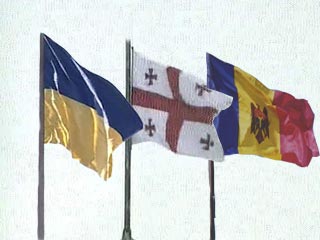
In Moldova - the former Soviet Republic, where the ruling Communist Party defeated the parliamentary elections on March 6 - did not happen to the "Orange Revolution". However, large changes are planned in this small country, clamped between Ukraine and Romania. For the first time, three states of this zone - Moldova, Ukraine and Georgia - enter the path of regional cooperation. This is not characteristic of the post-Soviet space, whose countries are accustomed to communicating with Moscow Tet-A-Tet, writes Le Monde (translation on the website inopressa.ru ).
On April 22, the leaders of Ukraine, Georgia and Moldova will gather in Chisinau for the Summit of Guowam (Georgia, Ukraine, Uzbekistan, Azerbaijan, Moldova)-a regional organization created in the late 90s in order to counteract the hegemony of Russia on its "periphery", but really not functioning.
“The Orange Revolution took place in the head of Vladimir Voronin,” says Arkady Barabarosich, who heads the institute of public policy in Chisinau, associated with the Soros Fund. Former apparatchik Vladimir Voronin, who still rotated in the orbit of Moscow, maintained a very sluggish relationship with his neighbors.
He quarreled with Romania because of the disagreement around the cooperation agreement, was cold with Ukraine, which, as he suspected, turned a blind eye to the stream of smuggling from Transnistria, and ignored Georgia.
Turning a person to the European Union, this police general, the former Minister of Internal Affairs of the Republic, is trying to follow the "basic principle of the European contract: to establish good relations with neighbors", one Western diplomat explains. But the announced resuscitation of Guuam, created as a CIS counterweight, has another dimension, the newspaper writes.
“The focus of its attention lies with energy, the need to diversify the ways of delivering hydrocarbon raw materials from Central Asia,” explains Alex Grigoriev, a representative of the National Democratic Institute (NDI) - creatures of the US Democratic Party, which has been playing the role of a counselor of local political structures for a year.
“Ukraine, Moldova and Georgia has a lot in common. All three countries depend on Russian supplies and are subjected to pressure and intimidation from Moscow,” continues Alex Grigoryevs. Over time, the entire Black Sea zone could become a communication channel between the Baltic and the Mediterranean Sea. Georgia and Ukraine are important corridors of transportation of Caspian oil to Europe. In 2005, the Baku -Tbilisi -Jaykhan (BTD) oil pipeline should be commissioned, built for pumping Caspian oil through the Mediterranean Sea, the newspaper writes.
Another way for the transit of Caspian black gold is the Odessa oil pipeline - Brody, which is now planned to be extended to the oil refinery in Lodz and the port of Gdansk. Until now, the Russian oil lobby, subordinate to the Kremlin, had an agreement with the former Ukrainian President Leonid Kuchma that the oil pipeline would work the other way, delivering Russian oil from fords to Odessa. But with the election of the new president of Ukraine, Viktor Yushchenko, who wants his country to become closer to Poland and the EU, this agreement has lost strength.
The energy dependence of Moldova on Russia is worried about local authorities, which are regularly the Kremlin - especially before the elections - threatens to increase oil and gas prices. But the main thing is the prospect of access to new sources.
Currently, several routes for laying oil pipelines are being studied, designed to "unload" the Bosphorus Strait. One of these routes runs not only through Ukraine and Moldova, but also through Romania and Hungary. These two countries received an invitation to take part in the upcoming Summit of Guuam.
The planned project of regional cooperation caused irritation in Russia, which sees the contours of the "anti -Russian alliance" in it.
Ukraine and Moldova have just signed a “action plan” with Brussels, which provides for strengthening cooperation in the economic and political areas. On March 2, the European Commission proposed to make the same Georgia, Azerbaijan and Armenia (not a member of Guuam). Finally, Chisinau expects the promised opening of the EU representative office in its territory, as well as financial assistance in the amount of 42 million euros.
But the Kremlin considers not the European orientation of these countries the main threat to himself, but the desire to become NATO members expressed by them. The Georgian authorities have just signed an agreement on strengthening partnerships with NATO, which will turn this Black Sea country into a departure of military equipment and contingents of the North Atlantic Alliance to Afghanistan.
Ukraine today uses special status in NATO. As for Moldova, the second most poverty of the European country after Albania, it has recently been in the orbit of Romania, which is preparing to accept NATO bases on its territory, the publication concludes.