
Translated material
Handelsblatt: Russia needs a new economy
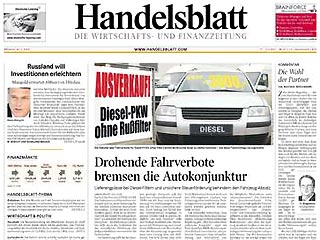
Handelsblatt German business newspaper on Wednesday devotes a special application to the analysis of the economic situation in Russia. The conclusions of the newspaper are disappointing. The main task is to overcome the technological lag and create competition. But so far the country cannot get out of the debate of bureaucracy and corruption, and unprecedentedly high oil prices make it possible not to think about low efficiency. (Transfer of an article on the website inopressa.ru .)
Overcome the technological lag
Competitiveness is a new magical word that the whole policy should be subordinated. The priority goal is to reduce Russia's dependence on oil prices and diversify the economy. Russia's GDP still a quarter depends on the oil sector alone.
According to the radical adviser to President Andrei Illarionov, a good 3% of 6.8 percent economic growth last year were directly related to high oil prices. At the same time, only 2% of the population of Russia are engaged in the oil industry.
In theory, now in Moscow, everyone should work together for innovation, but instead there is a dispute between the Liberal economists and Prime Minister Fradkov, Handelsblatt states. It seems that the prime minister is yearning for Soviet ideals and wants to use the so -called "industrial policy" to pump up the lagging industries with the help of multi -billion dollar programs. Instead of really developing competitiveness and diversification, Fradkov created a “competitive advice”, which gives rise to only even greater bureaucracy and endless disputes of warring camps.
At the same time, tax disputes, bureaucracy and corruption are now undermining the investment climate, the conjuncture is deteriorating, despite the high oil prices. Along with these "political factors" there are other serious problems: energy consumption is three times higher than in developed countries. This reduces competitiveness and requires huge investments in modernization.
At the same time, the German newspaper notes a number of positive factors: for example, the government reduced income tax to 24% and promised to continue to reduce taxes. In addition, a large economic growth for the sixth year in a row sharply increased budget revenues and companies. Land reform, which allowed the first time after the October Revolution to buy land, significantly improved the situation. Customs and certification reforms also made life easier for companies.
However, oil, gas and metals continue to be the main export items. Russia is really competitive so far, mainly in the oil sector. In the gas sector, the state quasi-monopolist "Gazprom" clamps much more efficiently economic competitors.
The main problem area of the Russian economy is the processing industry. Despite the solid increase in mechanical engineering, automobile and light industry, a huge technological lag remains from foreign competitors. The only high -tech export hit remains Sukhoi fighters, and Handelsblatt states.
At the same time, in Russia, investors are waiting for a market that, by the population, is more than ten ten states that have recently entered the EU together. In addition, the cost of labor is 0.88 euros per hour (in China - 0.79 euros), which is much lower than, for example, in the same in Hungary, where this figure is already 5.03 euros. According to the head of the Moscow Consulting Company Ernst & Young Hans Yokhum Horn, the question is no longer a risk and go to Russia, the question is when to do it: "Whoever considers himself a real capitalist should go to Russia. There is still true capitalism." True, some experts were inclined to call Russian "true" capitalism "wild".
The Yukos case ruined the initiative
Attempts by the Russian authorities more strongly to take the economy of the economy weakened the prospects of the country. "Due to the struggle for political dominance in strategic sectors and attractive companies, Russia runs the risk of missing a unique and huge chance," says one German banker in Moscow. Igor Nikolaev from the audit company FBK says that the Yukos case turned into at least $ 20 billion. The leak of capital survived a jump from $ 1.9 billion in 2003 to 7.9 billion in the past.
For the first time, foreign direct investments were also reduced - by 12%, to $ 6.6 billion. But the worst is that an increase in GDP by 8-9%necessary for the GDP, declared by Putin, did not take place in 2004. A number of 6.8%was reached. This year, the Ministry of Economic Development and Trade counts on an increase of only 5.8%.
Deputy Minister of Economic Development Andrei Sharonov has already warned that if the pressure on entrepreneurs does not decrease, then the economy will grow by only 4%.
The main locomotive of economic growth was weakened, first of all, the oil sector. Although oil concerns for the first time managed to reach the level of production of the USSR, in connection with the strongly increased tax burden, their investments decreased, so that production is growing more slowly than in previous years. For the current year, the International Energy Agency predicts production growth at 3.8%. This will be less than half of average height over the past five years and the lowest growth rate since 1999, when the industry has experienced a drop in prices.
Other opportunities for growth activation are also not used. The potential of small and medium -sized enterprises in Russia is not developing enough, Sergey Borisov, the head of the association of small and medium -sized businesses, complain. As a result, 5.7 million small and medium -sized enterprises provide only 12% of GDP in Russia (in Germany - 59%) and give work 19% of the able -bodied population.
The traditional problem remains bureaucracy and bribery: on average, even small enterprises are subjected to 23 checks by the authorities per year, a survey of 2700 firms conducted by the “support” showed. At the same time, firefighters, police, tax authorities and veterinary service need to be “soaked” so much that each employee accounts for $ 400 bribes, Borisov calculated. “The so -called administrative barriers cost 10% of the turn,” admits the head of the Ministry of Economic Maid by German Gref.
“The authorities are sacrificing economic growth for the sake of control over entrepreneurs,” the Economic Journal of the Company gives its comment. The fears were primarily caused by disproportionate tax requirements for previous years, presented, among others, and foreign investors, for example Japan Tobacco. Even in the highest Kremlin circles, they recognize that the price of Yukos was "extremely high." “We cannot afford another such thing,” the German newspaper quotes a source in the presidential administration.
The Kremlin promises reforms
Russian reformers are again in the mercy of Putin. Tug the rope and the struggle for power in the Kremlin play on the hands of supporters of reform. They are sure that they will be able to influence the nature of politics in the second period of the reign of Vladimir Putin. “The president will very soon understand that his economic policy is absolutely liberal. We are preparing a package of reforms that leaves no doubt about it,” promises Igor Shuvalov, adviser to Putin on economic issues.
The president took an important step in this direction on Monday: he instructed the government to issue a law on the recognition of the legitimacy of privatization transactions of a decade ago. This means an amnesty for the so-called oligarchs, which in the mid-90s privatized most of industrial enterprises, and gives a guarantee to investors. “For us, this is a signal that the Yukos case is left in the past and will no longer be repeated,” said Chris Granville, the chief economist of the Moscow Broker company United Financial Group.
Investors have long been waiting for the Kremlin’s open statement. The case of Yukos, the liquidation of one of the most profitable private enterprises and the nationalization of its main subsidiary, instilled deep uncertainty in them. During the first term of Putin’s reign in the Russian economy, positive development was planned, but the time after its re -election a year ago can be considered as an unsuccessful start.
Self -criticism of reform developers, emanating from the Minister of Economics German Gref and the Minister of Finance Alexei Kudrin, went unnoticed. But the "security forces", Putin's supporters from the KGB, acquired influence in the economy.
But now the pendulum swayed in the other direction, according to Handelsblatt. The leak of capital, the lack of investments, the weak indicators of economic growth and Putin's falling rating forced the Kremlin to wake up, and the president again listened to the supporters of the reform.
The liberals won in some specific controversial issues. So, for example, Kudrin prevented Fradkov from implementing his plan and weakening the budget with a ruined medium -term decrease in VAT and launch a hand into a stabilization fund, which receives a significant part of the profit from the sale of oil.
But this does not mean that the "patriots" leave the battlefield. Some pressing disputed issues have not yet been resolved, and only after their resolution will it become clear what the real direction of the economic policy of Russia. German investors with tension monitor whether Siemens will succeed in buying a machine -building concern "Power Machines", about which there is already an agreement, or this will be hindered by those who want to save this strategically important enterprise for their Russian customers.
Of great importance is the question of whether enterprises with majority foreign participation will be excluded from the process of mastering "strategic raw materials". Gref and Shuvalov promise that this will concern only a very limited number of exceptional cases, for example, uranium extraction. “Patriots” at the same time want to supplant concerns such as Exxonmobil and Shell, from Sakhalin-2 and Sakhalin-3 projects.
Far -reaching consequences may have a struggle conducted by two Kremlin factions in connection with the fusion of Gazprom and Rosneft. Dmitry Medvedev, the head of the Presidential Administration and the chairman of the Supervisory Board of Gazprom, with the help of Rosneft, wants to make Gazprom a heavyweight in the world market - controlled by the state, but open to foreign minority owners.
This is exactly what Igor Sechin, deputy head of the administration and the head of the board of directors of Rosneft, seek to prevent. He wants to integrate Gazprom, Rosneft and Yuganskneftegaz and turn them into a new Russian Center for Power.