
Translated material
Dying stars can make frozen planets inhabited
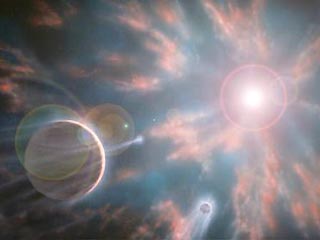
The planets hunters should turn their attention to the dying stars - it is near them that life can be discovered, writes New Scientist magazine, the translation of the article published by Inopressa .
Astronomers believe that the best environment for the appearance of life surrounded by any star is in the so -called "habitability zone" - where the surface temperature of the planet allows water to exist in liquid form. In previous scientific works it was shown that this belt expands and covers all large spaces, if the stars, such as the sun, over time are heated and heated.
Currently, three astronomers from France and the United States calculated how long the "zone of abode" remains at various distances from the star. They compared these indicators in the meantime for which life arose on Earth (approximately 700 million years) to see if the expanding "thermal wave" can be the impetus for the emergence of life on previously frozen planets.
They found that the stars like our Sun pass three stages that favors the development of life. The first lasts about 10 billion years, during which hydrogen burns in the nucleus of the star. The sun is currently located in this period, that is, it is a star of the main sequence, and the earth is within the "zone of abode". This zone extends from the orbit of the Earth almost to the orbit of Mars.
Then, when hydrogen begins to burn in the bark around the helium nucleus, the star becomes brighter, expands and goes into the category of subgiants. The "zone of abode" expands to the outer side. The inside of this zone remains inhabited by several billion years.
Then the star shines for about 20 million years with a pulsating light, as it switches to the burning of helium, before becoming a red giant and increasing to sizes ten times higher than the diameter of the sun. After that, the "zone of abode" expands over a billion years.
“Thus, the planets that are now cold and frozen can be heated and become potentially inhabited,” says William Danchi, one of the participants in the research group and astrophysicist from the NASA space flight center.
In the work of scientists, it is assumed that "microorganisms can be transferred from the planets with a meteorganic stream, where life disappears, to the planets where the conditions favorable for life appear."