
Translated material
The Kremlin cultivates nostalgia for Brezhnev times
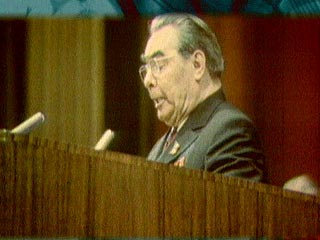
Recently - for the first time since 1982 - Leonid Brezhnev reappeared on the Russian television screen. The symbol of the Soviet “stagnation”, a sick old man with inarticulate diction, suddenly became the hero of the television series, writes the French newspaper Le Monde (the translation of the article publishes the site inopressa.ru ).
The four-part film "Brezhnev" shown in the prime time shows the former Secretary General in the last year of his stay in power. In the picture with a sense of soft nostalgia, flavored with humor, the exhausted Brezhnev, which became a victim of court intrigues, but does not stop taking care of the people (“let the sausages be brought to the shops!”). In his dacha, he writes in despair letters of resignation for health reasons, but the Politburo does not want this: "Leonid Ilyich, the country needs calm and stability. And stability is you!"
In 2008, when the mandate of Vladimir Putin, who has been in power since 1999, will end, the first generation of Russians who have never lived in the Soviet Union will receive the right to vote. Today, many young Russians do not remember what the Brezhnev era was. As under President Putin, the country lived in conditions of relative stability, and world oil prices were high (Brezhnev’s film does not say anything about repressions against dissidents).
The contrast between Brezhnev, seriously ill at the end of the reign, and the sports Putin, who wants to “double the GDP in ten years,” plays into the hands of the current owner of the Kremlin. But at a time when the outskirts of the former empire - Georgia, Ukraine, Kyrgyzstan - are amazing at the revolution, the film between the lines says something else: stability can fly to smithereens.
On April 5, shortly after the series released on the screens, the head of the presidential administration Dmitry Medvedev through the media called on the elite "consolidate" in order to prevent "the disappearance of Russia as a unitary state." “The collapse of the Union,” he said, “may seem a matinee in kindergarten compared to state collapse in modern Russia.” The country is threatened with terrorism, poverty, crime.
In January, Russia was shocked by demonstrations of protest against the “social reform”, which became the first manifestation of popular discontent for the entire reign of Mr. Putin. The president remains popular (his rating is more than 60%), but there was no trace of initial enthusiasm. The Russian press writes about "Putinsky Stagnaya."
A thin political opposition - democrats and liberals on the one hand, communists and ultra -rationalists - on the other - is trying to declare themselves on the eve of the (parliamentary) elections of 2007, but suffers from internal expanse and constant temptation to compromise with power for the sake of material benefits.
Russia is not Kyrgyzstan, where the economic crisis pushed a significant part of the active male population to migration as illegal labor. Russia is also not Ukraine and not Georgia, where the overthrown presidents have been in power for ten years, and the mobilization of society took place around specific events - the murder of a journalist, falsification of elections.
Opposition financing. Russian society is not yet inclined to lay responsibility for Vladimir Putin for a worsening social situation, but the Kremlin wants to prevent any manifestations of protest. The gap between the rich and poor in Russia resembles the situation in Latin America: 10% of the most wealthy Russians account for 30% of income - against 2%, which falls on 10% of the poorest citizens of the country. The demographic crisis, indicating the decline, continues: now the population of Russia is 143.5 million people - against 148 million in 1994. The influx of migrants from Central Asia or from the Caucasus does not compensate for this negative dynamics. The epidemiological situation is threatening.
The decrease in Russian influence in the former Soviet space is partly explained by the fact that Russia remains a country with a low GDP, which is in the grip of internal problems. Putin trusts only a narrow circle of his employees. So, during the Ukrainian crisis, he turned to "public relations advisers" for help, generously paid, but not too competent.
The giant Russian bureaucracy, corroded by corruption, lays a mine under the “vertical of power”, which makes itself felt only by its tendency to authoritarianism, not to mention military violence in the North Caucasus. Most of the last year, Vladimir Putin was engaged in restricting the consequences of a series of terrorist attacks and the struggle for control over financial flows from the energy sector (Yukos, Gazprom and Rosneft).
A wave of democratic revolutions - these "permanent revolutions", which the Russian president fears, called the echo in Russia. Small opposition student groups arose in the country. In Bashkiria, at the end of March, 20 thousand people (some were in orange shawls) took to the streets to demand the resignation of the local satrap Murtazi Rakhimov.
Russian oligarchs, eager for revenge, are ready to finance a new opposition. The potential competitor of President Putin, former Prime Minister Mikhail Kasyanov, associated with the Yeltsin "family", went for support in the United States.
Nowadays, on the territory of the former USSR, the only faithful ally of the Kremlin (except for the heads of unrecognized mini -republics - Abkhazia, South Ossetia and Karabakh) is the President of Belarus Alexander Lukashenko, whose regime Bush calls one of the "Avvanposts of tyranny". But he is so only because Western countries offend him, and he needs cheap Russian gas.
Some in Russia calls on Mr. Putin to remain in power after 2008 to prevent "the threat of a fascist coup." The Kremlin denies that he has such an intention, but expects to use this topic in order to mobilize public opinion on the eve of the election. In contrast to Ukraine, post -Soviet Russia has no experience of a democratic change in power. The Kremlin adviser Gleb Pavlovsky talks about the need to fight the revolution virus by power methods.
The appearance of Leonid Brezhnev on television screens recalled those times when, in the words of one Russian commentator, “every day looked like the previous one,” the empire was intact, and the political leadership seemed permanent.