
Translated material
A missed chance
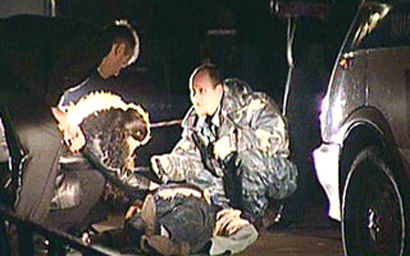
On Sunday, April 10, a brutal murder was committed in Moscow. In front of a four-year-old girl, Killer shot her father, a man of 65 years old, mortally wounded a 28-year-old mother (she then died in the hospital)-and disappeared from the scene of the crime. What can I say, the tragedy: the hired killer instantly destroyed the small happy world, and this in itself causes sympathy.
In addition, the murdered, Andrei Vasilievich Trofimov, until recently held a considerable position at Fininvest - headed the security service. In March, in a building that was subordinate to him, it seemed to be a dummy of an explosive device, after which Trofimov from his post and left. And now he has been killed next to his own black Jeep Cherokee - as if the place of action is not Moscow "zero", but "gangster Petersburg" of the nineties.
But not at all this circumstance made the murder on Klyazmenskaya Street the main news of the past Sunday, and the last position of the deceased in the civil service is the head of the FSB department in Moscow and the region. He received it at the end of 1994, standing in the place of the Democrat in civilian clothes, Evgeny Savostyanov. The latter was by no means not mediocre CGT games with the Chechen opposition, which led to the failure of the assault on Grozny in November 1994 and the beginning of the “first Chechen”, and the fact that on December 2 it recklessly intervened in the collision of Korzhakovsky fellow from the Presidential Security Service on the office of Most. And Trofimov always maintained good relations with Korzhakov. There were common affairs: on October 4, 1993, when the special forces subordinate to Korzhakov took the White House, Trofimov participated in the arrest of Rutskiy and Khasbulatov. And before that, from January 1992, the general led the Office to combat smuggling and corruption of the Russian Ministry of Security - just at that time, Yeltsin’s compromising opponents about the “Rutskoy Truste” and all that were promoted ...
Then, in May 1994, Trofimov became deputy head of the Academy of the Federal Counterintelligence Service, led courses in advanced training of the leadership. The deceased was resigned on February 20, 1997 with the motivation "for gross violations, opened by checking the Accounts Chamber of the Russian Federation, and omissions in official activities." They wrote that in December 1996, the Ministry of Internal Affairs entered the drug dealer who, part-time working with Trofimov by a senior investigator for particularly important matters. But everyone agreed: it was only an occasion, the reason was Opala Korzhakov, which happened in June 1996, after the story with a “photographic box” and half a million dollars. Trofimov oversaw the investigation of this case - which, apparently, predetermined his resignation.
However, Andrei Vasilievich became famous much earlier, back in the seventies, when he made a career from the investigator to the head of the investigative department of the KGB department in Moscow and the region - in this capacity he more than once appeared in the "Chronicle of current events".
"On August 27 [1972], Yukhnovets Yu.I. Sysk was carried out by Lieutenant Katalikov, Vidovenko, Martynov, senior investigator Trofimov from 9 to 15 hours." Chronicle "N 26, Songs of Galich," Sowing "and photographs of Dostoevsky" (xr. 27) were seized. This anecdotic episode will later come up in the play by Julia Kim: "This is Dostoevsky!" - “Yes? And it seems to me that Solzhenitsyn! ”
And in December 1974, Trofimov communicates with the editor of the Chronicle by Sergey Kovalev: “On December 26, investigator Trofimov invited Kovalev to go at any time convenient for him for a passport and for a short,“ 10 minutes ”, conversation. The 27th Kovalev came to Lubyanka by 10 a.m. Kovalev did not go to freedom “after 10 minutes”, but ten years later.
Then Trofimov is already the boss, not the actor, but the director, and is visible only in the background. The “chronicle” is finished off, on November 1, 1979, her editors Tatyana Velikanova are arrested, a wave of searches is held in Moscow: “... a search [at Sokirko], St. Lieutenant Zotov ... addressed him to the deputy head of the Moscow UKGB, Major Trofimov ...” (XR 54).
Trofimov, by the way, was conducting the only matter of the seized Chekist - his classmate Captain Viktor Orekhov, who warned dissidents about searches: this "cellular" received then eight years.
Note that in parallel in St. Petersburg, Viktor Vasilievich Cherkesov makes a similar career. They are not operatives, but investigators, and only draw up "in accordance with Soviet legislation" the work of their colleagues from the ideological fifth department. In addition to investigators, operational workers participated in the persecution of dissenters - they prevailed numerically, carried out the most “dirty” work that was not fixed, however, in the documents. Compared to them, Trofimov, like Circassians, were more or less legally literate ...
Here are “competent lawyers” by Chokhu approved and left in 1992 a special commission in the bodies. The commission, by the way, included the same Sergey Adamovich Kovalev, by that time - a deputy of the Supreme Council. There was no lustration, there was no removal of the political police from power or from business in the nineties. It seems that everything was found for themselves. For example, Pavel Ivanovich Aleksandrovsky, an investigator of the KGB, who conducted Viktor Krasin in the early 70s, became an expert at Alexander Rutsky. Philip Denisovich Bobkov, who has been supervising all political examination since the sixties, settled down during business - in the Most group ...
What will you answer now if they tell you that there were democrats in the nineties in power? There was no fundamentally different elite in Russia - every alternative, any dissent for decades fell out and dragged out: a hundred "prevented" were per planted. And those who directed such a “prevention”, on the contrary, received a career move-like Gabriel Popov, who worked out the university in 1958, after the “case of Krasnovovetsev”, or Ruslan Khasbulatov, who “sifted” the same Moscow State University after the “rally of publicity” on December 5, 1965. These, however, did everything legally and openly. And the KGB had unhappy employees - their ties with the authorities were often not interrupted, and now they have already attached the former "curators" at their side.
It turns out that the nineties were a continuation of the eighties, and now all the same. And Vladimir Putin himself looks like a periscope at a submarine, temporarily gone under the water, and now pop -up. And the gangster lawlessness continues - the presence in our life of the "employees of the invisible front" did not prevent him and did not stop him.
... And Andrei Vasilievich Trofimov could have survived - if he had left in time, then, in the early nineties, when the country had a chance to part with his past.
The author is a member of the board of society "Memorial"