
Translated material
"The last dictator of Europe" brought Putin 17 questions. Presidents equalized their citizens in rights
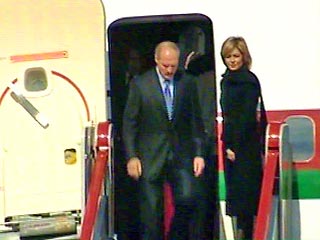
President of Belarus Alexander Lukashenko arrived in Moscow for one day to participate in a meeting of the Higher State Council of the Union of Belarus and Russia.
The Supreme State Council of the Union State of Russia and Belarus has discussed today a number of integration issues, primarily the problems of currency integration, interaction in fuel energy, and ensuring the equal rights of citizens of the two countries. In particular, the course of work was discussed in agreement in the current plan of joint actions to introduce a single monetary unit of the Union State for the period 2001-2005.
At a meeting of the State Council, the updated composition of the joint commission for the preparation of the Constitutional Act of the Union State was approved. The meeting participants discussed the issues of agreed actions in the field of foreign policy, strengthening the security of the Union State, primarily the creation of the conditions for the functioning of the regional grouping of troops of Russia and Belarus, Interfax reports. The last time the Supreme State Council of Russia and Belarus gathered in Moscow in October 2003.
- Lukashenko brought Putin 17 questions
- Putin: Many questions are "overripe"
- Presidents equalized citizens in rights
- following the results of the meeting, 15 documents were signed
- On the eve of the US Secretary of State met with the Belarusian opposition and wished her victories
- "The Last Dictator in Europe" is not afraid of the "color" revolution
Lukashenko discussed many issues with Putin - from the most difficult to the simplest
Upon arrival, President of Belarus, Alexander Lukashenko, said that he wanted to discuss 17 issues with Vladimir Putin - from the most difficult to the simplest, RIA Novosti reports.
"We will discuss the problems of a single currency, issues of a constitutional act. The main issue will be the unification of our legislation - granting equal rights to citizens of Russia and Belarus," Lukashenko told reporters. In addition, according to him, the budget of the Union State for 2005 should be approved.
In addition, it was about strengthening the security of the Union State. "This refers, first of all, decision -making to create the appropriate conditions for the functioning of the regional grouping of troops of Russia and Belarus," the source noted.
On the agenda of the meeting of the highest state council, currency integration, interaction in the fuel and energy sphere and ensuring equal rights of citizens were also included. "In the part of further work on promoting foreign currency integration, the work course was discussed in agreement in the current plan of joint actions to introduce a unified monetary unit of the Union State for the period 2001-2005," a source in the Kremlin said.
"The possibility of ... preparing agreements on freedom of movement, choosing a place of stay and residence, as well as on the procedure for providing medical care and cooperation in the field of pension provision, is considered," the Kremlin representative said.
According to the official representative of the Ministry of Foreign Affairs of the Russian Federation, Alexander Yakovenko, a meeting of the highest body of the Union State is aimed at taking specific results in the field of integration cooperation of Russia and Belarus and will ensure additional dynamics of the interaction and the entire union construction process. " The diplomat noted that "in the past year, a record level of trade - $ 17.6 billion will be reached."
The Higher State Council is the highest body of the Union State of Russia and Belarus. It includes heads of state, heads of government, heads of the chambers of the parliaments of Belarus and the Russian Federation. The chairman of the Council of Ministers, the chairmen of the chambers of parliaments, and the chairman of the court of the Union State also participate in the meetings of the HCS. The chairman of the Higher State Council is one of the heads of the participating state on the basis of rotation if they have not agreed on another.
Currently, the functions of the chairman of the Supreme State Council are performed by President of Belarus, Alexander Lukashenko. He has been holding this position since 2000.
Putin believes that Lukashenko brought "overripe" questions
Vladimir Putin believes that some issues regarding the construction of the Union State of Russia and Belarus, with which Alexander Lukashenko came to him, are overripe.
Opening a meeting of the Supreme State Council of the Union State of Russia and Belarus, the President of the Russian Federation expressed the hope that this meeting "will pass, as usual, in a business vein, very constructively." “Moreover, we have not gathered for a long time about this,” he said. But "some questions have already been overpowered by us," the Russian President considered it, RIA Novosti notes.
At the beginning of the meeting, it was about the weather. Putin asked Lukashenko what the weather was in Minsk. The President of Belarus noted that the temperature is the same as in Moscow, there may be two degrees higher. “I want to note that we always bring you the sun. They called up three times, and they brought the sun three times,” the president of Belarus remarked, recalling that the day before in Moscow there was even snow.
The presidents of Russia and Belarus equalized their citizens in the rights
The presidents of Russia and Belarus, Vladimir Putin and Alexander Lukashenko, were signed today following a meeting of the Supreme State Council of the Union State Agreement to ensure equal rights of citizens of the two countries.
As Lukashenko said after the signing, the presidents agreed that by the end of the year the issues of pensions, medical support, as well as the income taxes of Russian citizens and Belarus will be resolved by a bilateral agreement, Interfax reports.
"We agreed that by the end of 2005 the issues of pensions, medical services, as well as revenue taxes of working citizens will be regulated by bilateral agreements," Lukashenko said. “This will be a significant progress and a concrete contribution to the realization of the rights of citizens,” says the president of Belarus, ITAR -TASS notes.
As Lukashenko emphasized, on this “most important issue, comprehensive decisions were made at a meeting of the highest state council, which will allow our citizens not to be foreigners in the territory of the country's country.”
For his part, Putin emphasized that the president of Belarus "absolutely rightly raised the question of the need to ensure the equal rights of citizens of Russia and Belarus." According to him, the departments of the two countries "were given the relevant instructions in the shortest possible time to agree on all the necessary positions."
The Higher State Council of the Union State of Russia and Belarus also adopted a program of agreed actions in the field of foreign policy.
"During the meeting, a program of coordinated actions in the field of foreign policy of the Union State was adopted," President Putin said at a press conference at the end of a meeting in the Kremlin.
According to the RIA Novosti source in the Kremlin, this document determines the key priorities for the formation of the foreign policy of the Union State and allows you to integrate the resources of the diplomatic departments of Russia and Belarus for this purpose.
The President of Belarus thanked the President of Russia and the Russian Foreign Ministry for the support of Belarus in the international arena. "Our foreign policy departments functioned exclusively synchronously and solved all the issues that we put before them," Lukashenko said. “I want to thank Vladimir Vladimirovich and Comrade Lavrov for the colossal support that you provide us in a difficult period of our existence as a sovereign and independent state,” Lukashenko added. “The whole world knows about this,” he emphasized.
In total, according to the results of the meeting, 15 documents were signed
In total, as RIA Novosti reports, the presidents of Russia and Belarus signed 15 decisions following a meeting of the Supreme State Council of the Union State. The leaders of the two countries put signatures under the documents:
- on the results of trade and economic cooperation of the two countries in 2004;
- on the implementation of the concept of social development of the Union State until 2005;
- The Regulation on the border committee of the Union State, its chairman and co -chair;
- On the chairman of the Customs Committee of the Union State;
- on the number of the Standing Committee of the Union State;
- On the head of the Committee of the Union State on Hydrometeorology and the monitoring of natural environment pollution;
- Decree on the program of agreed actions in the field of foreign policy for 2004-2005;
- On the budget of the Union State for 2005;
- on a change in the composition of the Russian-Belarusian commission for the preparation of a constitutional act;
- On the powers of the FSB of Russia and the KGB of Belarus to solve the problems of ensuring the security of the Union State;
- on the plan of joint measures to ensure the functioning of the regional grouping of troops of Russia and Belarus in 2005;
- About the work plan for the work of HCC for 2005.
"The last dictator in Europe" is not afraid of "color" revolution
Alexander Lukashenko is not afraid of "colored" revolutions and calmly leaves Belarus. On the eve of Minsk, he very sharply reacted to the accusations of the United States in massive violations of human rights - the head of the State Department of Condolas Rice, the United States, even called the Lukashenko regime "the last dictatorship in Europe" and hinted at the possibility of a revolution.
And on the eve of Kondoliza Rice in Lithuania, she met with the leaders of the Belarusian opposition , one of which was detained on the border in the evening, upon returning to his homeland.
Today, having arrived in Moscow, the Belarusian President Alexander Lukashenko said that he sees both positive and negative aspects in the statements of Condolisian Rice on Belarus. “It is good that she knows that there is such a country as Belarus. From this point of view, there is a lot of positive. She recently flew over us and saw that there were no terrorists,” Lukashenko said, answering the question of Interfax regarding the sharp statements of the US Secretary of State to Belarus.
“In each process, if you look at it philosophically, there are positive and negative sides,” Lukashenko said. "As for her statements about Belarus and Russia, I would not share them. I do not belong to either Rice or her statements," he said.
The Western press writes that the visit of the American Secretary of State Condolizes Rice to Moscow and Vilnius was to become a stage of rapprochement between Bush and Putin after a “frank” conversation between the two presidents in February in Bratislava. But on Thursday, Rice called Belarus - the closest ally of the Kremlin, his vassal, “the last real dictatorship in the heart of Europe,” saying that there was “the time to renew” and wishing President Alexander Lukashenko to lose in the 2006 elections so that the country would leave the “dark corner”.
Applications of the US Secretary of State, according to which voting will become a “catalyst of freedom”, as it was in other former Soviet republics, provoked a diplomatic incident: Russia criticized the USA for supporting democratic changes in Belarus, opening a new front in the global war of the Bush administration’s plans to promote democracy in the world, the American newspaper The Wall Street Journal writes , which is the translation of the article by Inopressa.ru .
Many saw in a 45-minute meeting of Rice with the leaders of the Belarusian opposition behind closed doors in Vilnius the symbolic support of the efforts of the Belarusian opposition to replace President Alexander Lukashenko with a new chosen one. "The leaders of Belarus should know that they are watching the international community, that Belarus is not a secluded corner, where no one will see them and will not say anything, as if Belarus is not on the European continent," Rice said.
Rice meeting with Belarusian opposition and her subsequent statements angered the Kremlin, which supports Lukashenko for the repeatedly expressed desire to unite with Russia. Russian Foreign Minister Sergei Lavrov, as well as Rice in Vilnius at NATO meeting, accused her of a desire to “change the regime” - euphemism used by Bush to invade Iraq: “Democratic reforms cannot be imposed from the outside, they must occur from the inside,” Lavrov said. “We do not want a change in the regime in any country. And we go with Belorussia. And we go with Belorussia. achieve political and social integration. " It sounds like a veiled warning of the United States, in turn writes the Italian newspaper Corriere Della Sera (translation on the website inopressa.ru ).
The Bush administration campaign to promote democracy caused an ambiguous reaction in the Middle East, where the support of democratic movements in Iraq, Lebanon and Palestinian autonomy inspired some Arabs and brought others to others. A skirmish due to Belarus demonstrates that the US parallel efforts in Eastern Europe complicate the already difficult American-Russian relations, weakening the US hope of support from Russia on issues such as nuclear non-proliferation and Middle Eastern peace process.
The Russian authorities show increasing discontent about pro -Western sentiments in many republics of the former USSR and concern in connection with the intentions of the United States in this region. Anti -American sentiments in Russian society are growing since the opposition forces with the support of the United States overthrew the Government of Georgia and Ukraine supported by the Kremlin.
The United States uses a similar strategy in Belarus, providing financial and other support to the opposition organizations of this country. After a meeting with Rice, representatives of the Belarusian opposition said that they expect to combine resources in the next election and unite around a single candidate. However, they noted that the hopes that Lukashenko will allow you to hold free elections and will voluntarily leave, if it loses, is not enough. Therefore, this fall, they plan to hold protests and hope to mobilize a significant part of the society to fight for the resignation of Lukashenko.
And if, according to the Kremlin, the actions of the Secretary of State - an unacceptable intervention in the internal affairs of other countries, then, according to Minsk, is a pre -calculated provocation. Vladimir Konoplev, chairman of the House of Representatives of the Parliament of Belarus, said that "America is a dictatorship, and it is becoming more brutal." Deputy Minister of Foreign Affairs Viktor Gaysenok recalled Rice: "Our people will decide their future, and not you: we are not a pawn in American chess, not a puppet in other people's hands." The parliamentarian Nikolai Sherginets reproached the Secretary of State of the fact that "she returned to the time of the Cold War and offended the national sovereignty."
At the same time, Corriere Della Sera notes that the “clash in Belarus” did not prevent Russia from concluding an extremely important agreement on military cooperation with NATO. But it strengthened the caution of the general secretary of NATO Japa de Joop Scheffer, who rejected the requirements for the speedy acceptance of Ukraine in NATO. Sheffer called Kyiv to active negotiations without specifying the date of their holding and thereby escaped the discharge of tension with the Kremlin, the Italian newspaper concludes.
After popular unrest in Georgia and Ukraine, Belarus began to attract more attention and interest, especially from the USA. Russia, the only sane friend and ally of Belarus, cannot remain indifferent to this, writes The Washington Times . The Kremlin, if he wants to, can make more to advance democratic reforms in Belarus than all other forces inside this former Soviet republic and abroad. (Translation leads inopressa.ru .)
Belarus with its population of 10 million people is an orphan of Soviet history. Today she looks like an old photograph, the American newspaper notes. The economy preserves central planning, the majority of the population operates in state structures, social services live on subsidies, and even the KGB retained its former name. Belarus refers to the West with suspicion and preferred political and economic integration with Russia.
Lukashenko ignores the West and rules Belarus as his own patrimony. However, he must take into account Russia by Vladimir Putin. Lukashenko and Yeltsin got along well, but this can not be said about Lukashenko and Putin. Lukashenko wants the proposed Union of Russia and Belarus to be equal and mutual benefit. However, in the planned association of Russia and Belarus, Lukashenko does not have strong cards that he could play. With all the successes of the macroeconomics, which Lukashenko loves to boast, he understands that the goodwill of Russia is based on the “Belarusian economic miracle”, the American newspaper notes.
Russia controls the Belarusian economy, and this control is becoming tougher. Russia receives 62% of Belarusian exports and provides 65% of its imports. Belarus is completely dependent on Russian oil and gas supplies. The economic reality connecting Belarus and Russia is at the same time a political unit for Lukashenko.
Putin appears in support of the Union, but on his own conditions, in all respects beneficial for Russia. Thus, the Kremlin helps Lukashenko drive himself into a corner. Lukashenko is isolated in the world as never before, and his only "friend" sits in the Kremlin.
In such a situation, Lavrov’s word that the reform process cannot be imposed from the outside, intrigue and sound even mysterious. The Kremlin has a huge impact on Belarus and actually controls the political fate of Lukashenko, concludes The Washington Post.