
Translated material
The daughter of Russian General Denikin is granted Russian citizenship
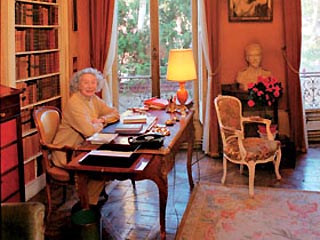
Russian President Vladimir Putin provided Russian citizenship Marina Denikina, born in 1919 in the Krasnodar Territory and living in France. According to the Kremlin press service, the head of state signed a corresponding decree.
Countess Marina Antonovna Denikina is the daughter of General Denikina.
"I am incredibly happy and proud that the decision of the President of Russia Putin is presented to me by Russian citizenship," she said.
“This news was a complete surprise for me. I learned about the provision of Russian citizenship in this morning,” Denikina admitted.
“For me, this is one of the happiest days in my life,” she said.
“The phone in my apartment calls without stopping, people congratulate me on this great joy,” Denikin shared.
She lives in the old house of the era of Louis XV, whose windows overlook the royal palace in Versailles.
Denikina is her maiden surname, inherited from her father - General of the Russian Army Anton Ivanovich Denikin. And for her husband (the last of the three, who died a few years ago), she is Countess Kyapp.
There is also a pseudonym - Marina Gray, under which she worked for almost half a century in journalism and literature, RIA Novosti reports.
Marina Denikina was born in 1919 in the south of Russia, in the Krasnodar Territory, in the midst of the Civil War. And already in 1920, she, along with her parents, was in exile. After several years of wandering, the family settled in Paris.
General Denikin wrote articles for various emigrant publications, received fees for books and a small pension from the Union of former Russian ambassadors, but this money was barely enough for a living, so the family, as Marina Denikina recalls, had to save on everything, even buying clothes. Russian officers who staged in Paris by taxi drivers and waiters helped the general and his family as they could, for example, gave boxes with cigars that Denikin loved to smoke, but did not buy himself due to lack of money.
In the small Parisian apartment of Denikin there have always been many guests, always only Russians - military, writers, journalists, artists. The girl, whom her father always called Masha, remembered the visits of Bunin, Shmeleva, Marina Tsvetaeva.
Marina Denikina worked with archives, collected diaries and notes of officers of the tsarist army, and then published several books about the white movement. She transferred the family part of the Denikin archive to Russia, leaving only his father’s weapon - a saber, a nagike, a dagger, which occupy an honorable place in her Versailles house.
Now Marina Denikina, who, despite the advanced years, looks harmonious and tightened and allows itself to be “excesses” in the form of smoking, the question of the origin is invariably answers: “I am Russian”.
And, as the journal "Spark" previously wrote, she even agreed that the dust of her father, General Denikin, is reburied in Russia.
"Father rests in the Russian cemetery in New Jersey in America. Various organizations, the noble assembly asked me many times to give permission to transfer my father’s dust to Russia. I used to refuse. But during a meeting with Putin, a conversation came to Paris and I asked what he thinks about the reburial of his father in Russia? Putin answered:" This is very important for Russia. "I asked, and you yourself, and you yourself, and you yourself, and you yourself, and you yourself, and you yourself, and you yourself, and you yourself. Vladimir Vladimirovich, what do you think about this? "He replied:" I think so too. "Well, then I gave permission," said the daughter of Anton Denikina.
Earlier, a group of veterans of the Great Patriotic War turned to the Russian media with an appeal to support the initiative of the Russian Orthodox Church and veterans of the Great Patriotic War transfer and rebellion in Russia of the ashes of the general.
“All our relatives served in the Red Army during the Civil War,” the appeal says, “but we support the decision on the church commemoration of Denikin and the transfer of his ashes to Russia.”
General Denikin died in 1947 in the USA. He bequeathed to bury himself in his homeland, but buried in the Russian cemetery in the city of Jackson (New Jersey). Currently, a number of public organizations in Russia are raising the question of the reburial of his ashes according to the will.
Denikin's biography before emigration
Denikin Anton Ivanovich (born 1872, near Warsaw - died 1947, Ann -Arbor, Michigan, USA). Born in the family of an officer. He graduated from the Kiev Infantry Junker School (1892) and the Academy of the General Staff (1899).
During the First World War, he commanded a brigade, a division, from the fall of the 1916th 8th Army Corps on the Romanian Front. In April-May 1917, the chief of staff of the Supreme Commander-in-Chief, then commanded the troops of the Western and South-Western fronts.
On November 19 (December 2), 1917, along with Kornilov, he fled from the Bykhov prison on the Don, where he participated in the creation of the Volunteer Army, which he headed after the death of Kornilov on April 13, 1918.
In the fall of 1918, he became the commander in chief of the Armed Forces of the South of Russia (VSYUR) and the deputy supreme ruler of Russia Admiral Kolchak. In the summer and autumn of 1919 he led the campaign in Moscow. After the defeat in March 1920, with the remnants of the army, he was evacuated to the Crimea, where on April 4 he handed over to General Wrangel and went in the English destroyer in Constantinople.