
Translated material
Report of the Council of Europe: Yushchenko - no longer the hero of the "Orange Revolution"
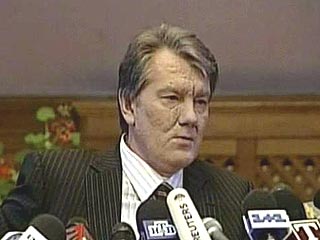
The bonus of the Ukrainian "Orange Revolution" is spent: the European Council took up the new government in Ukraine. The EU report criticizes the poor provision of the foundations of the legal state, insufficient compliance with the principle of separation of powers, as well as the unacceptable interweaving of the economy with politics. This was written by Frankfurter Rundschau (translation on the website Inopressa.ru ).
The brilliance of Viktor Yushchenko finally faded about two weeks ago, after he fired Prime Minister Yulia Tymoshenko and set Yuri Yaronurov at the head of the new government, which caused international resonance. The former hero of the revolution is now just one of many presidents, involved in a dubious struggle for power. The fact that at a meeting of the Council of Europe they are now discussing a critical report regarding the situation in Ukraine has coincided with the latest events quite by accident, this study was prepared for a long time.
The essence of the report compiled by the liberal Danish deputy Hannah Severinsen and the deputy from the conservative party Renata Volvent from Liechtenstein is as follows: despite the indisputable domestic political progress, there is no question of real democracy in this Eastern European country almost a year after the revolution. “The principles of the rule of law have not yet been completely established in many areas,” both politicians complain.
Due to the continuing problem period, the Council of Europe can extend the “monitoring” in Ukraine on Wednesday. With the help of this method, in countries that are part of the Council of Europe, compliance with the democratic and legal standards of this Union of states is monitored. Severinsisen and Volvent are also advocated to send a special authorized person from the Council of Europe to Ukraine. He must observe political development in the country and act as a adviser to leaders, the newspaper writes.
In particular, the resolution requires that laws have been issued in Ukraine by which the principle of separation of powers recorded in the Constitution would be implemented in practice. The next requirement concerns the Ukrainian parliament, where the opposition should be guaranteed its rights. Severinsisen and Volvent expressed approval that censorship in the press, widespread under the President Kuchma, was canceled, but now it is necessary to stop any media intervention in the media, they indicate.
The Council of Europe insists on strengthening the fight against corruption: "Economic reforms should not only lead to the redistribution of power between the oligarchs." The basis for this call is the following: under Yushchenko, it is also not always possible to clearly draw a border between the economy and political power.
Strasbourg makes special emphasis on innovations in the spirit of the rule of law, which will ensure the courts independence from political influence. This includes, in particular, the reform of the General Prosecutor's Office and the creation of the Bar Chamber. Severinsisen and Volvent are among the shortcomings the fact that a new Criminal Procedure Code has not yet appeared. "Protection from arbitrary and illegal arrest" should be guaranteed. The report also recalls the need to improve conditions in prisons and medical care of prisoners.
The Council of Europe is outraged that the circumstances of the murder of journalist Georgy Gongadze have not yet been clarified. The reporter was killed during the autocratic regime of Kuchma. The suspicion that the former president then could personally be involved in this murder was not completely refuted. Severinsisen and Volvent demand that the guilty people "who ordered, organized and commit this murder", appeared before the trial.
Despite the failures in Kyiv, the new President Viktor Yushchenko as the hero of the "Orange Revolution" is still using great honor on the continent. After the coup at the end of 2004, the European Council is so far the only international organization that is in detail critically dealing with political development in Ukraine after the revolution, the newspaper concludes.