
Translated material
Le Figaro: Russia dangerously flirts with Iran
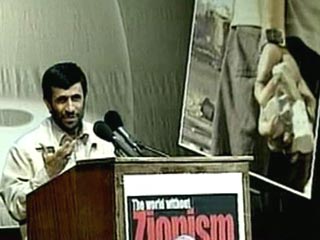
What country did the Iranian president put in the most difficult situation, saying on October 26 that “Israel must be erased from the world map”? As at first glance, this country is Putin's Russia, writes Le Figaro (translation on the website of Inopressa ).
At the end of September, the Magate officially stated by Iran violations of her obligations under the agreement on non -proliferation of nuclear weapons: this country carried out secret works to enrich Uranus. The American Secretary of State immediately flew to Moscow to get consent to the question of the question of Iran’s behavior before the UN Security Council. Condoliza Rice heard a polite refusal from Vladimir Putin: Russia, they say, believes that the Iean, which the Iranian nuclear programs that are peaceful, and that the agency is able to prevent any attempt to transfer the peaceful atom to the military is sufficiently controlled.
Russia has a long tradition of nuclear cooperation with Iran, for which it is the main supplier of ordinary weapons. In January 1995, Russia signed a contract for the construction of a nuclear power plant in the Iranian Bushera. Due to delays caused by technical, financial and political reasons, the construction of this nuclear power plant with a capacity of 1000 mV should end only in 2007.
In February 2005, the Russian Federal Agency for Atomic Energy, led by physicist Alexander Rumyantsev (faithful ally of Vladimir Putin, with whom he was very close in St. Petersburg in the 90s) signed a new contract with Iran. According to him, Moscow took the obligation to uninterruptedly supply nuclear power plants with fresh fuel (uranium enriched by 5%), and most importantly, ensure repatriation to the Russian territory of the spent fuel.
After the provocative statement of the Iranian president regarding Israel, the Russian Foreign Minister did not even consider it necessary to hide his irritation. The Iranian ambassador to Moscow was called to the Foreign Ministry for explanations, and Sergei Lavrov admitted at a press conference: "Those who insisted on the transfer of Iran’s nuclear dossier to the UN Security Council receive an additional argument."
The irritation of the Kremlin intensified on November 12, when Tehran refused the compromise proposed by Russia and supported by the Magate, according to which the whole uranium, necessary for the work of Iranian atomic reactors, would be enriched in Russia. "Iranian nuclear fuel will be produced in Iran itself," said the head of the Iranian nuclear program Gormrazov Agazade. In other words, Iran now refuses to consider the February contract in 2005 under Busher as a model.
It is the intention of Iran to enrich his own uranium (at the Tanans underground facility) that is concerned today by Americans and Europeans. For the centrifuges available among the Iranians (Iran was provided by the father of the Pakistani nuclear bomb Abdul Kadir Khan, who himself stole their drawings in Holland during an internship in the center of the European Consortium Urenco) can provide a 5 percent (the level necessary for the work of a civilian reactor) and 95 percent (the level necessary for the production of nuclear weapons) Uranus.
"Russia believes that Iran has not committed new violations of the agreement on non -proliferation since September 2002, and therefore there is no reason for transferring this country to the Security Council," explains Anton Clapkov, a specialist on the problems of non -distribution of nuclear weapons from Moscow. “The Kremlin believes that the transfer of the UN Dossier would be counterproductive: the only thing that is important today is an opportunity for inspectors sent by Vienna to work in Iranian territory,” he said.
However, the Kremlin does not want to recall the fact that in 1976 he sent France an official note of protest, when the government of Raymon Barra obliged to build a plant for the processing of nuclear waste in Iran (then managed by Shah, a supporter of the West). Since that time, Russia, who, after the Islamic Revolution of 1979, dreamed of taking the place of the United States and France, invariably responded to Iran’s requests to put the technologies necessary for the development of the “peaceful” atom. The fact that under Shah was considered as the distribution of atomic weapons, oddly enough, is no longer considered today, when Pasdarana (militias from the "Corps of the Guardians of the Islamic Revolution". - Ed. ).
“Many things in Russia are explained by corruption,” says the Moscow lawyer who is accustomed to working with state firms, and therefore with the presidential administration, the only real center of power in the country. "The Kremlin does not see the reasons why Russia should have abandoned the financial manna, which is brought by peaceful atomic export.
Moreover, Sergey Chemezov, Putin’s personal friend and the head of the state-owned weapons export company Rosoboronexport, is ready to sell Iran with a fully equipped air defense system. ”This system, which is based on heavy S-300 missiles and radars that are poorly aware for interference, Russia refused to supply Yugoslavia, attacked by NATO in the spring of 1999. But since then. Moscow sold them to Syria and a number of Persian Gulf countries.
On the terms of anonymity, one Russian diplomat confirmed that such a contract may be signed someday - but only to "give the Iranians a sense of safety that would make them abandon atomic weapons."
Did Russia cross the red line in its nuclear flirting with Iran? “No,” Anatoly Khlopkov replies, “although now we need to be very careful. We need to complete the construction of the nuclear power plant in the Bushera. But so far we will not have complete clarity about the Iranian nuclear program, we should refrain from delivering additional civilian technologies and stop the training of Iranian specialists in Russia.”
Busher does not threaten the spread of atomic weapons, since it is almost impossible to extract weapons of plutonium from a reactor of this type. The danger lies not in the operation of the nuclear power plant as such, but in the possibilities of gaining experience in the nuclear field that it opens up to Iranian specialists.