
Translated material
The artist Viktor Melnikov died - the keeper of the famous masterpiece of constructivism on Arbat
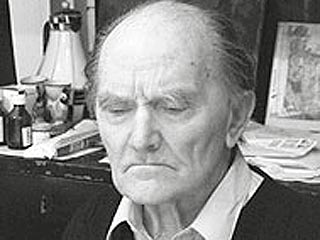
Last Saturday, Viktor Melnikov, the son of Konstantin Melnikov, the keeper of his heritage and a house in Krivoarbatsky Lane, died in Moscow last Saturday in Moscow. The fate of his father's heritage remains unclear.
Victor Melnikov was an artist and lived in Krivoarbatsky Lane, in a house that is currently part of any history of architecture of the twentieth century. It was possible to get into this house only on the recommendation.
According to Kommersant , it was a person who owned his own house on Arbat. In addition, he owned the graphic heritage of Melnikov. This graphic heritage is not described or evaluated, but, judging by the analogues, we are talking about a very expensive collection.
Viktor Melnikov constantly insisted on the need to transfer everything that he owned to the state to create a museum, but it is very difficult to fulfill this will, the newspaper notes. According to the will, he has two heirs. Real estate was bequeathed to her daughter, Ekaterina Viktorovna Karinskaya, but so that she arranged a museum of her father and son Melnikov in the house and then transfer the house to the state.
Melnikov left the graphic heritage of his father and his work, but provided that they will be stored in the museum created in the future. Melnikov was owned by the heir with his sister Lyudmila Konstantinovna, whose heir is currently Alexei Ilkanaev.
In addition to Ekaterina Viktorovna, Melnikov has a second daughter, Elena Viktorovna, who has her own inheritance rights. Two years ago, in the presence of journalists, Viktor Melnikov accused her of various sins and deprived of inheritance. However, this decision is contrary to Russian legislation, which does not allow to infringe on the rights of the heirs of the first stage in the field of real estate.
In order to create a museum in the house, it is necessary to redeem from all heirs property rights to the house. At one time, the Ministry of Culture discussed the amount of about $ 2 million, which allowed everyone to get a similar area, but today this amount seems to be a little realistic.
Even if you do not take into account that this is a separate mansion in the city center, but just take the price of a square meter in the Arbat area and multiply on the house area, it will turn out to be two or three times large, Kommersant notes.
As for the collection, it has not yet been described - this work has constantly stopped due to the ambiguity of property issues. At one time, Victor and Lyudmila Melnikov agreed on the indivisibility of the inheritance, but it is not clear how much this contract applies to their heirs.
According to the publication, in this way we are really faced with the next threat to lose the legacy of Konstantin Melnikov, and enormous efforts will be required from Ekaterina Viktorovna Karin to fulfill her father's will.
Reference
Melnikov’s house is located at the address: Krivoarbatsky lane, house 10. Two huge white cylinders are leaned against each other, sixty small rhomboid windows are located around the perimeter, creating the image of the hive. On the facade there is a giant, a few meters window. Above the window is the inscription: "Konstantin Melnikov. Architect."
In 1927, Konstantin Melnikov received a piece of land in Krivoarbatsky Lane in several hundred parts and began to build his own home-made house. In the fall of 1929, the Melnikov family entered a new house.
Melnikov was one of the largest and most recognized not only in the USSR, but also in the world of Soviet architects. According to his projects in Moscow in the 20s, several working clubs and other buildings were simultaneously built.
Melnikov was the author of the USSR pavilion at the international exhibition of decorative art in Paris in 1925, where a new, avant -garde concept of architecture and design was presented. The French were so amazed at the Melnikov pavilion that they immediately ordered him a project for a taxi garage in Paris. This project remained unfulfilled.
In 1933, Melnikova’s personal exhibition was held as part of the famous Triennal of decorative art and architecture in Milan, where all the masters of the 20s participated.
In 1987, Melnikov’s house on Arbat entered the list of local architectural monuments and was taken under the protection of the state.