
Translated material
Mars Reconnaissance Orbiter entered the orbit of the Red Planet
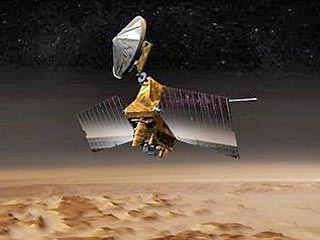
The American interplanetary automatic Mars Reconnaissance Orbiter today has successfully entered the orbit of the Red Planet artificial satellite. The flight of the flight control center in the reactive traffic laboratory in Pasadena (California) exploded with enthusiastic exclamations and applause, when radio communications with the apparatus recovered after its exit due to Mars, ITAR-TASS reports.
At 13:25 local time (00:25 Moscow time March 11), the brake engines of the device were earned. They worked for 27 minutes and slowed down the station to such a speed that the gravitational field of Mars seized it and transferred the planet to the orbit of the artificial satellite.
The first 21 minutes the device was available for radio communications, but then disappeared behind Mars and the connection with it was restored at 14:16 local time (01:16 Moscow time March 11). This was the most intense waiting period for the expedition managers, which already cost $ 720 million.
Now the device is located in a very elliptical, 35 -hour near -Marcian orbit with minimal removal from Mars of 300 km and maximum - 45 thousand km. It has to be changed to almost circular, 2-hour orbit. This will be carried out by braking in the atmosphere of Mars and will require, according to estimates, about 6 months. During this time, the apparatus will have to make about 500 "dives" in the Martian atmosphere, each of which is carefully calculated. Only after that will the full -scale scientific research will begin. The implementation of the initial scientific program should take 2 years.
According to all estimates, Mars Reconnaissance Orbiter is the most scientifically equipped device. 6 scientific devices were installed on it and every minute it will transmit about 10 times more scientific information than any of the previous Martian expeditions.
The main task facing the Mars Reconnaissance Orbiter is to help the choice of the place of landing on Mars of future expeditions, including the manned one, that is, a person’s landing on Mars.
The on -board devices of the device should also establish the presence of ice under the surface of Mars at a depth of 1 km, or rather determine the mineralogical composition of the planet, learn more about the chemical composition of the Martian atmosphere and climatic changes on the Red Planet.