
Translated material
In May, the dollar can fall to 26 rubles
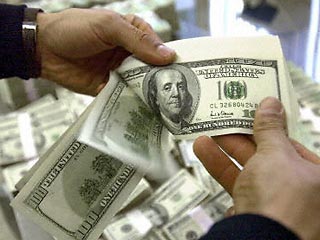
The future May holidays can be remembered for a long time for the Russians - the dollar exchange rate at this time can collapse more than a ruble of up to 26-26.5 rubles per dollar, as at the end of 1999, Renaissance Capital analysts believe. If the dollar will stand in the spring, then it will definitely collapse in the fall - they do not see any other way out. Other experts also expect the fall of the American currency, but not so strong, the newspaper Vedomosti writes.
The head of the Central Bank, Sergei Ignatiev, quickly responded to the assumptions of experts from the rostrum, speaking to Russian banks invited to the congress of the Association. He promised that the Central Bank "in the coming months will refrain from increasing the nominal course of the ruble in relation to the foreign exchange basket." “How long this pause will continue, I do not know yet: everything will depend on the macroeconomic situation,” ITAR -TASS quoted the words of the head of the Bank of Russia.
- Global risks of the dollar: a collapse in relation to the euro
- Discussion of inflation in the government does not subside
The dollar in Russia has been getting cheaper for the third year and during this time lost 13% - in February 2003 it cost 31.85 rubles. The flow of petrodollars flooding the country, which flooded the country: is forced to buy them, printing rubles in return for the stability of the national currency. As a result, gold and foreign exchange reserves in mid -March exceeded $ 200 billion. According to experts, if not for the intervention of the Central Bank, then the cost of the dollar would now be 25-25.5 rubles. Since the beginning of this year, the Central Bank has already strengthened the ruble by 3% in nominal terms to the bivalyut basket, and in real terms, taking into account inflation in Russia and beyond, the strengthening of the course by the results of the year will already be about 9%.
On April 5, the Central Bank set an official rate of 27.69 rubles per dollar. On Wednesday, at a single trading session of the MICEX, by 11:30, the dollar fell into 13.19 kopecks. According to Interfax, they give 27.5602 rubles for the dollar. Compared to the closing level of the previous trade day, the dollar rate decreased by 12.20 kopecks. The euro rose by 21 kopecks to 33.8197 rubles. And the Bax can cheaper much more significantly, the analysts of the Renaissance of Capital believe.
In a study published on the eve of the “Ruble revaluation - soon and much” the author of the study Alexei Moiseev writes: “We expect a one -time strengthening of the ruble exchange rate to 26-26.5 rubles per dollar in April -May or in October - November 2006.” According to the author of the study, the Central Bank simply does not have another way on the eve of the election. President Vladimir Putin set three macroeconomic goals: an increase in government departments, the fight against inflation and holding a low ruble course, the report said, but everything is impossible to complete at once.
Gosrafers are inviolable for the government. According to official figures, 25 million Russians (17% of the population) live behind the poverty line, 60% of the social infrastructure needs modernization, the labor of state employees is paid extremely low. Therefore, according to the researcher, if state savings that are 56 billion rubles will not be spent on social needs, the authorities will not be able to explain this.
"The existing regime, it seems, found the original way to stay in power ... - To pave the way through the election season of 2007-2008 with the help of budget expenditures. The period of large expenses began," the report said. However, it is quite natural that an increase in expenses is a direct path to inflation, which many economists call tax on the poor. So it is she who will become the main target of the monetary authorities, Moiseev is sure. So, the analyst believes, "sacrifice the ruble." Moreover, they will try to strengthen it sharply and unexpectedly, otherwise speculators and the population, realizing what was happening, will begin to rapidly sell the American currency, aggravating the position of panic in the market.
Indeed, with inflation, a serious, though unsuccessful struggle has recently unfolded. On Wednesday, the Ministry of Economic Development reported that inflation in Russia in March amounted to 0.8%. Thus, since the beginning of the year, prices have already risen by 5.5%, although at the end of the year the government wants to stay within the framework of 9%.
Moreover, Moiseev believes that in order for the economic effect of strengthening the ruble to appear before the elections, it must be carried out this year. He considers May holidays or October as convenient moments - November. At the same time, the fall should be deep enough to reduce prices for imported goods inhibit inflation, and the market received a clear signal that the new collapse will not occur for a long time.
According to the analysts of the Renaissance, the fall of the dollar will occur to a level of 26-26.5 rubles. The last time the dollar cost so much at the end of 1999.
According to the Vedomosti newspaper, sources in the Central Bank and the Kremlin consider such a scenario for the development of events incredible, since "there is an indication of without sudden movements." A strong reduction in the dollar is probably only provided that the dollar exchange rate to the euro will fall in the world market, which Western analysts do not expect.
However, in early 2006, Standard & Poor's analysts warned that in 2006 there was a risk of a 45%fall of the dollar in relation to the euro .
However, subject to stability in the world currency market, experts of Russian investment companies believe that by the end of the year the dollar will fluctuate around 27 rubles. A noticeable decline will occur most likely in the summer. Most analysts agree that below the level of 26.8 rubles will not fall.
Analyst of IG Aton Alexei Yu believes that by the end of the year the American currency can be 27.3-27.5 rubles per dollar, that is, the potential for reducing the dollar to the ruble is small. "" Consensus prognosis of global banks is about $ 1.25 per euro. If it is 1.25 dollars per euro, then the dollar to the ruble will be about 27.3 rubles per dollar, and we think that in the region of 27.3-27.5 rubles per dollar before the end of the year the ruble exchange rate and it will be, ”he told Interfax.
Alfa-Bank analyst Natalya Orlova believes that the dollar exchange rate to the ruble by the end of the year will not only not fall, but, on the contrary, will grow. “At the end of the year, the forecast is 28.4 rubles per dollar, and in the middle of the year - 27.5-28 rubles per dollar,” she says. “I have the feeling that now it is time to revise forecasts in the direction of a weaker ruble, and not stronger.”
The UBS Securities analyst Elena Romanova believes that the ruble will be strengthened in the near future, and the forecast of the investment bank at the end of the year is 26.5 rubles per dollar. At the same time, Romanova believes that strengthening the ruble can continue not only in the current, but also next year.
In early 2006, experts of the Standard & Poor's international rating agency published a report in which they did not exclude a sharp decline in the dollar in the global foreign exchange market.
In particular, in the forecast of the growth of the economies of European countries “ahead, the dollar is a risk factor” said: “The situation in the currency market can stimulate the fall of the dollar. We believe that in the second half of 2006 there is a risk that the dollar will fall stronger than the market. If this happens, the dollar can fall from 30% to 45% with respect to the euro.”
The main threat is the growth of US payment deficit, which in 2005 reached $ 790 billion, or 6.4% of GDP. “The deficit is funded by the sale of American assets - shares, bonds and real estate,” the authors write. “While the value of these assets is growing faster than the deficit, it can be maintained.” The two -digit increase in the value of the assets lasts too long, but in the long run they cannot grow faster than the economy as a whole, the authors warn. And the growth of US GDP has not been close to 10%for a long time.
“If the players understand that the system cannot maintain a shortage of 6.5% of GDP, and this is so, the question arises of the sustainability of the dollar,” the author of the report, S&P Analyst Jean-Michel Six. “In this situation, it is possible that they will begin to lose dollars, which will cause a collapse of the exchange rate.” The dollar will become cheaper, and the euro will sharply rise in price that it will undermine the well -being of European exporters.
Strengthening the ruble and dollar rate are not the only factors that determine inflation. Moreover, the government does not even have a single opinion about its nature and priority areas of influence on prices. The spore on the nature of inflation, recently a shaking cabinet of ministers, has been closely intertwined with the discussion about whether it is possible to increase budget expenditures. In particular, state investments, which in the Ministry of Economic Development are considered the locomotive of the economy. The opponent is the head of the Ministry of Finance Alexei Kudrin, who does not get tired of warning about the inadmissibility of further swelling of the budget.
Kudrin at the conference of the Higher School of Economics on March 29 stated that inflation in Russia is exclusively monetary in nature, that is, it is the result of increasing the money supply, including due to an increase in the non-expert expenditures of the federal budget, and indicated the need to tighten monetary policy.
The Ministry of Economic Development at the beginning of the week dealt another blow. Deputy Minister Andrei Belousov presented on Monday the plan of the Ministry of Inflation and Evidence that the increase in prices through one tightening of a monetary policy cannot be defeated.
Mart's proposals on April 17 will go to the government.
Referring to the Economic calculations of Mart and expert surveys, Belousov concluded that out of 10.9%of inflation in 2005, the monetary part was only 4.3%, while the non -monotarian part and price increased, due to "local monopolism" in commodity markets, amounted to 6.6%. "Talks about the exclusively monetary nature of inflation and the need to tighten monetary policy in the short -term plan are neither theoretically nor practically," Belousov believes.
Belousov also highlighted sources of non -nmonetory inflation and explained how to deal with her. The first source is the growth of the tariffs of the State Monopolies. Therefore, it is necessary to move on to the new model of tariff formation for the services of natural monopolies based on the cost indicators of the state monopolies. In particular, according to Belousov, the state monopols should clearly explain the principle of the formation of costs, paint them, and then develop investment programs. "I admit that the tariffs may be higher, but this will be a meaningful position. Until we see the justified figures on the dynamics of costs, it makes no sense to review the tariffs," the deputy minister said. The second source of non -monetary inflation is “markets that are especially sensitive to the population” (oil products and fruit and vegetable market). The deputy minister proposes to make meetings of the government and oil workers systematic and “check the clock” in order to “determine how justified the increase in prices” for oil products. You will also have to "strengthen control" in the market of fruit and vegetable products and at the tariffs of housing and communal services.
On Wednesday, speaking at the Congress of the Association of Russian Banks, Minister of Finance Alexei Kudrin said that the government could and should bring inflation to 3-4%within three to four years. In this case, loans can be 5-7%, loans will be issued for up to 10 years.