
Translated material
The head of the Magate arrives in Tehran for negotiations on a nuclear problem
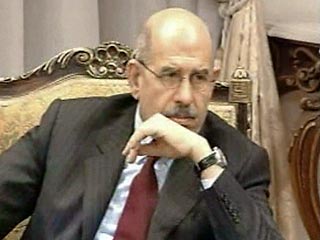
The General Director of the International Atomic Energy Agency (IAEA) Muhammad al-Baradei arrives on Wednesday to Tehran for negotiations on nuclear problems. This is reported by Iranian media.
"The visit of the General Director of the IAEA is carried out to expand the relationship between Tehran and the Agency and is not related to the requirements contained in the last statement of the UN Security Council to Iran," the Mehr news agency indicates, referring to the statement of the "informed source".
On the eve of an influential politician, ex-president of Iran Ali Akbar Hashemi-Rafsanjani, touching the visit of al-Baradei to Iran, said that "when al-Baradei would arrive in Iran, he would see that the situation has fundamentally changed."
As it became known later, he implied “joyful news” regarding the Iranian nuclear program, which was announced on Tuesday evening by Iranian President Mahmud Ahmadi Nezhad and his deputy, head of the atomic energy organization Iri Golyamzhez Agazade. In particular, the Iranian leadership reported that local scientists managed to enrich Uranus to the level of 3.5 percent content of the uranium-235 isotope. (The nuclear bomb requires 80-90% uranium-235 in the mixture, for more details see "Atomic bomb: do it yourself." )
- World nuclear powers: who has how many bombs
- Iran bomb may appear by 2009
- Russia condemned Iran's activities
- China is concerned about the statement of President Iran
- US Secretary of State called on the UN Security Council to "Decisive Steps"
- Iranian nuclear dossier: Bush against Busher
- Iranian uranium: tactics and enrichment strategy
- USA: This is another challenge to the world community
- Atomic bomb: do it yourself
It turned out that a cascade of 164 centrifugs was successfully launched at a nuclear facility in Natanze. “For military atomic production, Iran will need tens of thousands of centrifugs. Tehran does not yet have such a number of installations, but the successful work of one cascade indicates the mastery of the technology of this production. Over time, it can be replicated on the necessary scale. And no one will guarantee that Iran will not begin to produce highly enriched uranium for military needs,” emphasizes the “News Time” .
Earlier, a group of Magate inspectors arrived in Tehran, which inspects the Iranian nuclear facilities as part of an agreement on non -proliferation of nuclear weapons. As for the launch of centrifuges, the Iranian side emphasizes that this agreement does not violate work in Natanze.
However, it is possible that Bush has already regretted his promise not to bomb Iran, the newspaper believes. On Monday, speaking at John Hopkins University, he said: “I read the articles in the newspapers last weekend is just wild speculation ... I know that we are in Washington, where the word“ preventive ”means“ the use of force. ”But this does not necessarily mean“ the use of force. ”In this case, this means“ diplomacy ”. The absurdity of the claims of the plans The head of the Pentagon Donald Ramsfeld confirmed to attack Iran: "It is simply useless to plunge into this science fiction."
Iranian experts, meanwhile, attach exceptional importance to the al-Baradei visit to Iran, because it is the General Director of the IAEA, in accordance with the decision of the UN Security Council, must provide a report on the implementation of the measures prescribed by this authoritative international organization until the end of April. The UN Security Council still in vain calls Iran to resume the moratorium on all work related to the enrichment of Uranus, ITAR-TASS reports.
Recall that after three -week difficult consultations and approvals, the UN Security Council accepted the statement of the chairman of the Security Council on the Iranian nuclear problem on March 30. It reflects the opinion of all 15 members of the Security Council and is its reaction to the report presented in the Council of Security Council at the beginning of March, the report of the IAEA nuclear program of the Iranian nuclear program.
At this meeting, the US representative said that Iran already has enough uranium gas to make 10 atomic bombs . Iran continues to defend its right to activity in the nuclear sphere - regardless of what measures the UN takes on this score.
True, Iran did not change the position of Iran: the Iranian president continues to emphasize that the country "firmly intends to enrich uranium on an industrial scale and create a full nuclear cycle." Some Iranian political scientists have already expressed the opinion that reports of the new Iran’s achievements in the nuclear sphere will provoke another round of psychological war with the Western community.
Russia condemns Iran’s activities to create a full nuclear cycle
Russia condemns Iran’s actions, which are contrary to the decisions of the International Atomic Energy Agency. In Moscow, “with concern,” the statement of the Iranian President Mahmad Ahmadi Nezhad on the creation of an Iran of the full nuclear cycle was accepted, the official representative of the Ministry of Foreign Affairs of the Russian Federation Mikhail Kamynin told ITAR-TASS. “We believe that this is a step in the wrong direction,” said the diplomat. “He is contrary to the decisions of the IAEA and the statement of the chairman of the UN Security Council.”
Kamynin expressed the support of the beginning mission to Tehran General Director Magate Muhammad al-Baradei. “We hope that Iran will perceive the concern of the world community correctly and take steps to put the Magate documents in practice,” the diplomat said. “These decisions include a call for the suspension of all Uranus enrichment, including scientific research.”
USA: Iran’s statement is another challenge to the international community
The statement of President Iran that scientists of this country managed to enrich Uranus is "another challenge to the international community." This was stated by the official representative of the US State Department, Sean McCormak.
He emphasized that he could not confirm the viability of Tehran's statements about the enrichment of Uranus from a technical point of view. However, according to him, it is obvious that Iran again chose the "Way of Undercover" instead of the path of cooperation. In this regard, the representative of the State Department called on Tehran "to revise the steps taken by him, to embark on the call of the International Community, the UN Security Council, the Magate Council of Governing Magate, to suspend uranium enrichment, and return to the fulfillment of his obligations under international agreements, previous obligations to the European Troika.
McCormak noted that the news received from Iran "is another argument in favor of the need for coordinated actions of the international community." According to him, now the UN Security Council has received additional "reflection foods."
As stated, in turn, the official representative of the White House Scott McLellan, the allegations of the successful enrichment of the uranium in Iran "lead only to an even greater isolation of the" Tehran regime from the outside world. “This regime needs to earn international trust, but instead it moves in the wrong direction,” the US president’s spokesman warned.
Maclelalan evaded a direct answer to the question whether he now considers the Iranian Safety Council against Iran by an almost resolved issue. “We will talk with members of the Security Council about the following steps,” he said, adding that Iran did not have much time left to fulfill his international obligations.
China is concerned about the statement of President Iran
China is “preoccupied” with the statement of President Iran Mahmud Ahmadi Nezhad that Tehran has nuclear technologies. This was announced today by the chairman of the UN Security Council, Van Guanga (China).
According to him, this statement “is contrary to the requirements of the international community, including the resolution of the International Atomic Energy Agency (IAEA) and a statement by the Chairman of the UN Security Council. Today, on the Council on the initiative of China, bilateral consultations are held on the Iranian nuclear issue in the light of the last statement of President Iran.
“We again urge all parties to show restraint, act in a constructive spirit and not take actions that could even complicate the situation,” the Chinese ambassador said to reporters. “Only by acting in this way, we will be able to make a positive contribution to the settlement of the situation with a diplomatic way.”
US Secretary of State called on the UN Security Council to "Decisive Steps"
In response to Iran’s statement regarding the enrichment of Uranus, “UN Security Council, US Secretary of State Condoliza Rice, called for“ decisive steps ”. Speaking on Wednesday at the press conference, she stated that, in her opinion, the UN Security Council will need to be done in the light of the news from Tehran, "in order to maintain the authority of the international community", which previously called for the Islamic Republic, return to the moratorium regime for work in the nuclear region.
The head of the American Foreign Ministry also said that she had a telephone conversation with the Director General of the International Atomic Energy Agency (IAEA) Muhammad al-Baradei, who arrives on Wednesday with a visit to Iran. Rice turned to him with a request to pay the attention of the Iranian leadership to the UN Council of Security Council on behalf of the Office of the Chairman, in which Tehran was given a month to answer questions about his nuclear developments raised by the Magate.
Iran’s atomic bomb may appear by 2009, according to Israeli intelligence
Iran has not yet fully joined the so -called "nuclear club", but by 2009 it can acquire a nuclear bomb. This was announced on Wednesday by the Israeli radio by a senior intelligence officer who commented on the statement of President Iran that Iranian scientists were able to enrich Uranus.
"We know that his declaration contains the truth, and this is particularly worried, since the pace of technological progress is ahead of the level of achievements in the field of diplomatic settlement of the problem," the officer said.
It is expected that the reaction of Israeli political leadership to Tehran’s new statements will follow this morning. Earlier, the acting Prime Minister Ehud Olmert emphasized that he would not allow Iran to appear nuclear weapons. He did not even exclude the use of military force, but expressed the hope that Tehran "would be stopped by diplomatic funds."
World nuclear powers: who has how many warheads
In early April 2006, the US State Department published a certificate of the balance of strategic nuclear weapons between the United States and Russia.
Russia , as of January 1, 2006, possessed 4399 nuclear warheads: 663 launcher installations of ground-based ballistic missiles (SS-18, SS-19, SS-25, RS-12M), which are equipped with 2183 warheads. The submarines of the Russian Federation have 292 launch mines and 1592 warheads. Another 624 warheads carry 78 strategic bombers (14 Tu-160 and 64 aircraft-Tu-95).
The United States possess 5966 nuclear warheads: 500 launcher installations of the Minutemen-3 ground-based ballistic base (total 1200 missiles) and 50 PEACEKEEPER missile launches (500 missiles). Underwater missile carriers have 432 launchers for Trident-1 and Trident-2 missiles (total 3168 warheads). Another 1098 warheads have 243 strategic bomber (81 aircraft B-1, 20-B-2 and 142-B-52).
France has about 350 nuclear warheads on 60 Mirage 2000n bombers, four atomic submarines armed with ballistic missiles, and ship -based aircraft.
The UK , experts believe, has arsenal in 200 strategic and "semi -strategic" warheads deployed on atomic submarines armed with ballistic missiles.
China , according to some estimates, has 140-290 strategic and 120-150 non-strategic nuclear warheads.
Pakistan claims that his “minimum nuclear deterrence” includes ballistic missiles that can strike at the central areas of India. According to analysts, the Pakistani Arsenal amounted to 10 bombs at the time of nuclear tests conducted in May 1998, and at present to 48 nuclear warheads have grown.
In India , according to estimates of groups engaged in monitoring around the world, there are from 55 to 110 bombs. Many analysts are more inclined to the lower border.
Israel did not sign an agreement on nuclear non -proliferation and officially does not admit that he has nuclear weapons. But, according to analysts, in his arsenal there are from 100 to 200 units.
North Korea , who had driven out of the UN nuclear inspectors from the country on December 31, 2002, and left the non -proliferation agreement, according to some experts, has at least one atomic bomb, despite the fact that, under the 1994 agreement, she froze her nuclear program. In the near future, according to Pyongyang, it is impossible to count on the resumption of the next round of six -way negotiations on the nuclear problem of the Korean Peninsula. The United States is also in no hurry to resume these negotiations, it has a more important pressure object - Iran.
Most experts now believe that terrorist organizations are not able to independently develop and create an atomic bomb. However, in 1975, an American student made the operating model of an explosive nuclear device. Experts then came to the conclusion that if the student had a highly enriched uranium, then the product would make a nuclear explosion. The student used only open sources of information and purchased all the details of his device in ordinary stores. At the modern level of technology development, obviously, the only subtle moment is the receipt of enriched uranium.
Stage 1 . Minus and purification of uranium ore. Many nuclear power plants use the same materials that can be used to create nuclear weapons, says Washington Profile . A low-enriched uranium is required for the nuclear power plant, which contains up to 20% of the uranium isotope (in the natural state, the uranium-235 isotope content does not exceed 0.7%).
Stage 2 . Enrichment of uranium. It is mainly carried out using two technologies: gas centrifuges or laser cleaning. The result is highly enriched uranium, with a uranium-235 isotope content to 90%. The share of the uranium isotope in the weapons mixture is 80-90%. However, it is possible less. In December 1995, IAEA experts approved the initial standards of the number of dividing materials minimally necessary for the manufacture of nuclear ammunition of the lowest power: Uranus -233 and Plutonium -239 - one kilogram of each isotope, Uranus -235 - at least three kilograms.
Stage 3 . Development of a nuclear explosive device. Conducting computer experiments. Test explosions without the use of nuclear materials.
Stage 4 . Creation and assembly of a nuclear explosive device.
Stage 5 . Testing nuclear weapons. There is one subtlety here. There are two types of nuclear charges - explosive and cannon type. The first type: around the charge of uranium or plutonium is an ordinary explosive. A nuclear explosion occurs after an explosion of conventional explosives. Such a bomb destroyed the Japanese city of Nagasaki and this was the first Soviet nuclear structure. In the second case, the charge is divided into two “safe” parts that are connected at the time of the explosion (one part is “shot” into the other). A bomb of this type was dropped on Hiroshima. The “cannon” bomb requires much more nuclear materials (up to 40-45 kg) than “explosive” (6-8 kg of plutonium or highly enriched uranium), but this type of bomb can be used without preliminary tests.