
Translated material
The suffering of Dr. Zhivago
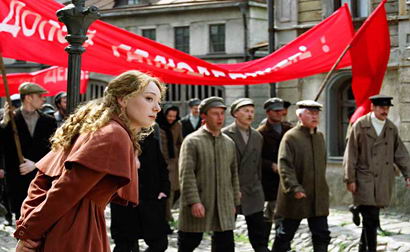
The series “Dr. Zhivago” on NTV was called “Premiere of the Year”, and this is the rare case when I am ready to agree with the advertising statement of the PR specialists. The eleven -part film directed by Alexander Proshkin with Oleg Menshikov, Chulpan Khamatova and Oleg Yankovsky in the main roles really an event. At the TEFI prize of this year, in the nomination “The Multibassed Television Film/series”, the “Master and Margarita” and “The First Circle” of the Russia channel will also be put forward to the “Event of the Season”. I don’t know what television academics will be chosen in November, but in my opinion it is “Dr. Zhivago” that is the most significant of all the multi -part films made by television this year.
The last two or three seasons, television in his documentary and gaming projects is increasingly turning to the beginning of the last century-to the origins of everything that happened to the country in that terrible century. The first of such projects that exalt television over his usual level was the series of Vladimir Khotinenko “The Death of the Empire”. “Dr. Zhivago” by Alexander Proshkin about the same time and about the moral torment of those who happened to live at that time.
Watching the movie of optimism is unlikely to add to you. On the contrary, after other episodes, such hopeless longing will roll up that it is not to be conveyed. And all the same issues that tormented the thoughtful people of the beginning of the last century will torment you - for what? Why such a fate fell to your country, your land? Why did fate close the circle so that there was no way out of it, and no? Why are others like Komarovsky’s lawyer (brilliantly played by Oleg Yankovsky), under any power, they are afloat and feel great, while others who think, feeling, suffering, like Yuri Zhivago (Oleg Menshikov), find themselves on the sidelines of life and simply cannot be at its other point?
Menshikov plays his best role in recent years. A role that may not rise to the level of his work in the “tired of the sun” and in the “east-west”, but which is able to reconcile the actor fans with dubious successes and frank failures of the “state adviser” and “golden calf”.
In the first episodes of Dr. Zhivago, it seems that Menshikov again repeats the played earlier. Young Yuri Zhivago is the viewer of the next blind with the same young (in contrast to the growing actor) Andrei Tolstoy from the Siberian Barber, then a quote from Nizhinsky played by Menshikov in the play “N” of thirteen years ago. But the screen time is coming. The hero is growing up, and it does not appear on the screen from former Menshikov works, but the image is new, powerful and tragic.
Other scenes will take you to trembling, to the coma in the throat, to animal seizures. The amputation that Zhivago performs at the front, sawing a leg with a saw, monstrous in their inhumanity of the picture of life in a partisan detachment, where doctors stole everything inside. And they make them think about the meaning of life, about the price of life, about who and why should pay this price.
In the last series of the film, a dropped hospital janitor is no longer the alive that was before. No longer a poet. And not a person. And not even the memory of a man who lived and loved ... The poet and man died in him before death. He died, not managing to save his love, but with her life. Having given his love to the one who could, Lara, and their future daughter take away from that terrible life, which Yuri himself could not protect from them.
Oleg Yankovsky plays the lawyer of Komarovsky with the evil that is sometimes more necessary than good. Because kindness, honor and love of the alive cannot save his family, and the evil and dishonor of Komarovsky can.
Give or not give love, pay or not to pay with life for harmlessness? In the film Proshkin and in Pasternak’s novel, this tragic opposition is solved in different ways. In Lara’s novel, his life will end as many girls of the beginning of the last century ended in Stalin's camps. And their life from the living daughter Tanya will be even worse. In the series, screenwriter Yuri Aravov and director Proshkin will give Lara with his daughters a different fate, entering Tony from emigration to the only letter that she had seen in Paris with two girls. In the filmant, the victim of Zhivago is, maybe, and not entirely meaningless. With all the hardships of emigration, it was easier to survive there than in the Gulag. Having giving the Komarovsky Lara and condemning himself to moral death, Yuri thereby saves his beloved woman and their future daughter. Pasternak is getting worse and more honest. The sacrifice of the Live is in vain. As outwardly, his life seems to be in vain.
Komarovsky Oleg Yankovsky acts in the series the main antipode of Zhivago-Menshikov. And it was he, and not the poet of Zhivago, not the revolutionary of Antipov is the main character of that terrible time. In addition to the Golden Trio-Menshikov-Khamatova-Yankovsky-in the series a whole galaxy of good acting. The head physician of Alexei Petrenko, Groatso Vladimir Ilyin, Shura Schlezinger Inga Stelkova-Osoldina, Senior Antipov Sergey Garmash, Misha Gordon Kirill Pirogov-behind each of the scenes they played the tragedy of an entire era.
The film adaptation can be approached in different ways. You can make a blind retelling, which we saw in the television version of the “Masters and Margarita”, when, it would seem, carefully preserved words and plot upheavals did not become a telecom, but turned only into television reading aloud.
Arabs and Proshkin refused to copy. Moreover, they went to change some storylines, and this step is largely explained and excusable. Because Proshkin really shot a television novel, if not equal, then close in strength to the prime ministry awarded to the Nobel Prize. It is the novel, it is television. And this is the main thing. The rest can be left on the conscience of the film adaptors. Someone in the first episodes will seem excessively relaxed, almost loose Lara Chulpan Khamatova. Someone will not accept the directorial liberties subscribed to the "non-Pasternak" replicas and dialogs. Nevertheless, the novel told by the language of modern television turned out, which forces today's viewer now, in May 2006, to think about the same questions that they suffered, freezing over the blind copies, reading it in the early 60s, when the Doctor Zhivago was banned.
In the final of the series, Misha Gordon, carried away by the new -fashioned cinema, takes away the vestibous of poems remaining from the deceased Yuri. Poetry gives way to the cinema to the conquered era, so that many decades later the movie returned poetry to its viewer. So that the turning man sounds from the screen: “Mel, the melting throughout the earth to all limits. The candle burned on the table, the candle burned ... ". So that after showing the series from the shelves of bookstores, books with Menshikov and Khamatova on the cover are daring. So that Pasternak’s novel is read by those who, without a heated interest, would not bother to read it ...
The only thing that bothers me today when NTV begins the show of the series is the context of the channel itself. NTV seems to have done everything to present Proshkin’s film to the viewer. He did not resell him, although the Russia channel offered a rather big money for the right to first show. Put in his broadcasting grid in the most advantageous position in the so-called prime time, at 20.50. He called the "premiere of the year."
But will the sensation of a criminalized context of the channel itself spoil the feeling from a good film? Will the audience come to the “Doctor of Zhivago”, different from the one that looks at NTV infinite “sincere confessions” and “Maximum program”? Will there be eleven evenings to follow the sufferings of the Russian intellectual those who love series like “Zone”?
The answer to these questions will be given the first days of the show. But even if the software illegibility of NTV will interfere with the fullness of the audience sensations, there will be an opportunity to buy the series on the DVD and watch it without intrusive invasion of news and advertising, left alone with the sufferings of Dr. Zhivago.