
Translated material
The legendary car "Victory" turns 60 years old
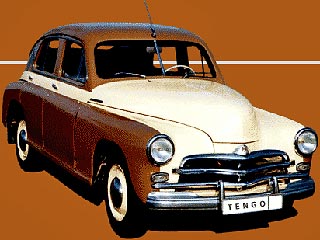
The legend of the domestic auto industry - Passenger car "Victory" celebrates its 60th anniversary on Wednesday.
The Gorky Automobile Plant received a government task for the design of a new passenger car in February 1943, immediately after the victory near Stalingrad. After showing Stalin, the car with the GAZ-M-20 serial number was decided to call the "victory".
The first "victories", which were destined to become the ancestors of the post-war generation of gas car, left the assembly line of the Gorky Automobile Plant on June 28, 1946, ITAR-TASS reports.
Both by name and technical solutions, it was a real victory of the Russian design school of that time - the first completely independent, and not a car copied from foreign analogues. Her body even served as an example to follow: according to experts, the body of the British Standard Vanguard of 1947, the release of the release is very reminiscent of the outlines of "Victory".
The GAZ-M-20 was the first domestic car with a load-bearing body and the first car in the world with a body of a "wingless" form made not for an external effect, but to accelerate and reduce the cost of the manufacture of body stamps and excellent aerodynamic indicators. The well -thought -out shape of the body, the finished lines and the abundance of chrome parts gave the car an elegant and respectable appearance.
In the "Victory" salon, 5 people were freely placed, in the car, the vehicles were installed for the first time, the turns of the turns, the stop signals and the sound signal of the high and low tones were installed. The speed of acceleration to 100 km/h in 45 seconds provided a 4-cylinder engine with a volume of 2.1 liters. The strongest side of Victory was the ability to work on any roads, which was recorded even in the encyclopedia on history and world automotive industry.
The Museum of the History of the Gorky Automobile Plant said that over 12 years of production, 235,999 cars were used from the assembly line, named after victory in the Great Patriotic War.