
Translated material
The Minister of Defense of Germany indirectly confirmed that Iran was offering the enrichment of Uranus under the supervision of the Magate
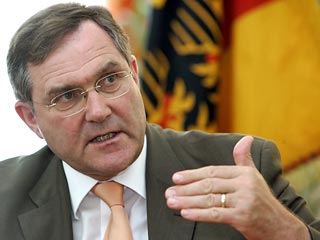
An unexpected statement about the Iranian nuclear problem was made by the Minister of Defense of Germany Franz Joseph Jung. According to him, Iran has the right to enrich Uranus for peaceful purposes under the control of the IAEA, like all other countries of the world.
When answering the question of journalists whether it is possible to allow Iran to enrich Uranus under the supervision of the International Agency for Nuclear Energy, the minister said: “I think yes. In the proposals (the Six -to -Tserka countries transferred by Tehran - approx. Newsru.com ) there are all options. This means that the civil use of atomic energy is possible, but not the creation of nuclear weapons. At the same time, it is necessary to use the mechanisms Monitoring.
Thus, the Minister indirectly confirmed the information that appeared in the early June in The Washington Post that the package of proposals transmitted to Iran on behalf of the five regular members of the UN and Germany Security Council in order to overcome the crisis around the Iranian atomic program, includes the opportunity for Tehran to enrich Uran in its own territory. Washington, like the rest of the proposals developers, officially do not disclose their content, waiting for Tehran’s answer.
Exposure from an interview with Joseph Jung was published by the Arab edition of Al Arab , in a cut-out form he was also transferred by the Russian ITAR-TASS agency.
According to Jung, close control of the Iranian Iran can give the necessary guarantees to the world community. "Magate inspectors can give such guarantees by monitoring. This is not a problem," he said.
"It is impossible to prohibit Iran what other countries of the world do on the basis of international law. The key point is whether a step towards the production of nuclear weapons is taken. This should not happen," said the Minister of Defense of Germany.
This statement looks strange against the general background of the Western media reports that the Six countries offer Iran a number of preferences in exchange precisely to stop the enrichment of Uranus on its territory. The details of the proposals transferred by Tehran in early June were not disclosed, but the Western media, with reference to sources familiar with the document, reported, in particular, that Eurotroshka offers a nuclear reactor on light water, the USA - economic and political benefits, Russia is a joint venture on uranium on Russian territory.
Last Monday, the head of the German Foreign Ministry called "unthinkable" that six world powers should wait two more months of Tehran’s response to their proposals, Reuters reports. “Our proposals have been with them for two weeks,” said the Foreign Minister Frank Frank -Walter Steinmeier. “I hope that Tiegran will soon make a decision. I can’t imagine that we will wait until August 22.”
The day before, the British Foreign Minister Margaret Beckett stated that Eurotroshka countries, as well as Russia, the USA and China, will not go to “negotiations on negotiations” on the Iranian problem. According to her, to begin with any consultations, Tehran’s response to the proposals of the West should be received.
President Mahmoud Ahmadi Nezhad last week said that Iran would give an official response by August 22, which gave President Bush to accuse Iran of an effort to win time. If Iran rejects the sentences "six", it is possible that the UN Security Council is sanctions. China and Russia can block them, especially after at the recent SCO summit in Shanghai Ahmadi Nezhad invited Putin to conclude a gas union, creating a kind of OPEC analogue. The Russian President then said that Iran’s dossier can be returned from the UN Security Council back to the IAEA.
The statement of the head of the Ministry of Defense of Germany also looks strange given that at present, all work to enrich uranium in Iran is carried out under the control of the IAEA. This is stated in the report of this organization , submitted by the Administrative Council of the IAEA managers. At the same time, it is indicated in it, the agency still does not have sufficient clarity regarding all aspects of the Iranian nuclear program. In particular, the document draws attention to the lack of progress in clarifying the issue of the origin of the traces of highly enriched uranium, which were discovered on individual centers of centrifuge even before the start of enrichment work.