
Translated material
Putin demands to give Russia Zakayev
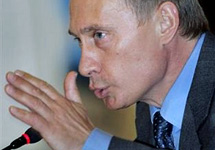
Russian President Vladimir Putin said that Moscow has evidence of the criminal activity of Ahmed Zakayev, who was one of the separatists in Chechnya, and is now in the UK, ITAR-TASS reports. Speaking to journalists following the results of the working day of the Eight summit, Putin also expressed the hope that different countries will unite against criminal elements.
“When we are told when developing a document to combat terrorism:“ Let's mention Syria, Iran, ”you can ask why not to mention other countries that cover criminals on their territory,” Putin said.
At the same time, he thanked the journalist who asked whether to be given to Russia Zakayev and how to develop general approaches in determining terrorist activities and methods for its suppression. According to Putin, the reporter "has focused on the problem of relations between countries for one of the most acute problems."
Putin expressed regret due to the fact that different countries have not developed general approaches and "criminal elements use this." “We must finally realize this and change the situation,” Putin said.
He emphasized that in some countries, indeed, complex legal and judicial systems, and many criminal elements and persons involved in terrorism "use this to destroy civilized countries and the basic principles on which today's civilization of democratic countries is based."
On June 27, Prosecutor General Yuri Chaika said that Russia will again try to get the issuance of crimes suspects from the UK. This was stated on Tuesday by the new Prosecutor General Yuri Chaika.
To this end, in the near future, a delegation consisting of employees of the Prosecutor General, the Ministry of Justice and the Ministry of Foreign Affairs of the Russian Federation will be sent to the UK. The seagull told about this in his first speech in front of the central apparatus and the leadership of the Prosecutor General.
“In the near future, by agreement with the Prosecutor General of England and Wales, we will analyze all the criminal cases on which there were refusals to extradite a number of accused and criminals,” said Chaika. “We will try to make up for the existing gap and use the mechanism of international legal cooperation, including taking into account the national legislation of the UK.”