
Translated material
In Moscow, a procession and a rally were held, dedicated to the Day of the State Flag of Russia and the failure of the putsch
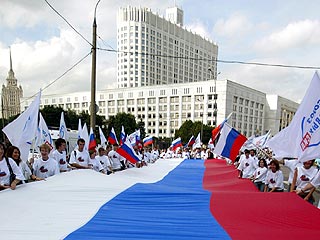
In Moscow, a procession and a rally were held on Tuesday, dedicated to the Day of the State Flag of Russia and the failure of the August Putch of 1991. About 500 people took part in the events. The organizers of the action were the "Union of Right Forces" and the public organization "detachment of Russia", which united participants in the events of 15 years ago.
At first, the column of participants in the action passed from the humpbacked bridge near the Government House to the new Arbat. Participants carried a 15-meter Russian tricolor along the central streets. Then a rally took place at the intersection of the garden ring and the new Arbat, where there is a memorial sign of the defenders of the White House, who died under the caterpillars of tanks - Vladimir Usov, Dmitry Komarya and Ilya Krichevsky.
The rally began with a minute of silence. It was attended by representatives of the ATP, the Republican Party and other political forces, including youth democratic movements. Of the famous politicians at the rally, Irina Khakamad, Boris Nemtsov, Nikita Belykh, was present, Interfax reports.
Many speakers at the rally said the same thing: democratic forces should be united, otherwise the slogan "Preserving the descendants of freedom" loses its relevance. Irina Khakamada is convinced that the current country is now to blame, the current authorities are to blame, the Echo of Moscow radio station reports. The rally lasted a little more than half an hour.
According to law enforcement agencies, the action in Moscow took place without serious incidents. At the same time, before the procession near the hunchback bridge, two young people were detained, one of whom walked along the state flag of the Russian Federation. Law enforcement officers detained the offender, he is currently delivered to the Presnya police department. As Interfax told a source in law enforcement agencies, the detainee is most likely charged under the administrative article - 20.2 of the Administrative Code of the Russian Federation. As for the second young man who was detained with a pistol such as a “stroke” and a knife with a rolled blade, then after the proceedings with him in the police department, he will most likely be released, the agency’s interlocutor noted. According to him, "such means of self -defense are prohibited at mass events. In this regard, upon inspection, when it passed the scope of metal detectors, he was detained by police officers."
The safety of measures was ensured by more than 300 police officers, including fighters of the Moscow riot police, who accompanied the procession and guarded security at the rally. All participants in the action went through the framework of metal detectors and were carefully inspected by police officers.
Similar shares on Tuesday are also held in St. Petersburg, Perm, Smolensk, Krasnodar, Ufa, Yakutsk, Lipetsk, Tomsk, Izhevsk, Stavropol and other cities of Russia.
Help: State flag of the Russian Federation
The state flag in Russia appeared at the turn of the XVII-XVIII centuries. For the first time, the white-blue-red flag was raised on the first Russian warship "Eagle", during the reign of the father of Peter I Alexei Mikhailovich. It is known that the "eagle" did not swim under a new banner for long: going down the Volga to Astrakhan, he was burned by the rebellious peasants Stepan Razin. Peter I was recognized as the legitimate father of the tricolor: on January 20, 1705, he issued a decree according to which the white-blue-red flag himself should raise a sample and determined the order of horizontal stripes. In different variations, the three -lane flag decorated the warships until 1712, when the Andreevsky flag established in the wartime.
In 1858, Alexander II approved the drawing "with the location of the stamp black and yellow-white colors of the empire on banners, flags and other objects for jewelry on the streets in solemn cases." And on January 1, 1865, the nominal decree of Alexander II came out, in which the colors are black, orange (gold) and white are already directly called the "state flowers of Russia." The black and yellow-white flag lasted until 1883. On April 28, 1883, the command of Alexander III was announced, which stated: "So that in those solemn cases when it is possible to allow the decoration of buildings with flags, an exclusively Russian flag consisting of three lanes was used: the upper - white, middle and lower - red colors."
In 1896, Nicholas II established a special meeting at the Ministry of Justice to discuss the issue of the Russian national flag. The meeting came to the conclusion that "the white-blue-red flag has the full right to be called Russian or national and its color: white, blue and red to be called state" and determined that for the whole empire, "a white-blue-red color should be finally considered, and no other."
Three colors of the flag, which became national, received an official interpretation. Red color meant "sovereign", blue - the color of the Mother of God, under the cover of which Russia is located, white - the color of freedom and independence. These colors also meant the community of white, small and great Russia.
After the February Revolution, the Provisional Government used as a state white-blue-red flag. Soviet Russia did not immediately reject the three -color symbol of Russia. On April 8, 1918, Yakov Sverdlov, speaking at a meeting of the Bolsheviks of the Bolsheviks of the All -Russian Central Executive Committee, proposed to approve the combat Red Flag by the national Russian flag, and for more than 70 years the state flag was a red banner.
The proposal to replace the “revolutionary” red flag with a white-blue-red was expressed by the People’s Deputy of Russia Viktor Yaroshenko-even before the August coup of 1991. On August 22, 1991, the Extraordinary session of the Supreme Council of the RSFSR decided to be considered an official symbol of Russia Tricolor, by decree of the President of the Russian Federation Boris Yeltsin of December 11, 1993, the Regulation on the State Flag of the Russian Federation was approved.
In August 1994, Yeltsin signed a decree that states: "In connection with the restoration of August 22, 1991, the historical Russian three -color state flag, covered by the glory of many generations of Russians, and in order to educate the current and future generations of Russian citizens, a good attitude towards state symbols, I decide: to establish a holiday - the Day of the State Flag of the Russian Federation and celebrate it on August 22."
On December 4, 2000, Russian President Vladimir Putin introduced to the State Duma, among other laws on state symbolism, the draft Federal Constitutional Law "On the State Flag of the Russian Federation". On December 8, 2000, the Duma adopted a bill in the first and third (final) reading. On December 20, 2000, the Federation Council of the Federal Assembly of the Russian Federation approved the draft law, on December 25, 2000 it was signed by Putin.
In accordance with the law, the state flag of the Russian Federation is a rectangular panel of three equal horizontal stripes: the upper - white, medium - blue and lower - red. The ratio of the flag width to its length is 2: 3. Currently, most often (unofficially) the following interpretation of the values of the colors of the flag of Russia is used: white color means peace, purity, immaculate, perfection; blue - the color of faith and fidelity, constancy; Red color symbolizes energy, strength, blood spilled behind the Fatherland.