
Translated material
DPRK prepares a nuclear explosion - Tokyo can cover a radioactive cloud
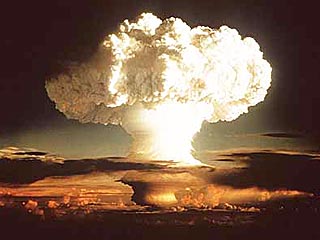
Radioactive dust, which will appear in the case of testing northern Korea of nuclear weapons, can reach Japan in a small amount after 1-2 days even during an underground explosion. This was announced on Friday in the evening at a press conference at Tokyo Chief of Staff of the Air Force of Self-Defense forces of Japan Tadasi Yosid.
In this regard, Japan is preparing for possible consequences, carefully monitors the position in the DPRK and collects information by all possible means, including satellite tracking and air intelligence.
According to the experts of the Japanese Research Institute of Nuclear Energy, in the case of a ground nuclear explosion, taking into account the wind rose, the radioactive cloud will reach the northern Hokkaido Island after 30 hours, and Tokyo will cover 78 hours after 78 hours. Japan to some extent “calms” the information that the DPRK intends to conduct a nuclear test in an abandoned coal shaft at a depth of about two thousand meters.
According to some reports, Pyongyang can choose a nuclear test of Sunday as the day of the celebration of the election of the leader of North Korea Kim Jong Ira to the post of head of the Korean Workers Party in 1997.
However, on Friday, the director of the National Defense Department (UNO) of Japan Fumio Kyum said that the time of the possible North Korea testing of nuclear weapons was not determined. "Since, as it is assumed, it can be an underground nuclear explosion, predict the time of its implementation with the minimum of the information that we have is extremely difficult," he said.
UNO Director said that the main indicator of the underground nuclear test is characteristic seismic waves, therefore, the main meteorological administration of the country has already been given the corresponding instructions on fixing all unusual signals.
At the same time, last Thursday from the Kaden Air Force base on the Japanese Okinawa archipelago to monitor the radioactive situation in the air near the North Korean territory, a specially equipped plane flew out, RIA Novosti reports.
The head of the Japanese government Shinzo Abe intends to discuss the issue of Pyongyang nuclear ambitions during meetings with the leaders of the PRC and South Korea on October 8 and 9 during his first foreign tour. In his opinion, such intentions are completely unacceptable, and "the international community should sharply respond to such statements and prevent their implementation."
Last Tuesday, North Korea announced his intention to conduct nuclear tests in the future, explaining their need for a threat from the United States. Pyongyang guaranteed their safety and assured that the country would not be the first to use nuclear weapons and "would not allow threats with the help of nuclear weapons or its transfer (the other side)."
Along with this, North Korea promises to make "comprehensive efforts to create a nuclear disarmament and non -distribution of nuclear weapons on the Korean peninsula."