Date
Author
Вероника Мовчан; Наталья Сысенко
Source

Preserved copy
Translated material
Between the markets of Russia and the EU
After the collapse of the Soviet Union before Ukraine, as before other republics, the question arose: which of the possible ways of integration into international political and economic structures [1] is most consistent with its long -term national interests? And as most countries of the post -Soviet space, with the exception of the Baltic countries, she has chosen a double -destroyed strategy: the intra -regional integration and rapprochement with the World Trade Organization (WTO) and the European Union (EU).
This strategy actually predetermined the constant balance of Ukraine between the EU and Russia. However, Ukraine, despite the significant dependence on energy supplies from Russia, is economically steadily moving away from it, which, given the colossal size of the EU market and its intimacy (after the EU expansion in 2004, Ukraine generally has a common border with the EU), is understandable and predictably [2] .
Politically, the situation is more complicated. In recent years, Ukrainian leaders have been constantly repeating that the country has been connecting its future with integration into European structures and EU membership [3] . However, these aspirations do not find the proper response among official representatives of the European Commission. So, in January 2007, in connection with the approximation of the term of the agreement on partnership and cooperation between Ukraine and the EU, the Council of the European Commission approved the mandate to sign a new, expanded agreement, but most likely it will not even contain a hint of Ukraine’s membership in the EU.
The EU position is understandable. Ukraine is too large compared to other countries that have recently joined the EU, has too low per capita income, its infrastructure is poorly developed. In addition, the EU itself has been faced recently with serious problems. This is still not adopted by the Constitution, and difficulties with the adaptation of new members (for example, their entry into the “Euro zone”), and the suspension of negotiations with Turkey on its membership in the EU, was deposited for an indefinite time.
Moreover, the adoption of Ukraine to the EU contradicts the interests of another geopolitical center in Europe, Russia. It is the Russian Federation that sets the tone in most intra -regional associations of the post -Soviet space, whether it be the CIS, EurAsEC or a single economic space (EEP). And since it is impossible to be in two different customs unions at the same time, Ukraine, in order to become a member of the EU, will have to get out of the EEP (unless, of course, all the stages of the formation of the latter are passed), which will inevitably cause Russia's displeasure.
For Ukraine, which is actually a natural transit state, the development of a foreign economic strategy is complicated by the openness of its economy: the share in GDP both exports and imports exceed 50%. From Russia, Ukraine receives most of the energy coiners necessary, and the EU countries are the largest importers of Ukrainian products and the main source of investment goods, and at the same time investment capital.
Macroeconomic situation in Ukraine
Economic growth in Ukraine was actually resumed only in 2000 after a decade of the fall of real GDP. According to the CIS Statistical Committee, Ukraine has left the recession of almost the last of the countries of Suise, which was largely due to the low rates of the economy.
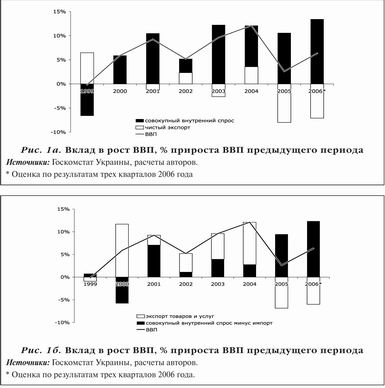
Since 2000, the contribution of domestic consumption to GDP growth has been the main one, while the growing volumes of imports determined the low contribution of pure export (Fig. 1a). However, the role of the latter should not be underestimated. The real export of goods and services explains about half of the total GDP growth in 2000-2004, while internal demand was largely satisfied due to imports (Fig. 1b). The role of export was especially noticeable in 2000 and 2004, when its contribution to GDP growth significantly exceeded the contribution of internal demand, the deductible imports. In other words, the Ukrainian economy would probably have grown at least twice as slowly, if not for high export growth rates. Note that a similar assumption can be made in relation to Russia, an important source of economic growth of which is the export of energy carriers, primarily oil and gas [4] .
The sensitivity of economic growth to export dynamics was confirmed by 2005, when almost a 14 percent drop in real export of goods and services led to a significant decrease in the growth of real GDP (to 2.6% compared with 12.1% in2004), despite a sharp increase in domestic demand, primarily consumption of households.
An important factor that determines the sensitivity of the Ukrainian economy to external shocks is the structure of its export. The country exports primarily the products of ferrous metallurgy, that is, goods for which are very variable. And although the low diversification of the commodity structure is partially compensated by the large number of partner countries, this is not enough for stability. Moreover, metallurgical production is energy -intensive, and their own energy in Ukraine is not enough. This makes the industry dependent on the supply of imported energy and prices for them, which exacerbates the vulnerability of both metallurgy and the economy as a whole.
In recent years, the dependence of the Ukrainian economy on external factors began to gradually decline. For example, in 2006, despite the ongoing decline in the real export of goods and services, the real GDP, according to preliminary estimates, increased by 7%. This is due to a high growth rate of domestic consumption of households - both its commodity component, and, to a large extent, services. Accordingly, the domestic market is developing, which is much less sensitive to the external conjuncture.
In order for the growth of the Ukrainian economy to be stable, it is necessary to continue structural reforms, as well as develop relations with key foreign economic partners, which opens wider access to foreign markets and allows the country's transit potential.
Features of the coward regime: Ukraine - EU
The current relations between Ukraine and the EU are regulated primarily by agreement on partnership and cooperation (ATP), which entered into force on March 1, 1998 for a period of 10 years. This document approves the primacy of market relations in economic, trade and other areas of interaction between countries. At the same time, the provisions of the agreement are quite declarative and do not contain any specific plans and mechanisms. Therefore, an important addition to it was the action plan of Ukraine - EU [5] , adopted in 2005 as part of the implementation of the new EU proximity program [6] .
Today, the trade regime used by Ukraine in the EU is far from the most preferential. In fact, only six countries, when exporting in the EU, pay duties that meet the regime of the greatest favors (RND). These are Australia, New Zealand, Canada, USA, Japan and Taiwan. Many states have certain preferences when entering the EU market. Some signed the agreements on free trade or the Customs Union with the EU (a number of countries of the Mediterranean, Mexico, South Africa, Turkey, the countries of the European Free Trade Association), others, such as the countries of the Balkan Peninsula, effectively use duty -free access to the EU in accordance with association agreements [7] .
Preferential access to the EU market, if certain regional trade agreements are not valid, is regulated by the General Preferences (GSP) system of the European Union. Today, Ukraine uses the general regime provided for by the GSP [8] . This means lower duties on certain products than with the RND, which actually involves a high proportional reduction in the fee (in many cases to zero) for most types of industrial products, but relatively low - for many types of agricultural products. Preferences that Ukraine receives within the framework of the GSP gradually expand. For example, earlier Ukraine did not have preferential access for fish products, iron and steel, grains, seeds, fruits and vegetables, as well as for fertilizers [9] , that is, goods that make up a significant part of the country's export in the EU.
In addition, there are separate agreements between Ukraine and the EU, which relate to trade in the goods of steel and textile industry. For example, at the beginning of the year, Ukraine has para) the agreement on quotas in the sale of steel for 2007. Complete liberalization of the trade in the products of steel industry will occur only after Ukraine joins the WTO, which is expected to take place until the end of 2007.
It should also be mentioned of measures that take both sides to protect the markets from unfair competition and excessive increase in imports. To date, in the EU in relation to Ukraine there are six different anti -dumping duties that relate to the products of metallurgical and chemical industries, and three other investigations were initiated in 2006. In turn, in Ukraine there are three anti -dumping duties against goods from individual EU, as well as five special duties without specifying the country of origin of goods, which also hurt imports from the EU.
Thus, Ukraine so far has almost the minimum possible benefits in the EU market. It is expected that after its entry into the WTO, official negotiations will begin on the creation of an extended free trade zone, where not only tariff restrictions will be lifted, but also liberalized trade in services, non -tariff barriers, etc.
Features of the coward regime: Ukraine - Russia
The inefficiency of the “wide” integration in the economic space of the CIS caused subregional integration processes to life [10] . In particular, the signing of free trade agreements between individual CIS members, including between Ukraine and Russia [11] .
According to the content, bilateral agreements on free trade between the CIS members are more or less standard [12] . They provide for the abolition of import duties for all goods, as well as free transit of goods through the territory of the states that signed the agreement. The goods excluded from the free trade regime (the list of them is set by separate protocols), the rates of import duties that meet the regime of the greatest favors are distributed.
At the moment, the list of exceptions to trade between Ukraine and Russia includes goods for which exporting countries set export tariffs [13] (in Russia it is 142 positions, including key products, mineral raw materials, fertilizers, etc. [14] , and in Ukraine it is cattle, skins, as well as scrap of ferrous and non-ferrous metals). In addition, white sugar, alcohols (when imported into Russia) are excluded from the free trade regime. It should be noted that the list of exceptions is gradually reduced. For example, in 2006, tobacco products were included in the free trade mode.
Both sides actively use anti -dumping and special measures. To date, there are six different protective duties for Ukrainian goods in the Russian market (anti -dumping, special, compensation), and four other investigations were initiated in 2005-2006. First of all, the products of Ukrainian metallurgy and mechanical engineering fall under protective measures. In Ukraine, three anti-dumping duties (railroad transfers, matches, wood and fiber slabs) are currently operating in relation to Russia. There are five more special duties without specifying the country of origin of goods, which also hurt Russia. Moreover, four anti -dumping investigations are underway regarding products from Russia (steel ropes and cables, iron ore concentrate, asbestos -cement corrugated sheets, tires), as well as three special investigations without indicating the country of origin of the goods.
More and more often, non -tariff regulation is used in trade relations between the two countries. An indicative in this regard is the ban on the import of Ukrainian livestock products into Russia in January 2006. The official reason for the ban was the failure to comply with the veterinary requirements for the meat supplied by Ukraine. However, it was distributed to all livestock products, as a result of which the dairy industry was mainly damaged, since the goods of this particular sector (primarily cheeses) were the main export product supplied to Russia (Ukrainian cheeses occupied up to 50% of the market in Russia). Subsequently, the ban for several enterprises was lifted, and on the rest there are inspections of Russian veterinary services. Because of this, voices are increasingly distributed that, contrary to the free trade agreement, a trade war is actually between the two countries [15] .
A separate discussion deserves the agreement signed on September 19, 2003 by the Russian Federation, Ukraine, Belarus and Kazakhstan an agreement on the creation of a single economic space (EEP). The EEP document is defined as “the economic space uniting the customs territories of the participating states on which the mechanisms of economies regulation are functioning, based on uniform principles that ensure the free movement of goods, services, capital and labor, and a unified foreign trade and coordinated, to the extent and to the extent, in which it is necessary to ensure equal competition and maintain the macro economic stability, tax, monetary, currency and financial policy ” [16] .
In fact, this means at least the creation of the Customs Union, which contradicts the previously declared intention of Ukraine to become a member of the EU. Therefore, the signing of the agreement was a complete surprise for both Ukrainian experts and many politicians and high -ranking government officials [17] . The Verkhovna Rada ratified the agreement, but the severity of the debate was such that the decision was equipped with a note: “Ukraine will participate in the formation and functioning of the EEP in the framework that correspond to the Constitution of Ukraine” [18] .
To date, the positions of the participating countries on the issue-what should be the level of integration within the framework of the EEP, vary. In the first stage, Ukraine proposes to create a free trade zone without exemptions [19] . Representatives of Russia, on the other hand, do not want to limit themselves to this and talk about the integration of economies, which “already at the first stage of unification and coordination in the field of transport, energy, communications, and a number of other areas of services” [20] . The mismatch of the aspirations of the project participants significantly inhibits its implementation.
Trading flows of Ukraine
Today, the EU-25 and Russia are the largest partners of Ukraine in the trade in goods-57% of the total trade [21] . Moreover, the vector of trade over the past decade has gradually changed its direction. If in 1996, 41%of the country's total turnover was traded with Russia, then in 2006 this indicator decreased to 27%, while the total turnover with the EU-25 reached 30%, i.e., the country's total turnover grew by 10 percentage points (see table.).
Table
Trade of Ukraine with the EU-25 and Russia, million US dollars
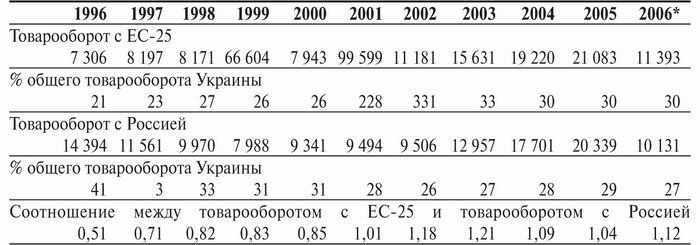
Source : National Bank of Ukraine (NBU). * The first half of 2006.
The displacement of proportions in commodity trade towards the EU occurred mainly due to the growth of trade with the European Union. Over the past decade, the turnover with the EU-25 has grown by 88.6%, while with Russia-by 41.3%.
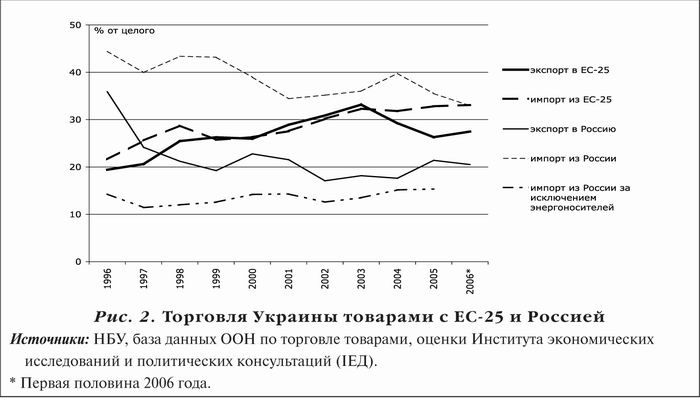
The European Union is the main buyer of Ukrainian goods and, if we exclude the volume of energy imports from Russia, the main supplier of imported goods to the country (Fig. 2). Moreover, both export B, and imports from the EU-25 have grown markedly over the past ten years. In parallel, trade with Russia was inferior to its leading positions, and if the volume of imports from Russia (including energy), gradually decreasing, equal to the volume of imports from the EU-25 only in 2006, then export to Russia was behind the EU-25 already in 1997.
The last decade has been an active reorientation of the trade flows of Ukraine, associated both with the restructuring of its economy and the growth of competition in traditional markets, including in the Russian market.
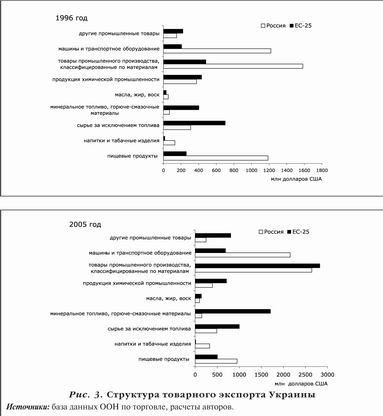
The nature of the change in the structure of commodity exports (Fig. 3) confirms this thesis. So, Ukraine gradually conquered the EU market in the industrial production sector (mainly, metals and products from them), which previously dominated deliveries to Russia. Export growth occurred contrary to significant restrictions on the supply of ferrous metals and products from them to the markets of the EU countries. This refers to quotas, the exclusion from the General Preferences [22] , anti -dumping investigations and duties. The volumes of supplies to the EU machines and equipment have also increased, although this category of goods is still a fairly modest place (about 8-9%).
Machines and equipment dominate the structure of Ukrainian exports to Russia. They make up 29% (in 2005) from total exports. It should be noted that it is with the supply of machines and equipment to Russia that they often associate hopes for the future growth of the high -tech exports of Ukraine. Однако более детальное изучение списка товаров, которые поставляются в Россию, не вполне подтверждает обоснованность таких надежд. Во-первых, около трети всех поставок продукции машиностроения в Россию составляет оборудование для железнодорожного транспорта, спрос на которое определяется в большей мере старыми связями и унаследованными от Советского Союза едиными транспортными стандартами, нежели реальным конкурентным преимуществом украинских товаров. Более того, экспорт этого оборудования Украина осуществляет преимущественно в республики Советского Союза (Россия 64%, Казахстан 12% и т. д.).
Во-вторых, уже сейчас на российском рынке импортных машин и оборудования конкуренция весьма высока: поставки этих товаров из Германии составляют 18% общего импорта продукции машиностроения, тогда как поставки из Украины только около 6%. Причем в 1996 году эта цифра равнялась 12%, т. е. за последнее десятилетие Украина потеряла часть российского рынка. Ожидать, что образование таможенного союза России с Украиной существенно укрепит позиции последней на этом рынке, вряд ли стоит, поскольку в перспективе темпы развития экономики зависят главным образом от качества завезенных машин и оборудования, что отодвигает соображения дешевизны и доступности на второй или даже третий план.
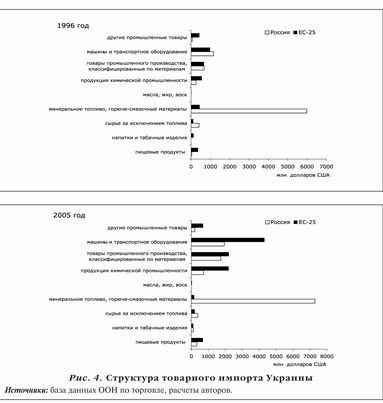
Импорт Украины был и остается смещенным в сторону энергоносителей (рис. 4), хотя их стоимостные объемы и сократились за последние десять лет. Это связано с высоким уровнем удельного потребления, по которому Украина все еще опережает другие страны Европы, в том числе и Россию, при довольно низкой обеспеченности энергоресурсами [23] . В 2004 году 85% общего предложения нефти и 79% газа на рынке Украины составил импорт, в первую очередь из России и Средней Азии.
Следующим после энергоносителей важнейшим компонентом импорта является продукция машиностроения. Причем за десять лет произошла значительная реструктуризация рынка. Если в 1996 году Россия была основным поставщиком машин и оборудования в Украину, то теперь лидерство захватил ЕС. Так, украинский импорт продукции машиностроения из ЕС-25 увеличился за 1996—2005 годы на десять процентных пунктов и составляет 45% от общего. В то же время доля России в украинском импорте машин и оборудования снизилась за тот же период с 42% до 20%.
Можно ожидать, что такая тенденция сохранится в ближайшем будущем. С одной стороны, рост цен на энергоносители будет способствовать увеличению их внутреннего производства и внедрению энергосберегающих технологий, что, соответственно, снизит импорт. С другой — рост инвестиционной активности увеличивает спрос на машины и оборудование, основными поставщиками которых для Украины на сегодня являются страны ЕС.
Таким образом, в том, что касается и экспорта, и импорта, Украина все дальше и дальше смещается в сторону стран ЕС. Потенциальные объемы рынка ЕС украинских экспортеров привлекают больше, нежели относительно более благоприятный режим торговли с Россией. К тому же ЕС-25 является чрезвычайно важным поставщиком машин и оборудования, т. е. инвестиционных товаров, без которых невозможен стабильный рост экономики.
Россия остается для Украины в первую очередь основным поставщиком энергоносителей, что ставит страну в слишком большую зависимость от одного поставщика (страны Средней Азии как самостоятельных поставщиков энергоносителей в Украину вряд ли имеет смысл принимать во внимание, поскольку система транзита такова, что последнее слово все равно остается за Россией). Это задает главное направление стратегии национальной безопасности — диверсификация рынка энергоносителей и повышение эффективности использования последних.
Украина как транзитное государство
Благодаря географическому положению — между Россией и Европой —Украина является страной со значительным транзитным потенциалом, к тому же в наследство от СССР ей досталась достаточно развитая транспортная инфраструктура. Сейчас на повестке дня стоит вопрос об эффективном использовании этого потенциала, увеличении объема экспорта транспортных услуг.
ЕС — один из крупнейших потребителей природного газа в мире. Импорт его составляет 55% (2004 год, для ЕС-25) от потребления [24] , при этом основными поставщиками газа являются Российская Федерация (41%), Норвегия (29%), Алжир (21%) [25] . Ожидается, что зависимость ЕС от импорта и цена энергоносителей будут только возрастать [26] , что в сочетании с ожидаемой либерализацией европейского рынка и усилением роли спотовых рынков будет стимулировать газодобывающие страны увеличивать поставки и снижать затраты на транспортировку.
Для Украины, которая владеет достаточно мощной транспортной системой перекачки газа (110—120 млрд кубометров в год), очень важно ее сохранить и оптимально использовать.
Проблемы, связанные с транзитом природного газа в страны ЕС и с поставками его в Украину, в последние несколько лет приобрели особую остроту. Украинская газотранспортная система до сих пор принадлежит государству и управляется без участия иностранных фирм. Сохранять такое состояние дел с каждым годом будет все труднее, поскольку активно разрабатываются проекты альтернативных маршрутов («Ямал — Европа», «Северно-Европейский газопровод», «Голубой поток» и др.). К тому же периодически возникающие газовые конфликты между Россией и Украиной во многом подорвали репутацию этих стран как надежных партнеров. Учитывая вышеперечисленные факторы, а также состояние газотранспортной системы и объемы необходимых для ее модернизации инвестиций, будущее Украины как страны-перевозчика газа трудно назвать безоблачным. Ведь чтобы обеспечить себе заметную долю транзита российского и среднеазиатского газа в ЕС, ей скоро придется включиться в конкурентную борьбу на глобальном энергетическом рынке.
Проблема усугубляется высокой зависимостью страны от импорта энергоносителей. Следствием роста мировых цен на нефть и привязанных к ним цен на природный газ стал пересмотр действовавших в газовом секторе соглашений. Вплоть до 2006 года украинские предприятия получали газ фактически по субсидированным ценам, поскольку мировая цена росла, а цена газа из России и Средней Азии была привязана к цене транзита и оставалась неизменной.
В 2006 году цена газа на границе с Россией увеличилась почти на 60%, до 95 долл. за тысячу кубометров, а с 2007 года до 130 долл. Вопреки мрачным прогнозам, заметного торможения экономического роста в 2006 году не произошло. Частично это было связано с благоприятной конъюнктурой на мировом рынке металла и товаров химической промышленности, а также значительным потенциалом энергосбережения, реализация которого на этом этапе еще не требовала больших капиталовложений. Однако как дальше экономика Украины будет реагировать на рост цен, предсказать трудно. Понятно, что в перспективе Украина будет платить за газ мировую цену [27] , а это требует принятия срочных мер по увеличению эффективности энергопотребления.
Одновременно Украина должна ориентироваться на мировые тенденции на газовом рынке и искать альтернативные формы кооперации с его участниками. Одна из возможных — создание международного газотранспортного консорциума, который бы ориентировался не просто на обеспечение транзита первичных энергоносителей в ЕС, но и на переработку газа на украинских ТЭС с целью дальнейшего экспорта электроэнергии.
В любом случае потенциальные партнеры по консорциуму ли, по торговле ли газом руководствоваться будут в основном не политическими, а экономическими соображениями. Поэтому сегодня необходимо вкладывать средства в мероприятия по снижению затрат на транспортировку газа. Тем более что увеличение транзита нефти и газа по территории Украины — одна из насущнейших задач. Кстати, в данный момент нефтяные и газовые магистрали Украины недогружены [28] , что, впрочем, можно объяснить не только политическими коллизиями, но и сокращением потребности в природном газе из-за аномально теплого осенне-зимнего периода 2006 года.
Свои интересы Украина должна отстаивать и в рамках Европейской энергетической хартии и Энергетического содружества. В частности, при разработке протокола к Энергетической хартии ей следует добиваться того, чтобы проблема диверсификации газоснабжения Украины рассматривалась в контексте программы диверсификации газоснабжения стран ЕС.
Схожие проблемы существуют и в сфере транзита товаров, хотя здесь позиции Украины не столь сильны. Более того, глобальная конкуренция, которая должна вроде бы стимулировать государство и бизнес вкладывать средства в поддержку и развитие транспортной инфраструктуры, подстраивать под нужды транзита тарифы и законодательство, до сих пор заметного влияния на политику Украины не оказывала.
При этом в ближайшее время следует ожидать значительных изменений в области пассажирских и грузовых перевозок, в основном из-за расширения связей между европейским и азиатским регионами: по оценкам экспертов ООН и ЕС, до 2010 года ожидается рост товарообмена по европейской оси «Север — Юг» на 25—30%, а по оси «Европа — Азия» — на 30—35%.
Чтобы привлечь потребителей транспортных услуг, необходимо развивать международные транспортные коридоры (МТК), совершенствовать таможенные и пограничные процедуры, углублять международное сотрудничествo в области транспорта. По территории Украины проходит несколько международных транспортных коридоров, но все они требуют существенной модернизации. В данный момент при участии Европейской комиссии ряд таких проектов осуществляется.
Что касается перспектив сотрудничества в этой области с Россией, то обе страны в принципе заинтересованы в развитии общих коридоров, нормальном функционировании так называемого Большого Европейского водного транспортного кольца и углублении сотрудничества в рамках Организации Черноморского экономического сотрудничества (ОЧЭС). Но есть здесь и много проблем. Так, Россия настаивает на том, чтобы все транспортные вопросы решались в рамках ЕЭП. Украина же предпочитает формат двусторонних соглашений.
Еще в 2004 году была подготовлена Концепция интеграции транспортных систем Российской Федерации и Украины, которая предусматривала проведение согласованной политики относительно приоритетных общих перевозок, в т. ч. по МТК, и поэтапную унификацию систем тарификации. Однако положения данной Концепции пока остаются нереализованными.
* * *
Будущее отношений Украины как с ЕС, так и с Россией будет определяться следующими факторами. Во-первых, это вступление Украины и России в ВТО. Членство в этой организации позволит Украине начать официальные переговоры о создании зоны свободной торговли с ЕС, а ее торговые отношения с Россией перейдут на качественно новый уровень, поскольку будут регулироваться международными правилами, у сторон также появятся новые инструменты защиты свои интересов.
Отдельный вопрос — очередность вступления. Каждая из стран опасается, что другая, если она окажется первой, сможет существенно затормозить вступление в ВТО отставшей. Эти опасения даже получили выражение в своего рода «пакте о ненападении», подписанном в рамках соглашения о ЕЭП [29] .
Во-вторых, это успех переговоров о новом соглашении между ЕС и Украиной, в том числе и переговоров о зоне свободной торговли. Уровень доступа на рынок ЕС, который получит Украина, будет определять, продолжится ли переориентация ее торговых потоков на этот рынок или же структура торговли останется приблизительно такой, как сегодня.
В-третьих, это степень участия Украины в формировании ЕЭП. Тут многое будет зависеть от готовности стран — участниц Соглашения отказаться от изъятий из режима свободной торговли без существенной интеграции других экономических сфер.
В-четвертых, это успех украинских реформ. От него будет зависеть, снизится ли чувствительность страны к внешним импульсам, повысится ли ее энергетическая безопасность, реализуется ли в полной мере ее транзитный потенциал.
[1] Burakosvky I. Economic Integration and Security in the Post-Soviet Space // Swords and Sustenance: The Economics of Security in Belarus and Ukraine / Ed. by Robert Legvold and Celeste A. Wallander. 2003.
[2] Frenkel J. Reginal Treading Blocs in the World Economic System. Institute for International Economics, 1997.
[3] См., например, «Универсал национального единства», 3 августа 2006 года [ http://www.president.gov.ua .
[4] Ahrend R. Russia's Post-crisis Growth: Its Sources and Prospects for Continuation // Europe-Asia Studies. 2006. Vo. 58. No. 1. January. P. 1-24
[5] План действий «Украина — ЕС». Европейская политика соседства. Утверждено Кабинетом министров Украины 12.02.2005, утверждено Советом по вопросам сотрудничества между Украиной и Россией 21.02.2005.
[6] European Neighborhood Policy Strategy Paper. Commission of the European Communities. 12/05/2004.
[7] Ukraine Trade Policy Study. World Bank — 2004.
[8] Схема ГСП предусматривает дополнительные льготы для наименее развитых стран и стран, попадающих под действие договоренностей об стимулировании стабильного развития и эффективного государственного управления.
[9] Council Regulation (EU) No 2501/2001 of 10 December 2001 applying a scheme of generalised tariff preferences for the period from January 2002 to 31 December 2004.
[10] Burakosvky I. Economic Integration and Security in the Post-Soviet Space.
[11] Договор был подписан в 1993 году
[12] Freinkman, Lev, E. Polyakov and C. Revenco. 2004. "Trade Performance and Regional Integration of the CIS Countries." Policy Research Working Paper 38. Washington, DC: World Bank.
[13] Существование экспортного тарифа (вывозной пошлины) — это нарушение принципа свободной торговли. Поэтому если одна из сторон вводит такой тариф, то другая получает право отказаться от режима свободной торговли при ввозе товара, на который он введен.
[14] Экспортный тариф Российской Федерации в соответствии с Постановлением Правительства Российской Федерации № 795 от 23 декабря 2006 года [ http://www.exportsupport.ru/req.exptax ].
[15] См., например, http://www.president.gov.ua/news/data/17_8218.html ; http://www.day.kiev.ua/157249/ ; http://www.zn.kiev.ua/nn/show/594/53249/ .
[16] Соглашение о создании ЕЭП [ http://www.eepnews.ru/record/ ].
[17] Burakosvky I. Economic Integration and Security in the Post-Soviet Space.
[18] Закон Украины от 20 апреля 2004 года № 1683-IV.
[19] См., например, Терехин С., Министр экономики Украины // Первый интеграционный форум «Единое экономическое пространство Беларуси, Казахстана, России и Украины: значение, возможности, перспективы». М., 2005 [ http://www.eurasianhome.org/doc_files/ses_forum.pdi ]; Распоряжение Кабинета министров Украины от 31 января 2007 г. № 26-р.
[20] См., например, Христенко В. Б., Министр промышленности и энергетики Российской Федерации // Первый интеграционный форум «Единое экономическое пространство Беларуси, Казахстана, России и Украины: значение, возможности, перспективы». М., 2005 [ http://www.eurasianhome.org/doc_files/ses_forum.pdf ].
[21] Необходимо отметить, что ни для России, ни для ЕС-25 Украина не является главным торговым партнером. Доля торговли с Украиной в общей товарной торговле Российской Федерации составляла около 6% в 2005 году, а для ЕС-25 этот показатель был менее 1%.
[22] В настоящее время оно не действует.
[23] По оценкам Международного энергетического агентства [ http://www.iea.org/ ], в 2004 году предложение первичной энергии для Украины составило 0,50 тонн нефтяного эквивалента на тысячу долларов ВВП, измеренного по паритету покупательной способности. Для России этот показатель составил 0,49, а для Германии и Франции 0,16.
[24] Соответственно, 45% потребления — газ собственной добычи, причем в будущем его часть будет сокращаться.
[25] The Supply, Demand and Pricing Outlook in Western European Gas Markets [ www.igu.org ].
[26] Согласно официальным прогнозам ЕС спрос на природный газ увеличится с 504 млрд куб. м в 2000 году до 646 млрд куб. м в 2010-м и 880 млрд куб. м в 2030-м.
[27] Например, официальная цена продажи российского газа — 230 долл. за тыс. куб. m.
[28] По данным ДК «Укртрансгаз», в 2006 году компания транспортировала в страны Европы 113,8 млрд куб. м природного газа. Объем транзита в страны СНГ составил 14,7 млрд куб. m.
[29] Соглашение о создании ЕЭП [ http://www.eepnews.ru/record/ ].