
Translated material
Focus: Litvinenko’s poisoning is associated with the death of Russian diplomat Ponomarev
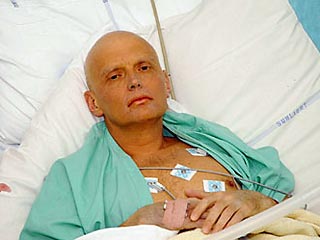
New facts related to the death of Alexander Litvinenko appeared in the German press. Focus magazine draws attention to the fact that shortly before the poisoning of a former FSB officer in London, under mysterious circumstances, Igor Ponomarev, a permanent representative of the Russian Federation in the International Maritime Organization ( IMO ).
The Russian diplomat died in the fall of 2006, two days before the alleged poisoning of Litvinenko on November 1. According to the German magazine, the diplomat was in the theater, when he suddenly felt bad, he was tormented by a strong attack of thirst. The Russian drank several liters of water, after which he died. The cause of his death was declared a heart attack, the body was urgently delivered to Russia, but there were no autopsy.
At the same time, as the Focus magazine notes with reference to specialists, people with heart attacks do not have seizures of severe thirst. According to the experts of toxicologists, Tallius could cause such thirst (at first it was assumed that Alexander Litvinenko was poisoned by this toxic substance).
Ponomarev’s relatives, Focus writes, do not exclude that the death of the Russian is connected with the case of the poisoning of the former FSB officer, because, according to the publication, the Russian diplomat was about to come to a meeting with Litvinenko and Mario Skramell, which took place on November 1 in the ITSU sushi bar.
The British law enforcement agencies did not investigate the causes of the death of the diplomat, because, according to them, no one asked for his excitement, Echo of Moscow reports. In the Necrologist IMO, posted on the organization’s website , the death of 41-year-old Ponomarev is called "unexpected, untimely and unfair," but nothing is said about its reasons.
British investigators are confident that they know who poisoned the former FSB officer Alexander Litvinenko, the British tabloid Daily Mirror writes on Monday. According to the newspaper, these people were questioned in Moscow by British investigators before the New Year. However, the newspaper notes, the Russian authorities are unlikely to issue these people for the trial in the UK. “They admitted that they met with Litvinenko in London, but rejected involvement in the murder. The police will transfer the case to the prosecutor’s office in which the names of these two persons will be indicated,” writes Daily Mirror.
The newspaper gives the words of an unnamed representative of Scotland-Jard: "We are absolutely confident in who led poisoning, where and how. Both of these people declare that we ourselves were infected and are victims of the conspiracy. Moscow also believe that we paid attention to those people." Recall that in Moscow in the case of Litvinenko, in the presence of British detectives, Russian investigators interrogated Dmitry Kovtun and Alexei Lugovoi, who met with the deceased, about whom they were officially reported that they were hospitalized with a radioactive element poisoning.
The British were not allowed to directly interrogate the meadow and Kovtun. According to the Russian Prosecutor General’s Office, former special services officers and now businessmen themselves became victims of Litvinenko’s poisoners. Vyacheslav Sokolenko, familiar to Kovtun and Lugovoi, who visited London with them was also interrogated in Moscow. The Russian authorities said that British investigators cannot interrogate those who have already been interrogated in Russia, and that none of the Russians who can arrest in this regard will be judged in another country.
A former employee of the Russian special services Litvinenko died on November 23 due to Polo-210 poisoning. According to The Daily Telegraph , the detectives suspect that 44-year-old Litvinenko was poisoned twice: the first time a few days before the blow inflicted on him in one of the hotels of Central London on November 1.
At first, the police thought that the first time he was poisoned that day in the ITSU Sushi bar on Picadilli, the Central London, when he met with the Italian spying expert Mario Skramell. But now Scotland Yard finds out whether Litvinenko was poisoned a few days before this meeting, and studies his movements at that time, writes The Daily Telegraph (full text on the website inopressa.ru ).
The police believes that the second blow was dealt in the Pine bar Millennium hotel in the Maifier area. The autopsy discovered two “peaks” of radiation poisoning, and this suggests that he received two separate doses. “It may well be that the killers of Litvinenko poisoned him twice, perhaps because they wanted a complete guarantee that he would not recover,” the newspaper quoted the words of one of the detectives.
Last Friday it became known that Polonia's traces were discovered in the Pescatori restaurant in Maifier, where, as they believe, Lugovoi had lunch until November 1. The British health protection department said that last week a restaurant at the request of the police had checked. Traces of polonium were discovered, but they do not pose a threat to public health. Detectives believe that Lugovoi and Kovtun could visit this restaurant on the same day when they met with Litvinenko at the Millennium hotel.
The tests found radiation in all three hotels, where Lugovoi stayed after arriving in London on October 16. Polonium-210 was also found in two aircraft with which he flew. Lugovoi and Kovtun admitted that they met with Litvinenko on November 1. They and Vyacheslav Sokolenko, the third former KGB officer, who was with them in London, deny their involvement in the murder. Lugovoi declares that he is stipulated.
Lugovoi lawyer Andrei Romashov on Monday commented on the information that appeared in a number of Western media that the British investigation has reason to suspect Russian citizens' poisoning Litvinenko. “I am deeply convinced that in this case, Russian citizens cannot act as suspects,” Romashov expressed his opinion in an interview with ITAR -TASS. "In my opinion, the emergence of such publications in the media may be associated with the need to close the information gap of the current posture lull of the already fitting topic," the lawyer believes. In his opinion, "this topic is already clearly exhausted today."
Where is the polonium for Litvinenko. The versions , meanwhile, the American newspaper The Washington Post writes that 97% of one of the most rare industrial goods in the world - an extremely radioactive isotope of Polonium -210 - is produced at a strictly protected nuclear power plant on the Volga River 450 miles southeast of Moscow.
According to the publication, on average, for a year at the Avangard station, which was a former nuclear weapon production plant, about three ounces (85 grams) of this substance (Russian officials voiced the figure of 8 grams annually - approx. Newsru.com). Then, under strict control, it is sold by Russian and foreign companies that value it for the ability to remove static electricity.
Now the international investigation is trying to track the place where the Polonius-210 was made, which was poisoned by Litvinenko. Scotland-Jard detectives do not report where the evidence is led. The Russian authorities say more willingly, saying that the Vanguard is under strict observation, and the secret production of Polonium-210 is technically possible on many reactors in the world.
But the almost complete dominance of Russia in the official world trade in this substance led to the fact that international attention again paid to the system of its production and control over it. In addition, the death of Litvinenko caused the authorities fears that this substance could be used by terrorists as a murder tool.
Russia is the main source of Polonia, since it offers commercial customers a high -quality product at an optimal price, says Nick Pristance, a professor of radiation toxicology at the University of Midlsex and the former head of the British atomic energy department. In the UK, polonium is not produced, and, according to Russian officials, it has not been exported to the UK for at least five years.
Polonium-210 is produced in reactors due to the irradiation of the Vismot-209 isotope. The substance obtained as a result is so radioactive that the period of its half -life is only 138 days - this means that half of the particles of the substance breaks up during this period.
According to experts, all over the world, reactors capable of performing this operation belong to either government agencies or universities, and therefore are under strict control. “Everything related to the production and use of Polonia is controlled by the government,” said Boris Zhuikov, the head of the radioisotope laboratory of the Institute of Nuclear Research of the Russian Academy of Sciences. “You can’t just put something inside the reactor. This is controlled and checked by many people. It will be discovered.”
The Avangard plant is under thorough control by the Russian government. The authorities say that in Russia, four organizations have a license to use the materials made there: the chemical faculty of Moscow State University, the Federal Nuclear Center in Samara, also located on the Volga, TechsnabExport, the state supplier of Uranus, as well as the private company Nuklon, which uses it in medical devices and is engaged in the sale of isotopes.
Russian officials claim that control is effective. “I absolutely say that in any structures of our fuel-core complex that we are overtaking, no deviations from the standards for the storage and movement of nuclear materials, including Polonia, have not been found,” RIA Novosti reports the words of Konstantin Pulikovsky, the head of the Federal Service for Ecological, Technological and Nuclear Supervision.
According to the UN agency located in Vienna, the UN structure, monitoring nuclear technologies, until 2006, is known around the world at least 15 cases of loss or embezzlement of Polonia, most of them in the United States, notes The Washington Post (full text on the website inopressa.ru ).
According to the Sailure, in Russia, checks can be circumvented if polonium is required by officials who have a great influence. Checks can also be an unreliable way to establish theft, since in the production process much more polonium is made than necessary, and this excess is not included in reserves that are officially recognized.
"During work, they produce polonies in large quantities, since its half -life is only 138 days, and they do not want to make it all the time. It is impossible to exercise full control at the expense of estimates in production," the priest says.
Supporters of another version suggest that the Polonium, who killed Litvinenko, could be received from official supplies that reached the final buyer.
Polonia is widely used in antistatic devices in printing houses, photolaboratories and textile factories. At these enterprises, it is used in extremely small quantities in alloy with other metals. However, it would be difficult to obtain a substance from alloys from alloys in which it is presented, since "treating Polonia is quite difficult," says Pristance.
But in the presence of qualified scientists and the necessary laboratory conditions, this is possible. “I understand how you can get a dose necessary for the murder of one person from them,” says Peter Zimmerman, a nuclear physicist, a royal college professor in London. “This will require a very subtle work in the laboratory.”
In a pure form, polonium-210 is a soft silver metal. One microgram, the millionth part of the gram, can become a deadly dose, and in the body of a poisoned Russian content the content of the substance is several times higher than the deadly dose. One gram, about 0.035 ounces, theoretically can kill tens of millions of people.
Polonia is a self -heated and extremely radioactive substance, however, if it is in a sealed capsule of glass or metal, then it can be safely transported, for example, in a drop of solution. It is not found by detectors at airports, at the border and in ports, since the substance emits alpha rays, and not gamma rays that detect these detectors.
Polonium-210 can be turned into a substance resembling chalk, and grind into powder. Or mix with aerosol, which will allow him to spray. However, many scientists believe that, probably, for the transportation and use of Polonia in the London murder, it was placed in a solution that could be poured into a drink or food.
“An ideal amount would be a couple of teaspoons of the solution. It is sometimes difficult to transport a drop or less,” says the priest. “When it is in the body, it irradiates the whole body.”
In case of a meager amount of substance in the body, death is inevitable. According to Zhuykov, the destructive effect of polonium on the body was studied in the 1960s, when in one of the Moscow institutes this isotope was tested on dogs, rabbits and rats. Then Soviet scientists sought to understand what the effect of sexes has on a person, since this isotope was used in various areas of the Soviet nuclear and space program.
Torment, which began with severe vomiting and diarrhea, and then led to hair loss, internal bleeding and organs, are clearly visible in photographs of poisoned Litvinenko lying in the London hospital. “If someone hates, really hates, then this is a suitable murder,” says Zhuikov. “This is genuine suffering.”
The death of a former agent forced the officials responsible for the fight against terrorism, to worry about the fact that the explosion or spraying of Polonia in the air, especially in crowded closed spaces, according to scientists, are able to cause many deaths and sow panic. And if you infect food or water, they say, then the consequences may be even more terrible.
The International Atomic Energy Agency considers the issue of tightening control over the Polonia. The IAEA employee, who was not authorized to make official statements, said that at the beginning of the Litvinenko case, there were concerns about mass poisoning through infection of food or drinking water.