
Translated material
In the Donskoy Monastery of Moscow they say goodbye to General Vladimir Kappel
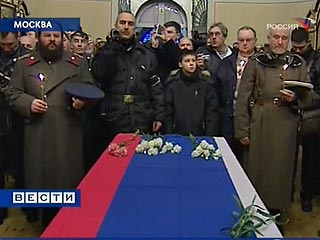
In Moscow, in the Donskoy Monastery today they say goodbye to General Vladimir Kappel, who died in 1920 in the ranks of the White Army. At the end of last year, his remains were discovered by the ruins of the Russian Church in the Chinese city of Harbin. The ceremony of their reburial is taking place today at the cemetery of the Don Monastery.
In the large cathedral of the monastery, the Patriarch Vicar, Bishop Egorievsky Mark, performed the Panichida. “The life of this person is instructive, with its boldness, severity, care for people,” the bishop noted. He recalled that "after the death of the general, his soldiers, saving the body from scolding, drove the coffin of the military leader for many thousands of kilometers to bury him in Harbin."
"The history of Russia of the twentieth century is replete with tragic events, division, hostility, fratricide. People understood in different ways what was the benefit of Russia. Some considered the Cappel to be the enemy of the people and the Fatherland, but time was allocated in their places - today representatives of officers, state power, and clergy gathered," the bishop said.
He noted, "that before his death, Kappel told his associates" not to forget about Russia. "
Along the path from the cathedral to the grave, soldiers of the company of honorary guard were built into a row. At the reburial ceremony, there are relatives of the general who came from Siberia and from the Urals. Vladimir Kappel is buried between the graves of Denikin and Ilyin.
General Kappel (1883-1920) went down in history as one of the brightest representatives of the white movement. He participated in the First World War and civil wars. Kappel caused respect even with his nobility towards prisoners and outstanding commercial qualities even among the enemy.
During the Siberian Ice campaign in January 1920, the general, as a result of the severe pneumonia of the lungs and frostbite of the legs that had to be amputated, died at the Utai.
The soldiers did not abandon the body of their commander and made the most severe passage through the Baikal, so that, with dignity, according to the Orthodox rite, to bury him in Chita. When they left the city, the remains of Kappel were transported to China and buried at the Holy Iveron Temple in Harbin. Later, the Russian Diaspora left the city, the temple came into desolation and the grave of the general was lost, reports ITAR-TASS.