
Translated material
Bush is preparing an appeal to the new Congress of the United States. New horse - "energy dependence"
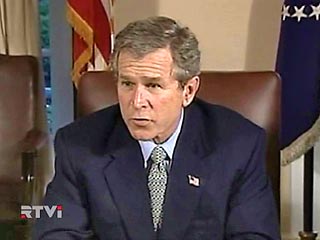
American President George Bush will perform on Tuesday with a traditional appeal to Congress of the country. According to observers, this year a particularly difficult task is faced with Bush: for the first time during the years of his presidency, Congress was controlled by Republicans, and democrats.
The media in America is building forecasts regarding how Bush and Congress’s relations will unfold. The active actions of the Democrats against the presidential administration in essence have already begun - the other day, bills have been introduced in both wards on countering the Iraqi course .
But, as Bloomberg writes, even the Republicans who could not forgive the president of his loss in the elections in November were disappointed in Bush's policy. Some of them in the first hundred hours of work of the new congress voted in support of the bills put forward by the Democrats.
American observers conclude that any proposal of Bush, in particular, on tax reduction (this reduction began to implement the "republican" Congress), may encounter "bipartisan" resistance.
Bush’s new speech will be the seventh in a row since he became the president. But only for the first time it will be called to "pave the path of cooperation with the Democrats and Republicans," said the representative of the White House. According to the official, the US president will affect a number of problems, including, of course, the war in Iraq, independence in energy, healthcare, immigration and education.
At least in two of these topics - immigration and Iraq - Bush will meet the opposition even in the person of his one -party members. In any case, some Republicans have already stated that they are on the side of the Democrats on the issue of obtaining citizenship for illegal immigrants. Bush advocates the possibility of obtaining such citizenship, democrats - against.
However, Bush has already received the most significant opposition in the camp of one -party members, and on the Iraqi problem: his decision to send new troops to the country met a sharp disapproval of at least a dozen of the Republicans of the Senate.
Bloomberg notes that the last two appeals of Bush to Congress "On the Regulation in the Country" were also divided on some issues in the opinion of the Republicans.
The US Energy Project: For and Against
Obviously, in the president’s appeal, increased attention will be paid to energy policy, writes The Washington Post . The congress has many energy bills, and a repeated approval of the farm program can turn a package of agricultural subsidies into an energy policy to promote alternative fuel - ethanol.
The United States purchases 60% of oil consumed, and this is almost twice as much as two decades ago, the publication concludes. They receive this import mainly from countries whose governments are unstable, unpleasant or frankly hostile to the United States: 60% of global oil reserves are in the Middle East, 10% in Africa, 6% in Venezuela and 5% in Russia. The argument is reasonable that if the United States depended less on these regions, it would be more comfortable. (Full text on the website inopressa.ru .)
However, as an example, the publication draws the following picture: if the United States replaced the entire oil import of domestic production, the Venezuelan or Iranian embargo would still hit American drivers and industries consuming oil. The embargo would give rise to a global oil deficiency, and fuel prices would increase everywhere, including in the USA. Americans would pay these high prices to manufacturers in their country, and not abroad, but the significance of this difference is controversial. Some manufacturers in the United States belong to foreigners, and many production operations abroad to Americans.
Even in such a situation, energy independence will strengthen national security, military experts say. The country should be able to count on access to a sufficient amount of fuel in order to set in motion its military machine and key industries. But two fifth oils consumed in the United States, domestic production, and the country has a strategic oil reserve. In addition, a really terrible enemy is needed to prevent the United States from buying oil simultaneously in the Middle East, West Africa and Latin America. A true energy security is not based on energy independence, but on the variety of supplies.
Another regarding security argument in favor of energy independence is that, buying oil from radical Islamic regimes, the United States finance both sides in the fight against terrorism. But for Islamic radicals, it does not matter who buys their oil. The United States banned Iranian oil imports in 1979, but it is still sold at a high price in the world market. Indeed, achieving energy independence, the United States will either reduce its consumption or increase its prey by slightly changing the global balance and demand balance, possibly knocking down the price of oil and reducing Iran’s income. But even this result is not predetermined: Saudi Arabia can in response to get less so that prices remain stable.
It is not about the fact that the treatment of American oil dependence will not bring any benefits in the field of security, writes The Washington Post. In the long run, it may be moderately affect oil prices, and this will weaken the influence of such authoritarian oil states as Russia and Venezuela. But this distant and not guaranteed good should not be done by the main engine of energy policy. Bush and Congress should focus their energy policy on mitigating climate change, and in addition, accept possible conquests in the field of security as a pleasant side effect.