
Translated material
The third single election day has ended in Russia
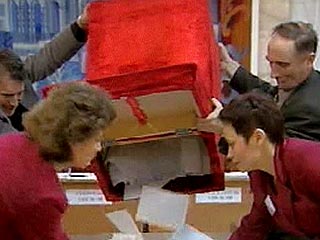
The third one in Russian history has ended. In the Moscow region - one of the four constituent entities of the Russian Federation, where the threshold of voter turnout was preserved, it amounted to more than 26 percent. The indicators in the Stavropol Territory and Dagestan are much higher. So, more than 60 percent of voters came to the polling stations of the republic, in the region this figure was about 40 percent.
Observers are also fixed by observers in the six north-west regions (St. Petersburg, Leningrad, Vologda, Murmansk, Pskov regions, the Komi Republic), where elections of different levels are also completed. According to a member of the CEC of Nikolai Konkin, the residents of the Pskov region and the Komi Republic were most active, where 38 and 36 percent of voters had already arrived at the sections by 18:00 Moscow time.
By the middle of the day, in four regions that did not cancel the threshold of turnout - Dagestan, the Moscow and Vologda regions, the Komi Republic, he was successfully overcome.
- Matvienko: We have not achieved completely pure elections - data on election violations - shooting in Buinaksk, "carousel" in Odintsovo
- "Yabloko" will experience a new method of struggle: voting "for all"
- In St. Petersburg, the head of the headquarters "Fair Russia" hit with a knife
- in Odintsovo at the polling station, Limonovites and journalists were detained
And the very first polling stations in Siberia were closed in Russia - in the Tomsk, Omsk, Tyumen regions. According to ITAR-TASS, here even more voters came to the election urns than during the previous elections, when the threshold of turnout was established.
In the elections to the Duma of the Tomsk Region, at 18:00 local time (15:00 Moscow time), 301 thousand voters voted, or 40 percent of all residents of the region entitled to voting, while in the previous elections to the regional Duma in 2001 there were only 37 percent at the same hour.
According to preliminary data, more than 20 percent of voters took part in the Omsk region in the elections, and in the Tyumen region, where deputies of the regional Duma were elected, according to preliminary data from the prostitute, this indicator amounted to about 43 percent of voters. The activity of the electorate was almost a third higher than in the previous elections of the regional Duma of 2003.
Exit-Polls show that the party in power is the leader
The United Russia party has a chance to gain about half the votes in the regional elections that have passed on Sunday, the voter surveys at the exit from the sections (Exit-Polls) conducted by the All-Russian Center for the Study of Public Opinion, RIA Novosti reports.
According to the VTsIOM survey, the pro -presidential "United Russia" can receive 62.4% of the votes in the elections to the regional legislative assembly of the Tyumen region, 55.5% in the Omsk region, 56.2% in the Tomsk region. In St. Petersburg, a party that controls the majority of places in the State Duma can count on 38.3%, in the Leningrad region - by 35.6%, in the Pskov region - by 52.7%, in the Komi Republic - by 45.3%, in the Vologda region - by 44.8%, in the Murmansk region - by 46.7%, in the Stavropol Territory - by 29.2%.
The second place in most regions is occupied by the Communist Party, which, according to polls, can apply for 11.1% in the Tyumen region, 25.3% in the Omsk region and 14.6% in the Tomsk region. In St. Petersburg, communists can receive 16.5%, 17.9% in the Leningrad Region, 20.3% in the Pskov region, 13.0% in the Komi Republic, 13.2% in the Vologda region, 18.0% in the Murmansk region, 14.8% in the Stavropol Territory.
The Fair Russia Party, headed by the speaker of the Federation Council, Sergei Mironov, who first participated in the elections as a combined political force of a social democratic orientation, can count on 10.3% in the Tyumen region, 4.1% in the Omsk region and 7.6% in the Tomsk region, 22.6% in St. Petersburg, 20.4% in the Leningrad Region, 14.8% in the Leningrad Region, in the Leningrad Region, in the Leningrad region. Pskov region, 14.3% - in the Komi Republic, 21.9% in the Vologda region, 18.1% in the Murmansk region, 40.2% in the Stavropol Territory.
The LDPR claims to be 14.6% in the Tyumen region, 5.3% in the Omsk region, 10.7% in the Tomsk region, 10.4% in St. Petersburg, 12.3% in the Leningrad Region, 8.06% in the Pskov region, 14.3% - in the Komi Republic, 10.9% in the Vologda region, 11.2% in the Murmansk region, 9.8% in the Murmansk region, in the Murmansk region. Stavropol Territory.
VTsIOM conducted a survey in 10 of 14 regions, where the elections of regional parliaments were held on Sunday.
Communist Party claims a large number of violations
The leader of the Communist Party believes that the elections held on Sunday to the legislative bodies of 14 constituent entities of the Russian Federation passed with the "maximum number of violations". “There were no such dirty elections as this time in Russia,” Gennady Zyuganov told reporters.
The Secretary of the Central Committee of the Communist Party of the Communist Party of the Communist Party of the Communist Party of the Communist Party of the Communist Party, Valery Razhkin, told about the violations. According to him, the main violations are associated with campaigning in polling stations and with fasclification of elections by stuffing.
He noted that, "the most gnawing elections today - in Dagestan." Members of the Communist Party also noted that there were violations associated with early voting. In Orel at home, according to them, more than 80% of voters voted.
"Previously, it was 4-5% of the strength. If it reached 20%, then this was considered a uniform outrage," Zyuganov said.
The Communists noted the low turnout of voters in the regions of the Russian Federation. According to Nikolai Vasiliev, the head of the Moscow branch of the Communist Party, this means that "our compatriots actually boycott the elections."
"Today, the people in the State Duma, the people declared a vote of no confidence today," Vasiliev announced today's course. Members of the Communist Party said they would deal with all the facts of violations.
“We are interested in the elections to be honest, and the calculation is objective,” Zyuganov concluded.