
Translated material
Matvienko: We did not achieve very clean elections
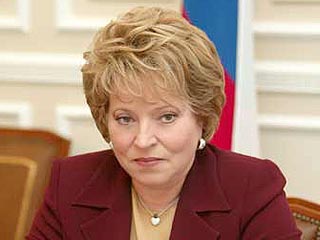
During the election campaign, the fourth convocation was not able to avoid unscrupulous competition in the Legislative Assembly of St. Petersburg, said the governor of the northern capital, Valentin Matvienko.
According to her, often the pre -election polemic turned into a "contest of empty, meaningless promises."
“It was not possible to achieve completely pure elections. I think that it will take time that we come to clean civilized elections,” said Matvienko to reporters, who voted at polling station No. 1771 of the Central District.
- Data on elections - shooting in Buinaksk, "carousel" in Odintsovo
- "Yabloko" will experience a new method of struggle: voting "for all"
- In St. Petersburg, the head of the headquarters "Fair Russia" hit with a knife
- in Odintsovo at the polling station, Limonovites and journalists were detained
The governor noted that, according to the parties themselves, there was a fairly calm atmosphere in St. Petersburg. “The authorities tried to create equal conditions for everyone,” Matvienko assured.
In total, about 3.6 million citizens who have the right to vote are registered in St. Petersburg. The threshold of turnout in the current elections is not provided, so they will be recognized as held, regardless of the number of voters voted.
The elections of deputies of the Legislative Assembly of the fourth convocation are held completely according to party lists, consisting of a citywide part of three people and the district for each of the 50 electoral districts, where one candidate can be nominated from each party participating in the elections. In total, six parties take part in the elections: United Russia, Fair Russia, the LDPR, the Union of Right Forces, the Communist Party and the Patriots of Russia.
Local parliaments choose in 14 regions
Regional parliaments are elected in Dagestan and Komi, Stavropol Territory, Vologda, Leningrad, Moscow, Murmansk, Omsk, Oryol, Pskov, Samara, Tomsk and Tyumen regions, as well as in St. Petersburg.
At the same time , a referendum was held to unite the Chita region and the Aginsky Buryat Autonomous Okrug . Representative bodies of local self -government in seven constituent entities of the Russian Federation are chosen, elections of chapters 87 of municipalities are also held. In total, the third voting day covers the elections of different levels of 70 constituent entities of the Russian Federation, during which more than 31 million Russian voters will be able to use their right, ITAR-TASS reports.
A feature of today's elections to regional parliaments was the absence of the column "against all" in ballots. In 10 of the 14 regions, the elections are held without the threshold of turnout. This norm is the last time in Dagestan and Komi (25 percent), Vologda and Moscow regions (20 percent).
One of the main innovations of regional elections was the fact that St. Petersburg, Moscow Region and Dagestan first elect the entire deputy corps on party lists. Thus, they turned out to be “ahead of the steam locomotive”: in the federal parliamentary elections, a proportional system will be applied only in December 2007.
In total, during the regional elections there is a struggle for 632 mandates: 402 - on party lists and 230 - in single -member districts. Most of the deputy places - 72 - in the People’s Assembly of the Republic of Dagestan. The smallest parliament is 30 deputies - the State Council of Komi.
They compete for places in the regional parliaments of 14 political parties. The Parliamentary Parties United Russia, the Communist Party and the LDPR, as well as the debutant of these elections "Fair Russia" registered their lists in all 14 regions where the legislative bodies will be elected.
"Patriots of Russia" are represented in 10 constituent entities of the Russian Federation, ATP-in 9, "Yabloko"-in 4. "People’s Volya" and the "Democratic Party of Russia" participate in elections in 3 regions, the agricultural party of Russia in 2. The Conceptual Party "Unity", the Russian Communist Labor Party, the Socialist Unified Party of Russia and the Russian Ecological Party "Green" master one region.
The number of party lists in ballots ranges from 5 - in the Stavropol Territory and the Vologda Oblast to 8 - in the Oryol region. The passage threshold is 7 percent. The average "competition" of single -magnanic - 5 people per place.
The scale and meaning that the parties of this election campaign give is also evidenced by its value. In total, the total election fund amounted to 1.5 billion rubles. In October last year, when the elections took place in 17 regions, the parties accumulated only 624 million rubles. And in the 2003 parliamentary elections, 1.6 billion rubles were received in party funds.
Traditionally, the largest election fund for United Russia is 600 million rubles. In second place - "Fair Russia" - 400 million rubles. The ATP - 214 million rubles, the LDPR and the Patriots of Russia raised 90 million rubles each, Yabloko - 36.5 million rubles, the Communist Party - 24 million rubles.
At the same time, revenues to party funds from non -governmental organizations were reduced to 2 percent. The most costly elections in St. Petersburg were: here the total party fund amounted to 530 million rubles. In the Moscow region, this indicator is 280 million rubles, the Stavropol Territory - 113 million rubles, the Samara region - 112. The most "economical" were elections in the Vologda region and Dagestan: 26 and 22 million rubles were received here, respectively.
The elections will become a landfill for the run into technical innovations. In addition to the already familiar set-in ballot processing complexes, which will be used in Dagestan, Leningrad, Samara and Oryol regions, in 5 sections of the eagle, the next test will undergo electronic-sensory voting complexes, which were first used in Veliky Novgorod in October 2006.
Voting on them takes place on the computer screen, without a paper ballot. And Russians will be able to control the voting course using a mobile portal. The information received in GAS "Elections" can be obtained on mobile phones.
In the Murmansk region, new technologies for the protection of ballots with the help of a self -adhesive brand will be tested. If these tests are successful, this form of protection can be applied in the federal elections, the head of the CEC of Russia promised. According to him, "it is much cheaper than existing and no less effective."
Working groups of the CEC of Russia will monitor the progress of voting in all 14 regions and at the Joint Referendum. It is expected that the preliminary results of a single voting day by the Central Election Commission will be voiced at noon on March 12.