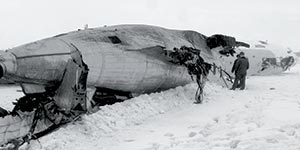
6 people became victims of the crash at the Samara airport "Kurumoch" aircraft Tu-134 of the Surgut Airline UTAIR. The main version is still the crew error. The same official explanation was given to many recent airlines. However, according to The New Times experts, the airlines themselves not only do not care about the preparation of their pilots, but, fearing financial losses, often force them to take fatal risk.
On board the Tu-134 aircraft flying with flight No. 471 Surgut-Samara-Belgorod, there were 50 passengers and seven crew members. During the disaster, six people were killed (four of them are women), more than 20 people were hospitalized (among them three children and eight women). Utair has promised the families of the dead at $ 75 thousand. Until now, the largest really paid compensations in Russia amounted to half a million rubles (about $ 20 thousand).
Prior to the completion of the official investigation, as usual, various possible causes of the plane crash are considered. This is the refusal of the chassis, and the malfunctions of the engine or the course-gallon system (which gives the crew about the position of the aircraft relative to the line of the landing course and its trajectory), and a strong fog, and the error of ground services. The totality of all factors was also allowed.
It should be noted that over the past five years, at least nine accidents, flight accidents and disasters with Tu-134 have been recorded in Russia, four of them with the Tu-134 of the UTAIR airline.
Why crews - are at risk -
However, after the initial decoding of these on -board recorders, the version of the technical malfunction of the aircraft disappeared. A preliminary analysis of the data showed that the aircraft engines were operational up to destruction. At the time of landing, the plane was in the landing configuration (the chassis was released, the flaps were released 30 degrees). There was no fire and destruction on board. Utair officially said that "the aircraft until the collision with the ground was technically working, complying with the norms of flight fitness, passed all the necessary forms of maintenance." True, the exact numbers are still not given. According to unofficial data, the Tu-134 crashed in Samara has long developed its resource and it previously had problems with the navigation system, and in 2006 it was this machine that made a rigid landing at the same Kurumoch airport. The Tu-134 does not comply with European standards, they are banned by regular flights to Europe from April 1, 2002.
As a result of the dominant, the version of the crew's guilt was the dominant. It should be noted that in recent years, the guilt for plane crashes has been imposed repeatedly. So it was, in particular, in the case of death near Donetsk Tu-154 “Pulkovo Airlines” on August 22, 2006 1 . Professional aviators, to whom the New Times addressed the comments, only partially agree with such a statement of the question. “Errors in landing are possible even in experienced pilots. Although it does not fit in my head, how to smear it like that, not reaching the strip as many as 400 meters. The norm is the landing after 300-350 meters after the start of the runway, a real shortage is about 700 meters. And evasion of the course: if it is within the plus or minus 30 meters-this is normal, but 150 meters-this is too much! It is not clear what the dispatcher was thinking then, seeing such a deviation? " -A pilot with 26 years of experience shared his opinion. He also remembered the disaster near Donetsk: “Who forced the pilot to go through a thunderstorm? He had a choice - to go to the spare airfield or return to Anapa, the fuel supply allowed to do this. However, the commander, not wanting, apparently, to write explanatory about the failure of the flight, decided to “jump over” the thunderstorm. Although it was almost at the limit of the ceiling of the car. The result is a flat corkscrew from which the Tu-154 is not excreted. ”
The Fear of Fear of Employers, The New Times experts call a very common occurrence. According to them, in many airlines, penalties are practiced, primarily for the overspending of fuel: “This is a very common practice, because the pilots are clinging, limiting themselves in maneuver, trying to save at all costs. They try to avoid leaving the spare airfield from the nose, and be sure to land from the first call. By the way, this is not always a fine. It happens that they are refueling so much fuel that it may not be enough on the second round. ”
"Fuel? There is such a problem. The final word is formally here behind the commander of the ship, but in reality everything is determined by the policy of a particular company, ”Miroslav Boychuk, the president of the trade union of the flight personnel of Russia, agrees. In his opinion, one cannot blame pilots. The head of the civil aviation, the head of the trade union sees the main reasons for the problems of civil aviation that the state has practically itself from the regulation of this sphere: “The emphasis was made on control functions, and the functions of the organization of flight work were missed. The state bodies have fully evaluated this key issue by the airlines themselves. But commercial motivation prevails there, because when the question arises of choosing between flights of flights and commerce, the choice is made in favor of the latter. ”
Almost a key problem directly affecting flight safety, all Aviators - The New Times sources consider the issue of social security of pilots. According to their statements, not in any developed country, it is not as bad as in Russia. The fact is that in most Russian airlines the flight staff is paid for the fed watches. A fixed, guaranteed salary is a meager share of the total income - 10-15% 2 . Therefore, if the crew is on the ground for a long time, for example, according to weather conditions or due to repair of cars that it will not earn worthy of money. Therefore, the pilots try to make the right plaque at all costs, very often - to the detriment of safety. The flip side of the coin is a wild processing of pilots of Russian airlines. The situation when the pilot from one flight, practically without rest, goes to the next one, does not surprise anyone. In the holiday season, this becomes almost widespread practice. No one can predict how confidently the aircraft will control the plane with a continuous work. At the same time, we note that, even having a much larger raid, the Russian pilot receives at least half as much as Western European.
Another problem is a huge fluid of flight personnel with a general Russian trend in their steady reduction. About 400 pilots are leaving annually from flight work, while 200-220 pilots are replaced per year. The shortage of personnel is also supplemented by their outflow abroad. As Miroslav Boychuk notes, “the transition of Russian airlines to foreign equipment sharply increased the competitiveness of our pilots in the international labor market; Therefore, in particular, the outflow of the most qualified pilots with good knowledge of the English language in the company of Southeast Asia is observed. ” About 100 pilots go there annually. “When our pilots will earn $ 8-10 thousand a month, then there will be no outflow of personnel. And now the average earnings of the Russian pilot are 42 thousand rubles. Is it serious? " - The president of the flight union asks the rhetorical question.
One of the safest airlines in the world is Finnair - not a single catastrophe over the past 34 years, not a single deceased. The secret is simple. Miroslav Boychuk explained: “There is a fundamentally different attitude towards pilots and the organization of flight work. Finnish pilots have no need to process, violate flight safety rules in order to earn on a piece of bread. They have guaranteed wages: they do not pay for plaque, but for working hours. Pensions - 55% of the average salary. Again, insurance in case of loss of flight license for medical indicators - from 100 to 300 thousand euros. The company gives its pilots for three years to interest loans for the purchase of a car. I'm not talking about medical insurance and other social benefits that the state provides. Finnair does not have a personnel. Another aspect: the state there retained in its hands a school of training pilots. It also holds the retraining center in its hands. In general, commerce there can not prevail over flight safety issues, and the social security of pilots is on top - that’s the result. ”
...
Who belongs to Utair
75.64% of UTAIR shares are in the nominal holding of the Central Surgut Depository. The real owner of the papers is considered structures close to the Surgutneftegaz oil company, whose representatives were included in the UTAIR board. However, Surgutneftegaz denies any attitude to the airline. In August 2004, the airline replaced the register of Surgutinvestneft CJSC, which is also maintained by the Surgutneftegaz register. In December 2004, representatives of Surgutneftegaz OJSC were introduced into the supervisory board of the airline.
...
According to the Center for the strength of the ANTK named after Tupoleva, with the design resource of the Tu-134 in 25 thousand flight hours, or 15 thousand flights, or 15 years of operation, some aircraft today have already developed over 40 thousand flight hours, 25 thousand flights and 27 calendar years. It is planned to bring the resource to 45 thousand flight hours, 28 thousand flights and 30 calendar years.
...
Tu-134 pilot
The commander of the ship is Oleg Zubkov, born in 1954. The total raid-more than 11 thousand hours, on the Tu-134-about 1900 hours, as the commander-740 hours. By the standards of civil aviation, the pilot fully masters the aircraft model after 3 thousand hours of plaque. “For the commander of the ship, such an aircraft as the Tu-134, 1900 hours of raid is clearly not enough,” say The New Times experts.
____________________
1 In a plane crash, then 170 people were killed. 2 In the West, this figure is 70 - 80%.