
Translated material
In Brussels between the Turks and the Kurds there was a collision, quickly dispersed by the police
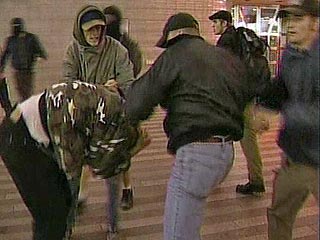
Last weekend in the capital of Belgium, not far from the buildings of the NATO and the EU headquarters, there were mass clashes between representatives of the Kurdish and Turkish communities, the reason for which was a fire in the building, which was located as the center of the Kurdish community.
The fire occurred on the night of Saturday to Sunday. None of the inhabitants of the apartments located above the cafe were injured, but the first floor was completely burned out. Among the gathered near the Kurds cafe was a rumor that the cafe was set on fire at night teenagers. Among Kurdish youth, replicas of the type "All Turks - Nazis" sounded. Traders of Turkish shops on the neighboring streets were worried, and there began to gather young people under the red with a crescent Flag of Turkey. The Kurds pulled out the flags of the Kurdistan working party and the portraits of their leader Abdullah Ojalan, who was serving a lifelong opinion in Turkey, the newspaper New Izvestia writes.
About a hundred police officers stood between the crowds of Turks and the Kurds, trying to calm them with persuasion from the speakers. When the stones flew and a policeman vodomet appeared on the street, stones and bottles flew already in the police. The police quickly arrested the most active participants in the riots. According to law enforcement agencies, about 250 people, mainly young people, took part in the clashes. The representative of the police press service Johan Vereleyen told Reuters that seven participants in the riots were detained.
According to the same police representative, clashes began not with a fire, but with an attack by Turkish adolescents on a small group of Kurdish youth. The police tried to separate the fighters, after which she attacked both warring parties. The attackers threw policemen with metal rods and bottles. Actually, as a result of the riots, the building of the center of the Kurdish community was set fire to.
As the New News write, the dispersed Turks threatened that 30 thousand people would lead by the evening. Among the Turkish diaspora there was a rumor that "a whole bus with Kurdish militants left Germany." However, neither one nor the other happened.
The newspaper notes that the area in which the collision occurred is the commune of Saint -Zhoz - the poorest in the capital and the most motley in an ethnic sense. In it, people of 152 nationalities live sideways, several national cultural centers are located, including the Russian Center for Science and Culture. Although the clashes are infrequent there, the district police are well prepared, since the European Commission, the EU Council and the office of the Prime Minister of Belgium are nearby. There are usually columns of European and Belgian workers at the call of trade unions, who are far from always peacefully defending their rights.
Immigration to Europe does not save the Turks and Kurds from mutual hostility, writes the Russian Newspaper . In the case of Brussels, the situation is aggravated by the fact that both immigrant communities live in close proximity to each other. But so far interethnic conflicts taking place in the homeland of migrants have not spilled out onto the streets of European cities.
Now the European authorities will have to not only convince part of their population to accept unified European norms and rules of behavior, but also to smooth out the contradictions between the opposing immigrant communities, the newspaper notes.
In Belgium, according to various sources, from 150 to 200 thousand immigrants from Turkey live, which include both ethnic Turks and representatives of the Kurdish minority. Moreover, the latter have repeatedly demonstrated their ability to carry out well -planned and organized public actions. So, in April 2006, in the center of Brussels, on their initiative, an anti -Turkish manifestation was held, during which the audience demanded the recognition of the independence of Kurdistan and the liberation of the leader of the Kurdish labor party Abdullah Ojalan.
Recall that in Turkey, according to various sources, lives from 12 to 15 million Kurds. In the places of their compact residence, and this is mainly the southeastern provinces of the country, for several decades, the struggle of Kurdish separatists and the Turkish army has not been subsided. For all the time of this conflict, according to approximate estimates, about 30 thousand people died.