
Translated material
The US President legitimized the program of assistance to Ukraine and Georgia to join NATO
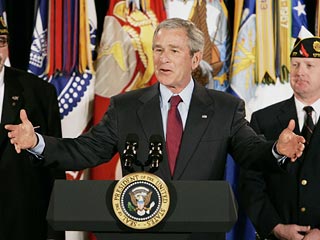
The US President launched a program to assist Ukraine and Georgia to join NATO. Previously signed by George Bush, the law was already approved by the American congressmen . The bill provides for the stimulation (including financial) further expansion of the North Atlantic Alliance ( NATO ) and the promotion of the timely reception of new members to this organization - Georgia, Ukraine, Albania, Croatia, and Macedonia.
"The 2007 Act on the consolidation of freedom in NATO confirms the support of NATO ongoing expansion, allows Albania, Croatia, Georgia, Macedonia and Ukraine to receive assistance under the 1994 Law on NATO Participation, and also allocates certain allocations for military assistance to these countries," RIA Novosti quoted with reference to reference to The press service of the White House.
According to the presidential administration, Bush put his signature under this bill on Monday, April 9 - after that the law entered into force.
- The reaction of Moscow: "does not contribute to normalization"
- prospects for expanding NATO
- North Atlantic Alliance: Help
And although the point of view of the American Congress and the President does not formally have a binding nature for NATO members, and the final decision on taking new members is made by consensus, the United States traditionally occupy a leading position in the alliance. At least this means that the other NATO participating countries will listen to the opinion of Congress, especially since the bill became the fruit of the coordinated position of the Democrats and Republicans.
"The US Congress calls for allies in NATO to work with the United States to implement the role that NATO plays in promoting global security, including continuing support for expanding and receiving the alliance of worthy states, especially by joining Georgia to the NATO membership plan, as well as through recognition of progress in the promotion of Albania, Croatia, Macedonia and Ukraine to fulfill the requirements and Ukraine to fulfill the requirements and Ukraine to fulfill the requirements and Ukraine to fulfill requirements and Ukraine obligations on membership in NATO, ”the text of the approved document notes.
The Law also refers to the decision to include these countries in the American “Security Assistance” program as part of preparation for joining the North Atlantic Alliance, for which “funds that will be necessary to provide assistance are provided from the US federal budget.”
According to the certificate prepared on March 9, 2007 by the US Congress by the US federal budget for the assistance of Albania, Croatia, Georgia, Macedonia and Ukraine, for joining NATO, in 2008, a total of $ 12 million will be in 2008. For the period from 2008 to 2012, management predicts expenses for these purposes in the amount of 30 million.
The reaction of Moscow
Kremlin diplomacy has already responded to Washington’s decision. The Ministry of Foreign Affairs (Foreign Ministry) of the Russian Federation (RF) states that the signing by US President George Bush adopted by the American Congress of the Law on supporting Ukraine’s entry into NATO does not contribute to normalizing the domestic political situation in Ukraine.
“Such actions clearly do not contribute to the normalization of the domestic political situation in Ukraine, taking into account the fact that the question of joining NATO was included in the list of those disagreements that served as one of the reasons for the current political crisis in the country,” Interfax quotes the official representative of the Russian Foreign Ministry, Mikhail Kaminin.
The prospects of NATO expansion
The question of admission to NATO Croatia is almost agreed. The integration of Albania and Macedonia also looks like a matter of time - perhaps longer.
It is more difficult to see the possibility of soon joining NATO Georgia and Ukraine. And the point is not only that historically established connections determine the gravity of these countries to Russia, which has already expressed sharp dissatisfaction with such an expression of American politics.
More important is the fact that Georgia did not solve its internal problems (the central government does not control the entire territory of the country), although the country has very high support for integration in NATO - according to Baltic Survey and the Gallup Institute, 83% of the country's residents advocate the alliance.
In Ukraine, the situation is exactly the opposite - there are no territorial problems, but only about 20% of citizens, according to the public opinion fund, supports the idea of joining the alliance. Moreover, if Mikhail Saakashvili is simply eager for NATO, then Viktor Yanukovych states that his country is not ready for integration in the near future. And the current conflict in Ukraine makes European integration of this country even more problematic than before.
Nevertheless, apparently the American leadership seriously counts on the possibility of such integration. Last February, the head of the NATO assessment mission, Frank Bland, visited Georgia, praised her leadership for serious successes in fulfilling the individual partnership with the Alliance and noted that the prospects of integration will depend on the results of reforms (therefore, not on the settlement of Abkhazian and South-Ossetian problems).
The situation with Ukraine looks more complicated - public opinion is indeed an important argument of "against." But this is a variable factor: at one time, the population of the Czech Republic and Slovakia also looked at the prospect of entering the alliance skeptically.
It should be noted that, according to the Public Opinion of the Foundation, half of the Ukrainians would like their country to enter the European Union. The information campaign aimed at the conviction of public opinion that NATO membership is part of European integration can significantly increase the number of supporters of Atlantic integration.
Thus, the American bill confirms that the issue of taking Georgia and Ukraine to NATO transferred from the category of hypotheses to the sphere of real policy. Which, in turn, will inevitably cause a tough response of Russia, even more complicating it by an already difficult relationship with the West.