
Translated material
Benedict XVI is 80 years old
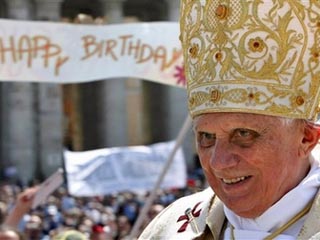
Today, Pope Benedict XVI -265th Bishop Rome celebrates his 80th anniversary today. The festive service was made on the eve of a pontiff on the steps of St. Peter's Cathedral in the presence of the cardinals, priests and tens of thousands of believers, Interfax reports.
Joseph Ratzinger is the oldest cardinal who became a dad (after Clement XII, who was also 78 years old at the time of election). In addition, J. Ratzinger is the first German pontiff after Pope Victor II, who headed the Roman Catholic Church in 1055-1057.
Joseph Ratzinger was born on April 6, 1927 in the village of Marctl-Am-Inn in Bavaria, in a family of a policeman. At the age of two, his family moved to the Austrian border, and in 1932 - to the Alpine town of Aushau. Ratzinger's father, who was negative about National Socialism, gave his son to a classic gymnasium in Transstein in 1937
For some time, Joseph was a member of the youthful fascist organization Hitler Youth. In 1941, his brother joined this organization, and Joseph, who studied at the seminary, was forced to act in a similar way. He himself previously said that he soon stopped attending the meetings of this organization, although such a decision was not easy for him: he was deprived of significant benefits when paying for his training.
In 1939, the future cardinal became a student of the pre -Seminarium, thereby starting a church career. During the war, young Joseph was a member of the youth units of air defense, at the same time attending classes at the Maximilian Gymnasium in Munich. Having reached conscription in 1944, he was called up to the Austrian legion. Ratzinger himself spoke about this time with disgust as a "ideological drill." In November 1944, he was drafted into the army as an infantryman and was aimed at training, but due to health problems, the newlywed almost did not participate in military training classes.
In 1945, deserting from the Wehrmacht in the approach of the Allied army, the future cardinal returns home to Transtin. When American troops were stationed in his native village, their headquarters is located in the house of the Ratzinger. In Joseph, a German soldier was solved, arrested and placed in a prisoner of war camp. But already in June, Ratzinger returns home, and in November enters the seminary again. In 1947, Ratzinger entered Georgianum, the Theological Institute at the University of Munich. On June 29, on the day of the holiday of Peter and Paul, 1951, Joseph Ratzinger and his brother Georg were ordained in priests Cardinal Faulhaber in Freysing.
In 1953, Ratzinger defended his thesis in theology at the University of Munich. The theme of his work is "the people and the house of God in Ecclesiology of Augustine." He devotes a doctoral dissertation to the history of holy bonanventure. In 1972, Joseph Ratzinger, together with G.U. von Balthazar, Henri de Lyubak and others founded the theological Catholic magazine "Communio" ("Communion"), dedicated to issues of theology and culture.
On March 24, 1977, Ratzinger was delivered by the Archbishop of Munich and Freusing, despite his reluctance. On June 27 of the same year, Pope Pavel VI elevated him to Cardinal dignity. In 1980, Pope John Paul II appoints Cardinal Ratzinger by the head of the special council for laity, and then offers him the post of head of the Catholic education. This appointment required leaving the Munich department and moving to the Vatican. Initially, Ratzinger rejects the proposal of the pope, but on November 25, 1981, he decides to become a prefect of the Congregation on the Affairs of the Doctrine - the ideological department of the Vatican, which inherited from the Holy Inquisition some functions and tasks to protect the church doctrine. Then he refuses pastoral duties in Germany and moves to the Vatican. Here he becomes a regular participant in the bishopric synodes, and in 1993 he accepts the title of Bishop of the Roman suburbs of Velletry-Senya.
In 2000, Ratzinger became the dean of the collegium of the cardinals, and his title began to sound as "Bishop of Ostia and Velletri-Senya."
Ratzinger's pen belongs to numerous works, such as “End of time?”, “Truth and religious”, “God near us”, “called for communion”, “God and the world” and others. In theological discussions, Cardinal Ratzinger occupies conservative positions, he acted as the chief adviser to theological issues of Pope John Paul II. Cardinal Ratzinger is a member of the EcClesia Dei commission and actually the main theologian in the Vatican. His position on a number of issues became the official position of the Vatican. So, for example, he acted in defense of the value of life and the inadmissibility of abortion, spoke out on a number of other theological issues.
In 1986, he severely condemned homosexuality and same -sex marriages. In 2004, he branded the "radical feminism" as an ideology that undermines the foundations of the family and the distinction of the Difference between a man and a woman. Ratzinger sharply opens against divorces, marriages of homosexuals, cloning.
Interestingly, in an interview with the German newspaper Die Welt, Ratzinger first suggested that the Black African Cardinal could be elected the next head of the Roman Catholic Church. He also said that, being retired, he wants to write a big theological work on Jesus Christ.
Shortly before his election, the head of the Vatican in Germany was published by Ratzinger's book, in which he spoke about his vision of the future Catholicism . It follows that Ratzinger offers a conservative path of development of the Church and the “rejection to the origins”. The pontiff, in particular, is dissatisfied with the so -called "multiculturalism" - a mixture of different cultures, which is now observed in different countries of Europe.
In a review of the book of J. Ratzinger, the newspaper Suddeutsche Zeitung writes that Cardinal considers European Christianity a salvation for civilization on the continent.
In an interview with the Italian newspaper Repubblica, Ratzinger did not take himself either to optimists or pessimists. “I,” he said, “a realist, convinced of the inner power of faith. I am convinced of this more and more, as Catholicism is becoming more“ Catholic ”, that is, universal. While other continents open their own way to be Christians and Catholics, Europe, the cradle and support of Catholicism, loses its Christian spirit. For the Church of Rome, this is a decisive challenge.
The culture that has spread in Europe absolutely and radically contradicts not only Christianity, but also the religious and moral traditions of all mankind. ”
This is only a small fraction of what is written and proclaimed by Ratzinger, the author of several books and numerous documents of the congregation. His composition "Introduction to Christianity" became the world bestseller.
Ratzinger is also called "Voithilan", that is, the successor of the thoughts and the acts of Pope Voitla - John Paul II. Their views on theology and ethics differ little. In the opinion of the Vatican experts expressed before the election of Ratzinger, he is "a more firm publication than the just left pontiff."
He does not have the charisma of John Paul II. But his mind, logic, breadth of views are supported by truly German perseverance, performance, punctuality and pedantry.
At the same time, according to observers, Benedict XVI is the dad of the "transition period". Such pontifications, as a rule, are short -lived and the great achievements and changes do not claim.
For the other place, due to his sharp and irreconcilable position in relation to the liberal part of the Catholic Church, Ratzinger received among the German Catholics the nickname Panzerkardinal (Cardinal-Bronite).