
Translated material
Sarkozy is returning to France to the management of the country and manifestations
The new manifestation of protest against the election of the president of France by the representative of the right -wing forces Nicolas Sarkozy was held in Paris on Thursday night, Interfax reports. It was not accompanied by acts of violence and vandalism, like the previous ones .
About 300 people, mainly students of extreme left -wing views, walked along the streets of the Latin quarter of the French capital. At the same time, a group of students of the Paris Sorbonne decided to occupy one of the premises of this university in protest against the election of Sarcosi. They object to his plan for reforming higher educational institutions of France, which he stated during the election campaign.
Students of students are expected on Thursday at another Paris University and at the University of Toulouse.
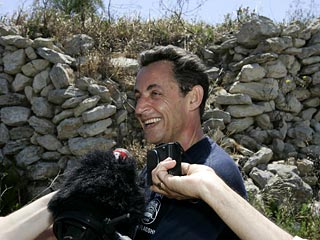
Sarkozy himself returned to France on Thursday night after two and a half days of rest on a private yacht off the coast of Malta. He was delivered to Paris by his friend, large entrepreneur Vincent Bollora (13th personal condition in France), who invited the elected president.
As Kommersant notes, going to the Mediterranean the day after the victory in the Sunday of the presidential election on Sunday, Nicolas Sarkozy hoped not only to take a breath after the election race, but also to cool the ardor of his opponents, giving them the opportunity to faster to reconcile with his victory. He himself diplomatically explained his departure to Malta by the desire to get away from the situation of dual power, inevitable, while the Champs Elysee occupies Jacques Shirak. Sarkozy officially takes office on May 16.
As it turned out, the rental of a 60-meter Paloma yacht, designed to travel 12 passengers, costs 200 thousand euros per week in the midst of the season. “This sends a murderous signal to the country, especially 53% of its citizens who earn less than 800 euros per week and who voted for it,” commented the cruise of Nicolas Sarkozy by the former adviser to his rival in the elections of the socialist Ruyal Patrick Mensucci. Meanwhile, the French press fell on a new president with ulcerative comments, which stated that Sarkozy will become the first president in the history of France, for which American values - money - money is the highest measure of success. The fact that Sarkozy was initially planned to spend a vacation at home, on Corsica, did not slip away from the attention of the media, but in the end he preferred "alien shores". This was regarded as the lack of patriotism.
Thus, the absence of Nicolas Sarkozy only exacerbated the situation - the riots flashed on an elected night in Paris continued. According to Kommersant, the pogroms took place according to the scenario familiar in the fall of 2005: groups of young people with a number of 150 to 600 people armed with stones and bottles with incendiary mixture, moved around the city, either appearing on the area of the Bastille or in poor suburbs inhabited by immigrants from the Middle East. Crowing out "Sarc - Fascist!", They turned and set fire to cars, smashed the shop windows and entered into clashes with the police, which in some cases had to use tear gas. Similar shares were held in Lyon - the second largest city in the country, as well as Toulouse, Nante, Renna and Kane.
On Thursday, new data was published on damage caused by stormy manifestations. The police found that during these protests, 1.4 thousand cars were burned.
The French courts began to consider the case of persons detained by the police during these riots. In Paris, Bordeaux, Toulouse and other cities, sentences were sentenced to fines, public work, and several people - to prison imprisonment for a period of a month to four. Some defendants are released, the list of a number of cases was postponed to a later date.
According to observers, recent events showed that, despite the victory of Nicolas Sarkozy in the elections, a significant part of the French still does not actively accept the radical market reforms and his strict policy in the field of immigration. The first serious test for the new president will be the elections to the National Assembly in June: in case of failure of the right and their inability to form the ruling coalition, the new president may lose the support of the parliament, which is of key importance for the success of the transformations he intended, the newspaper concludes.