
Translated material
The US Congress Committee blocked the allocation of money for missile defense missiles in Poland
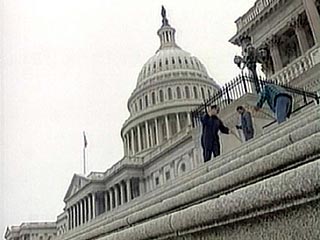
The US Armed Forces Committee of the U.S. Nizhny Chamber approved the country's military budget for the future financial year on Wednesday evening, while deciding to postpone $ 160 million to post elements of the missile defense system on the territory of Poland. These funds were requested by the administration of George Bush for the construction of mines and the placement of 10 anti -tanks in them. At the same time, the committee members agreed with the administration’s request to create a radar station in the Czech Republic, reports ITAR-TASS.
The military budget approved by the Committee will be sent to the House of Congress representatives in full force.
- Russia welcomes the decision of the Congress and the concern of the Czech Republic
- USA: Discussions move in a positive direction
-Poland: The issue of about the bilateral Polish-American and Czech-American relations is resolved
The entire project for creating a Pro in Europe system is estimated at $ 310 million. Having blocked the means for the placement of anti -thresholds in Poland in the upcoming budget, the Armed Forces Committee, nevertheless, left the opportunity for the US administration to return to this issue and request them in 2008.
The congressmen cut out the financing of not only the European part of the pro. In general, from $ 8.9 million dollars, $ 764 million were excluded from the $ 8.9 billion agency requested by the White House for financing the pro -missile defense agencies. In particular, the reductions affected the programs for creating an air-based laser, as well as space tracking and exploration programs and creating a multi-charged interceptor missile. At the same time, American lawmakers decided to finance the cost of continuing the deployment of ground -based OP ground elements in the United States.
Russia welcomes the decision of the Congress and the concern of the Czech Republic
In Russia, it is believed that in the decision of the Congress there is and their merit is transmitted by "Echo of Moscow" . "The decision of the Committee on Affairs of the Armed Forces of the House of Representatives of the US Congress Congress to block the allocation of funds for the placement of elements in the PO to some extent and Russian merit," said Anatoly Tsyganok, head of the Center for Military Forecasting.
According to the deputy of the State Duma, ex-secretary of the Russian Security Council Andrei Kokoshin, the decision made by Congress to reduce financing the program about "very symptomatic and seriously." According to him, "voting showed that in the House of Representatives, after the US Congress of the US Congress held last year, people appeared who more seriously related to the problems of strategic stability, the Russian-American relations in this area and are ready to listen to the voice of the mind to a greater extent, sober assessments of what is happening in this area."
Kokoshin noted that a number of American scientists and experts are also seriously concerned about the problems of the development of missile defense that has been in the United States over the past years.
The Vice Speaker of the State Duma from United Russia Vladimir Pekhtin, commenting on the first round of Czech-American negotiations that begins on Thursday in Prague regarding the plans for accommodation about the United States in the Czech Republic, noted the statement of his Czech colleague that the arguments in favor of the deployment of elements of American PRO in Europe are not convincing. At the same time, Pekhtin recalled that according to sociological studies, about 70% of the Czech citizens are opposed to the placement of PROs in this country, and almost 80% are expressed for the mandatory holding of a nationwide referendum on this issue.
USA: Discussions move in a positive direction
For his part, the US Department of Minister for Political Affairs, Nicholas Berns, believes that discussions on the issue of placing American Pro in Europe "evolve in a positive direction." In an interview with the Le Monde newspaper, he noted that at a meeting of NATO foreign ministers, a single position was recorded on the issue of missile defense and alleged installations in Poland and the Czech Republic (full text on the Inopressa.ru website).
“The Russian side did not understand and incorrectly interpreted our proposal. It is absolutely impossible that ten interceptors that we want to install in Poland can have offensive goals. This is a defense program against a ballistic threat, mainly from Iran. It is still unknown whether this threat will be implemented or not, but we must provide ourselves with protection,” Burns said.
He stated that Russia is not right, expressing concern about the placement of American military bases near its very borders, since "this is not a base in the full sense of the word." Berns admitted that the bases existed in Bulgaria and Romania, "but we have already stopped their activity on an ongoing basis." “We already promised Moscow that we would not place combat weapons or powerful nuclear missiles there, and we are fulfilling this promise. The Russian side is known,” the USA deputy commander said.
He also expressed the hope that disagreements on issues of about do not prevent Russia from effectively working in the coalition of countries involved in solving the Iranian problem. Berns noted that Russia is interested in preventing nuclear missiles to prevent Iran. He also recalled that Russia pledged to adopt a third resolution (according to sanctions), if Iran does not fulfill its obligations, within the framework of the UN resolution.
Poland: The issue of about the bilateral Polish-American and Czech-American relations is resolved
The Minister of Defense of Poland, Alexander Shchiglo, in an interview with the newspaper New Izvestia, stated that the painful assessments of the Russian leadership of the placement of elements of American Pro in Poland and the Czech Republic, "certainly exaggerated." In his opinion, the tension around this issue is intentionally pumped in the light of the approaching parliamentary and presidential elections.
He noted that such a reaction of Moscow is all the more amazing that Russia itself has been working on creating its own PRO for many years.
The head of the Polish Ministry of Defense also rejected the danger of anti -throat in Poland for Russia. “How can ten interceptor missiles, devoid of warheads and knocking down the goal by the power of kinetic energy, can threaten the Russian nuclear arsenal?”, The minister was surprised.
At the same time, he noted that this defense system is aimed at reflecting a possible threat from precisely those countries that Russia can have a serious influence on. “Russia is quite capable of convincing the Iranian leadership that you should not get nuclear weapons,” said Shuglot.
He also did not agree that the placement of American Pro in Poland is a pan -European issue that should be agreed with the participation of Russia. The Minister of Defense noted that each European state has a sovereign right to take care of its own security and Poland is no exception. "It is no secret that many in Russia are still not able to realize that Poland is an independent sovereign country, a member of NATO and the European Union," said Shuglot.
He also noted that it is inappropriate to talk about the development of consensus with NATO, since this issue is resolved in the framework of bilateral Polish-American and Czech-American relations. “Be that as it may, we will make a decision on this issue, not the North Atlantic Alliance,” the Polish Minister of Defense emphasized.
He admitted that the problem of placement of anti -tanks in Poland is not easy. “We must take into account many aspects, including the technical order. For example, what will be the probable trajectory of the fall of a downed enemy missile, how to prevent the danger of radioactive pollution, and so on,” the minister said.
Recall that the decision to reduce the costs of placing the American PRO in Europe made the Congress committee last week . As the main reason for the refusal of financing, the chairman of the subcommittee on strategic forces Ellen Tausher (Democrat from California) called that the United States could not clearly prove to Russia that this system was not directed against it. She also said that Washington could not dispel fears about even his NATO allies.