
Translated material
Soviet dissident Vladimir Bukovsky agree to run for the presidency of Russia
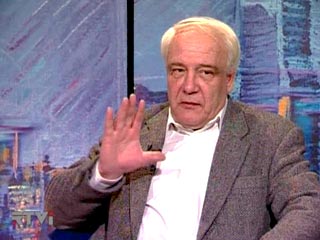
The initiative group of nine people proposed to be nominated as a presidential candidate in 2008 of the famous Soviet dissident and former political prisoner Vladimir Bukovsky, expelled from the USSR in 1976 and now living in England, but having Russian citizenship, reports Prima-News .
The group’s statement says that the task of the opposition is to disrupt the “elections without choice” and “turn a meaningless farce into a democratic procedure”. For this, according to the group, the opposition needs a “strong, uncompromising, decisive, with impeccable political and, which is more important - moral authority. Famous and respected in society. Not related to any parties and groups. A honest program of democratic, legal and social reforms can offer the country. We need a candidate who can support all the democratic voters of Russia.”
It should be noted that Article 81 of the Constitution of the Russian Federation states that "a citizen of the Russian Federation at least 35 years old, permanently residing in the Russian Federation for at least 10 years," can be elected by the President of the Russian Federation. " The article does not noted whether it is necessary to live in the Russian Federation directly before the elections for 10 years or even throughout life. In the latter case, Bukovsky passes according to this condition.
Recall that in Eastern Europe, after the collapse of the Bloc of the Warsaw Treaty, in many countries, former dissidents, persecuted by communist regimes, became the presidents in many countries. In Poland, then the leader of the “solidarity” of Lech Valens, in the Czech Republic, was repeatedly sitting in prison, the playwright and public figure Vaclav Gavel, the current president of Serbia Boris Tadic also has a dissident past.
- Bukovsky - the history of confrontation with totalitarianism
- Bukovsky: Litvinenko was killed because of the ghost of the "Orange Revolution"
- Who else agrees to replace Putin at the presidential post
The initiative group included a journalist, historian, member of the ATP party Vladimir Kara-Murza, political scientist and writer Andrei Piontkovsky, columnist for Novaya Gazeta, editor-in-chief of the Prima-NEWS news agency Alexander Podrabinek, chairman of the Central Council of the Democratic Movement of the Dobrookotov Democratic Movement, journalist, historian, editor of the Resistance Book series Philip Dzyadko, the book of the book, Dyan Historian, head of the Internet library Antimpromat Vladimir Poblovsky, Academician of the Russian Academy of Sciences, President of the International Engineering Institute Yuri Ryzhov, civil activist, curator of museum projects Yuri Samodurov and secretary of the Russian Radicals Nikolai Khramov.
“The writer, a scientist, a defender of human rights. With all his life, he proved that freedom and civil dignity can be defended even in hopeless conditions. Fighted against lies and dictatorships and paid for his struggle - and for the freedom of his country - for years of camps and prisons. Never compromised with conscience,” the initiative group of Vladimir Bukovsky characterizes.
Vladimir Bukovsky himself said that “political prisoners again appeared, that for Russia, with its history, it is equivalent to symptoms of mortal illness. Astmatik Mikhail Trepashkin is suffocating in his cell; a number of scientists were convicted, whose entire fault consisted with their contacts with Western colleagues; rebellious businessmen were sent to hard labor; for the sake of self -affirmation of the Chekist power, a small one was destroyed Caucasian nation;
"The threat of the return of the Stalin era was precisely what prompted us, the boys of the 60s, to speak out against this power. I become old, but I can’t change the principles of my youth. I am a prisoner. This is my nationality, biography, faith. I can’t allow a person to suffocate in prison. If my nomination can stop at least it, I have already agreed on it.
He also noted that he could not promise the people of happiness and that "exhausting, difficult" road of recovery that is to be not overpowered. “But if the people have the strength to call people like me, we are ready to try. You and I will have huge obstacles. For ten years they have not allowed me to even a tourist for Russia, although there are no legal grounds for this. Perhaps Polonium -210 awaits me, but this does not stop me. If only it doesn’t stop you,” Bukovsky writes.
“We have always had a favorite toast -“ for our hopeless business. ”Today it seems hopeless. That is why I agree to him. For yours and our freedom!”, The dissident concludes his message.
Vladimir Bukovsky - the history of confrontation with totalitarianism
Vladimir Bukovsky was a famous Soviet dissident and human rights activist. He, as historians now write, early came to the idea of an open confrontation of communist totalitarianism for Soviet dissidents, although he considered the possibilities of various methods of struggle, including conspiratorial (later he was accused of organizing underground groups in the Soviet press).
For the first time, Bukovsky was arrested in 1963 for trying to reproduce the books of the Yugoslav dissenting Milovan Gilas “New Class” for the photo spoke for the photo spoke for the banned photo. For the third time, Bukovsky suffered for organizing a demonstration of protest against the arrest of Alexander Ginzburg, Yuri Galanskov and their friends, held on January 22, 1967 on Pushkin Square in Moscow.
In 1971, he was arrested for the fourth time. Freed from a conclusion in 1970, Bukovsky gave several interviews to Western correspondents in which he spoke about political prisoners undergoing psychiatric repressions. By this, he made the problem of punitive medicine the property of publicity. After the publication of the interview, Bukovsky began to be threatened with criminal liability if he does not stop transferring information about human rights violations in the USSR to the West. Behind him was a demonstrative external surveillance. Despite this, in the beginning of 1971 he addressed an open letter to foreign psychiatrists, and attached copies of the conclusions of forensic psychiatric examinations of famous dissenters recognized in the USSR insane. Then he was 29 years old. The arrest was preceded by an article in the newspaper Pravda, in which he was called a malicious bully engaged in anti -Soviet activities. The article brought Bukovsky all -Union fame. In 1972, he was convicted of 7 years in prison and 5 years of exile.
Being in conclusion, in collaboration with his colaigator, psychiatrist Semyon Glisman, wrote a “Psychiatry manual for dissenters” - a guide designed to help those whom the authorities are trying to declare insane. In 1974, Bukovsky was returned to Vladimir prison as a "malicious violator of the regime."
The international campaign in defense of Bukovsky, meanwhile, acquired an extraordinary scope, which, apparently, was the reason for the exchange.
The exchange occurred in Switzerland, where Bukovsky was brought under escort and handcuffs. According to the commander of the group “A” (“Alfa”) of the Hero of the Soviet Union Major General Vitaly Bubenin, the exchange looked like this: “We ensured the combat cover of a special operation to exchange the General Secretary of the Central Committee of the Communist Party of the Communist Party of Luis Corvalan for the Soviet dissident Vladimir Bukovsky. We even sang a ditties with a fervent chip in the USSR:
Exchanged a bully
On Luis Corvalan.
Where would I find such a b ** d.
To change to Brezhnev?
Shortly after expulsion from the USSR, Bukovsky was accepted in the White House by US President Jimmy Carter. He settled in the UK, graduated from Cambridge University with a degree in Neurophysiology. He wrote a book of memoirs "and the wind is returning", published in many languages.
Bukovsky continued to actively engage in political activities: he became one of the organizers of the 1980 Moscow Olympics campaign. In 1983, together with Vladimir Maksimov and the former political prisoner Eduard Kuznetsov, he participated in the creation of the International Anti -Communist Organization "International Resistance", was elected by its president. He participated in the organization of propaganda for the "limited contingent" of the Soviet troops introduced into Afghanistan. He made a lot of efforts to liberate Soviet soldiers who were captured by the Mujahideen.
In April 1991, Vladimir Bukovsky visited Moscow for the first time after sending. In 1992, at the invitation of the new Russian authorities, Vladimir Bukovsky took part in the CPSU case in the Constitutional Court of the Russian Federation (July-October 1992) as an official expert of the Constitutional Court of the Russian Federation. In preparation for the court hearings, Bukovsky gained access to the secret documents of the CPSU Central Committee from the Archive of the President of the Russian Federation. The assembled archival materials were included in the Bukovsky book "Moscow Process" (1996).
In 1992, Bukovsky was nominated by a group of deputies of the Moscow City Council as a candidate for the post of mayor of Moscow (he took self -industry). In 1993, he participated in the referendum campaign in support of the President of the Russian Federation Boris Yeltsin ("Da-da-no-da"). In 1996, in Moscow, an attempt was made to create an initiative group to nominate Vladimir Bukovsky as a presidential candidate. However, since the late 1990s, the Russian authorities again began to refuse Vladimir Bukovsky in an entrance visa.
In 2002, the leader of the ATP faction in the State Duma of the Russian Federation Boris Nemtsov came to Cambridge to meet with Bukovsky and discuss further actions of the Russian opposition. According to press reports, Bukovsky called on Nemtsov to the transition to a radical opposition to Vladimir Putin.
In 2004, Vladimir Bukovsky became the co-founder of the Social and Political Committee 2008: Free choice. "
Bukovsky: Litvinenko was killed because of the ghost of the "Orange Revolution"
Bukovsky was friendly with the former FSB agent Alexander Litvinenko, who was recently killed by poisoning with radioactive polonium-210 and of whose death the UK now accuses the former Litvinenko’s colleague Andrei Lugovoi. Bukovsky told The Wall Street Journal that Litvinenko received threats about the murder, but believed that British citizenship would serve him as a defense and continued to meet with former intelligence agencies (full text on Inopressa.ru ).
In an interview with the Internet publication , Glavred Bukovsky explained the murder of Litvinenko with the panic fear of Moscow before any ghost of the "Orange Revolution". He called nonsense conversations that the murder of Litvinenko was committed in order to undermine Putin. “When they tell me that it works against Putin, I reply:“ He works against himself all the time. This is his tradmark. "Take Kursk, Beslan. This is a person who does not know how to do anything so as not to undermine himself. And with Khodorkovsky? This corrected his image?" - said Bukovsky.
Vladimir Bukovsky - one of the heroes of the documentary "They chose freedom" ( RTVI television company, 2005).