
Translated material
The chicks of the nest of Petrov
The chicks of the nest of Petrov. The Twentieth Trust Corporation can be called the most successful Russian business project of the 20th century. It is unlikely that any other company of the world boasts such an impressive career growth of its founding fathers and their assistants. Among them: the president of the country, the first deputy prime minister of the government, the Minister of Finance, the director of the largest defense institute, the former head of the Federal Agency, etc. The fifteenth anniversary of the Twentieth Trust Corporation The New Times celebrates, together with its creators, now occupying high Kremlin and ministerial rooms.
| From the message of Vladimir Putin to the Federal Assembly of May 10, 2006: “Both a businessman with a billionth state and an official of any rank should know that the state will not carefully look at their activities if they extract illegal benefits from special relations with each other. I’m talking about this now because, despite the efforts made, we still have not been able to eliminate one of the most serious obstacles to our development - corruption. I believe that social responsibility should be the basis of the activities of both officials and business representatives. And they must remember that the people are a source of well -being and prosperity of Russia. ” (Applause.) |



15 years ago, the twentieth trust corporation was created in St. Petersburg. On October 20, 1992, the Chairman of the Committee on Foreign Relations (KVS) of the city hall Vladimir Putin signed a certificate of registration of the corporation. The company was headed by Sergey Nikushin, now sitting in the Legislative Assembly of St. Petersburg and representing United Russia. In 1999, in connection with the activities of the corporation, criminal case No. 144128 was instituted, which was closed on August 30 (after Vladimir Putin’s arrival in the Kremlin). Soon, one of the investigators who worked in the case of the corporation, Oleg Kalinichenko, went to the monastery. Another, Andrei Zykov, was retired. As it managed to find out the investigation then, only in 1993 from the city budget, as well as from a special extra -budgetary fund created by the Ministry of Finance and the Central Bank, about $ 4.5 million took about $ 4.5 million. According to the data that the investigators could not prove, the amounts were laundered by tens of millions of dollars. The case of the company's twentieth trust and involvement in the company's financial fraud of representatives of the current Russian leadership in the early 2000s was written by the New Gazeta. She said that corporations, officially engaged in construction, reconstruction and repair of facilities in Russia and abroad, were unreasonably allocated by large loans to the mayor of St. Petersburg, which later disappeared on the accounts of almost 30 subsidiaries of the twentieth trust. The answer to the publication was silence.
Cottage, apartment,
- disappeared -
Budgets
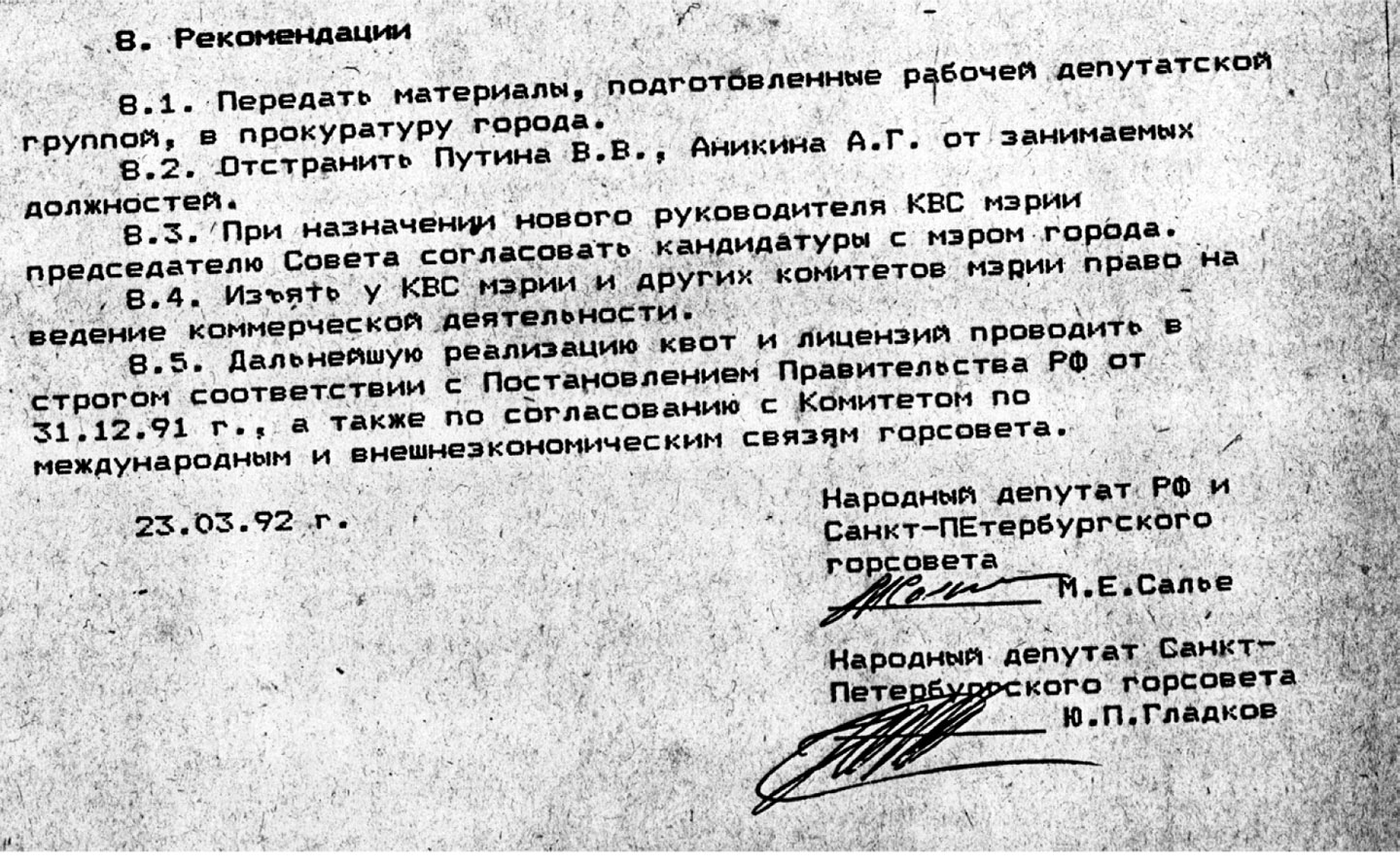
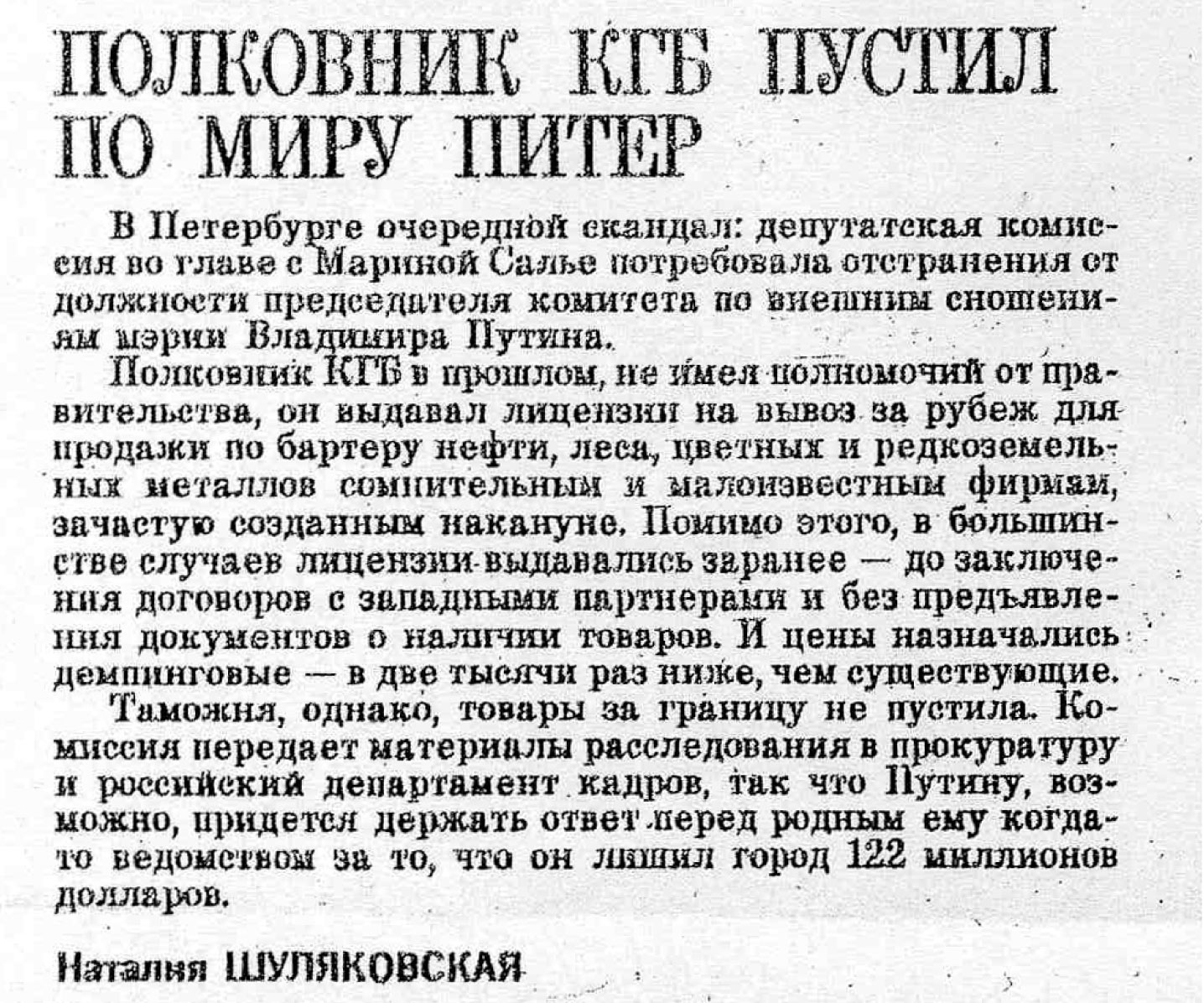
The materials of the investigations of the activities of the head of the KVS Vladimir Putin in the 1990s concerned not only the work of the Twentieth Trust Corporation. At different times, scandals arose around the name of the future president related to the illegal acquisition of a cottage near St. Petersburg, fraud in the field of housing, and the theft of budget money allocated for the purchase of food. The greatest resonance caused the case with the disappearance of just government quotas for the purchase by the city administration of food abroad. In the report, prepared in 1992, a deputy group, led by Marina Salier and Yuri Gladkov, made quite unambiguous conclusions: “The CVS of the City Hall of St. Petersburg, ignoring the decree of the Russian government, exceeded its powers ... the facts ... Facts are quite enough for the incomprehensible conclusion about the incompetence of the management of the City Hall of St. Petersburg in the decision in the decision of them in the decision of the questions ". The document ends with recommendations to other deputies of the Legislative Assembly to transfer the collected materials to the prosecutor’s office and remove Vladimir Putin from his position. But in 1992, the deputies failed to remove Putin. The mayor of the city Anatoly Sobchak openly patronized him and did not give offense his assistant.
From the materials of the criminal case transferred by The New Times, Andrei Zykov, a former senior investigator of the Investigative Department of the Central Internal Affairs Directorate of St. Petersburg, the head of one of the groups in the investigation of the criminal case of the Twenty Trust Corporation, sent to retirement after case No. 144128 was closed:
“The sources said about Putin that he currently works at the St. Petersburg City Hall, is the head of the committee on foreign economic relations. Usually at work he is busy throughout the day, leaves the house at about 8.00 and returns to various evening hours. Where and how he spends his free time is unknown. For trips to the place of work and vice versa, he uses a business car of foreign production with a driver. During the residence in the audit address, Putin has established himself as a calm, secretive person. He communicates with the residents of the house only as necessary, when meetings with them, he is limited to greetings, reluctantly enters into conversations, answers the questions monosyllabic, does not talk about himself. Friendly, trusting relations he did not work out with any of those around him. Entertaining persons visit the check address extremely rarely. In the apartment they are from 1 to 4 hours. Sources suggest that these people are either Putin's colleagues at work, or related to him by the genus of activity. Their installation data is unknown. Materially, the family of the audited is provided at a good level. Before being settled in the apartment, expensive repairs were made in it, imported furniture was brought up ... ”
"Narrounds"
- in ministerials -
offices
Many officials related to the Twentieth Trust Corporation made swift careers. The New Times has already written about one of them (see No. 15 of May 21), related to the first deputy prime minister Dmitry Medvedev, who was related to serious financial flows controlled by the Foreign Relations Committee. The source who wished to remain anonymous told The New Times that it was Medvedev who carried out Vladimir Putin's instructions on the transfer of funds to various kinds of construction projects. In those days, the head of the corporation, Sergei Nikushin, could easily call the future President of Russia and inform about the need to transfer the amount of several million dollars to restore the Orthodox Church in Greece. Medvedev controlled this translation. Nothing is known about the future fate of this money. Money left through the famous Bank "Russia" of the brothers Kovalchuk. The bank’s office was on the ground floor of Smolny, and, as the sources of The New Times, the investors who addressed Vladimir Putin say, could get good to their project under one condition: everything was supposed to be carried out through the Bank Russia.
On this, the list of VIP-lice involved in the corporation’s affairs does not end. Under the documents on the allocation of the “twentieth trust” loans of the city hall, the current Minister of Finance Alexei Kudrin, who then headed the finance committee of the administration of St. Petersburg, is the signature of the finance minister. As follows from the materials of the criminal case, the corporation received loans on preferential terms, and transferred the received funds to the accounts of various foreign firms. Together with Kudrin, his deputy Dmitry Pankin, who in those distant years, set his signature on payment orders on which the money was allocated, also moved to Moscow. Currently, Pankin is still working in conjunction with Kudrin, holding the post of director of the Department of International Financial Relations, the State Investigation of the Ministry of Finance of the Russian Federation.
Not only the subordinates of Kudrin, but also the employees of the Putin Committee on External Relations made a rapid career. On the authorized documents of the “Building and Financial Corporation“ The Twentieth Trust ”, which are at the disposal of The New Times, are pressed by the KVS. The charter of the corporation was registered by the head of the KVS registration department Albert Stepanov. Having moved to the Kremlin, Vladimir Putin did not forget about this colleague. Currently, Stepanov leads the Department of Finance and is a member of the standing committee of the Union State of Russia and Belarus. The director of the registration chamber of the St. Petersburg City Hall Sergey Movchan, who in 1996 re-register the constituent documents of the corporation, until recently he led the Federal Registration Service. In April 2007, however, Vladimir Putin resigned Movchan. According to the information that took place in a number of the media, the Movchan should become the first (that is, the main) auditor of the Accounts Chamber, but so far the official has not received a new appointment.
The leaders of the corporation were less lucky. Apart from Nikeshin, sitting in the St. Petersburg Legislative Assembly, the traces of most members of the leadership are lost. Evgeny Yurkevich, who in 1993 was a member of the leadership of the Twentieth Trust, chose to leave, concentrating on a scientific career. Now Yurkevich is a corresponding member of the Russian Academy of Natural Sciences, candidate of technical sciences, member of the International Academy of Informatization and Forecasting. Vladimir Gaidude, who was part of the Trust Board, after coming to the presidential post of Vladimir Putin in June 2000, became deputy chairman of the Finance Committee of the Administration of St. Petersburg, and is currently the first deputy chairman of the housing committee. Directly in the construction sector, only one of the leaders of the Twentieth Trust remained. At one time, the corporation became famous for the promise to build Peter the Great on Vasilyevsky Island, which was supposed to be the first skyscraper of St. Petersburg, for a decade ahead of the scandal that flared up around the construction in the city of Gazprom-City tower. There is nothing left of that project now, except for the fence around the empty construction site and memories of the missing two and a half billion rubles allocated from the city budget. But it is impossible to consider the construction stopped. One of the leaders of the “Twentieth Trust” Ravil Kamaletdinov is now building “elite residential complexes”, being the director of economics and business processes of the RBI holding. On the official website of the company in the Golden Thoughts section, the visitor can familiarize himself with the quote Friedrich V.-I. Schelling: "Architecture is frozen music." But if a little is known about frozen music, then about how and in whose accounts the allocated budget funds are freezed, all participants in the Twentieth Trust operation know perfectly.