
Translated material
New Testament Mikhalkov
The opening ceremony of the XXIX MMKF, held on June 21 at the Pushkinsky cinema, was dedicated to the 50th anniversary of Mikhail Kalatozov’s film “Cranes fly”. The famous black and white shots were played on the screen-the kiss of Samoilova and Batalov in the wedding veil, the Batalov’s mileage on the stairs, the crane wedge in the sky, crying Samoilov at the end; On the stage they sang "It seems to me that the soldiers ...". Thus, the opening ceremony of the Moscow Film Festival definitely passed with tears in her eyes.
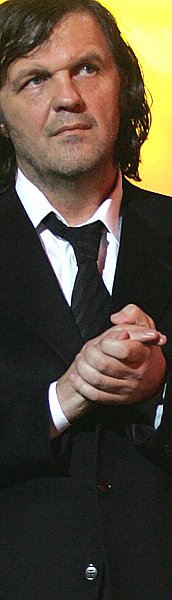
A strong Russian accent of the ceremony was sometimes replaced by a light Slavic. Tatyana Samoilova and Alexei Batalov received awards for their contribution to cinema. At the same time, Samoilova spoke of civil duty, and Vicepremier Sergei Naryshkin - about the tragic date for the Russian people on June 22 and about the Great Victory - including Russian cinema. The traditional prize of the festival, which is awarded at the opening, - Silver George for his contribution to world cinema - received Serb Emir Kusturitsa. And Nikita Mikhalkov completed the festival of the Russian spirit with a bike that he gave the Kusturitsa a suit in which he rose on stage, because the Serbian director “arrived as a homeless”, and a reasoning about the fraternity of the Slavs-kinematographers among themselves.
Brotherhood of brotherhood-so Kusturitsa at the morning press conference talked about the fact that Russian and Serbian cinema have only roots-but clearly does not smell of twins. In our country, if you cross the “brother-2” and “Kill Bill”, “scums” are obtained at best. And the Serbs with the same ingredients have a bureau.
In this film, everything is seen more than once - in “Black Cat, White Cat”, in “Life as a Miracle” and other films about crazy rural Serbia. The viewer feels as if in the yard still 1997 or 1998, and he is still sitting in the past cinema and watching the past Kusturitsa. Or the current, but it doesn’t matter. Because all in the “Testament” is from there: and the incendiary music that the son of director Stribor Kusturitsa wrote, and a dirty black and white cat, a lickening ear at the very beginning, and the plot. The plot is like that.
Tatyana Samoilova and Alexei Batalov (photo by N. Chetverikova)
A boy of Tsane lives in the village. In addition to him, his grandfather and teacher live there, who had dreamed of marrying grandfather for many years. One fine day, grandfather announces his grandson that he is going to die, and therefore the young offspring should go to the city, sell a family cow there, and for the proceeds to buy the icon of St. Nicholas, some souvenir and wife. The wife, however, can not be bought, but without a material reward, neither the grandfather nor the grandson thinks of marriage with a city girl.
Everything that happens further has nothing to do with this plot. The most charming moments of the film are not the execution of the grandfather’s grandson (although he, of course, performs it), and how Kusturitsa plays the cartoons by means of author's cinema. Here are two bald bandits in shorts - large and small. A large three -story brothel of its main competitor breaks his head later. Here one of the bandits is inflated with a hose and launched to fly under the ceiling of the room, and the other sheepskin plugs are cut off. Here the bandit with cut eggs moves off the hill on the coffin and falls into tartarara.
All this, of course, is packed in a highly ideological wrapper: they say, a movie about the conflict of the city and the village, about the relations of America and Little Europe, which is all unexpectedly about the relationship of men and women, in the end. But the main thing here is not this, but a high -tech peasant hut, from which a grenade launcher crawls out of the roof, or a boar running to rape one of the bandits into rye fields. The bandits generally get here, but not for some reason, but simply because they always get in cartoons. “As you noticed, there were no bad guys left for the final: they were killed by all,” Kusturitsa said at a press conference. - Because it is necessary. In the cinema ".
With this need for cartoon mocking over evil, the director is easy, and live with her to live with her. When grandfather watches black and white shots from a longtime Olympiad on TV, and under the "indestructible union" gets up and cries-the same gestures that the heroes of the Olympiad on TV-the viewer begins to laugh and then resolves. Because the music, in fact, has not gone anywhere. And so all the time: in a very export, essentially, entertaining Happy-end film, Kusturitsa is scribbled-the Russian viewer-perhaps sees too much personal.
Therefore, the Russian rolling name sounds so pathetic. In fact, the “Testament” in Serbian is “promise”, and in English the film is called “Promise Me This”. In Serbia, this movie has not yet been shown, but the foreign viewer has already loved him. In particular, Nikita Mikhalkov, who shoots the same Russian-export cinema, in which the foreigner is shown by the greatness of Russia, and the Russian-, in general, is generally squalor, fell in love with him.
And everything is said about the “Testament” in his finale. There, an almost blind centenary old man from a neighboring village creaks: “It seems to me that all this is one big provocation.” And it is better to think so than to believe that Kusturitsa took himself himself specifically for Nikita Mikhalkov. The next film of the famous Serb is called Pancho Villa and will be dedicated to the Mexican Revolution. Rather, how the guillotine was brought to the headquarters of the revolution. What will come of this? Surely some kind of bureau again.