
Translated material
Shokhin: Putin can lead the party and get the constitutional majority in the State Duma
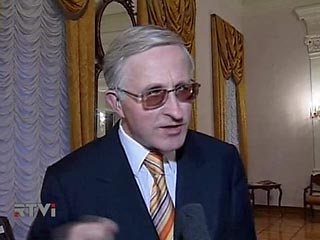
During the campaign in front of the Duma elections, Russian President Vladimir Putin or his successor may join “one of the political parties”, which will subsequently gain the constitutional majority in the State Duma and will receive the right to apply a veto to decisions of the next head of state. This version of the nearest future of the Russian political system after the 2007-2008 elections was voiced by the President of the Russian Union of Industrialists and Entrepreneurs (RSPP) Alexander Shokhin. The current President Vladimir Putin, according to Shokhin, can be headed by the Constitutional Court of Russia.
Speaking about the "one of the political parties" Shokhin, most likely, had in mind the party of power "United Russia". Upon the entry into the successor, the presidential election of 2008, in fact, will become a formality, and the specific name and surname of the successor of the president will not bear the special semantic load, since the continuity of the course will be formally preserved, writes "News Time" .
The head of the RSPP believes that the demonstration of such continuity was the participation in the recent St. Petersburg Economic Forum of both current potential successors of the president - the first deputy prime ministers Sergey Ivanov and Dmitry Medvedev. True, closer to the 2008 elections, Alexander Shokhin suggested, someone else can become a successor, but they will most likely be a person whose back there are no significant financial resources - to avoid a new redistribution of property.
By the way, literally a day after these assumptions of Shokhin, the leader of United Russia Boris Gryzlov and the head of the United States of the United Russia Vyacheslav Volodin said that in the first three of the federal list of their party, one of the deputy prime ministers could be.
Analysts tend to believe that the future president will be non -partisan
The Deputy General Director of the Center for Political Technology, Alexei Makarkin, believes that voters would like to see the president who is not part of any of the political parties, and are already ready to vote for any successor. According to Makarkin, the emergence of a successor in the list of United Russia is a scenario that was relevant and actively discussed until that moment in the creation of “Fair Russia”.
"In a situation where the successor would lead the list of" United Russia ", she would receive additional points - hardware, image. But the problem is whether the Kremlin needs a new CPSU, which will enhance the influence? The appearance of" Fair Russia "suggests that the scenario is most likely when the successor is not included in any of the political forces, and they simply support it. In addition, according to the survey conducted by the survey conducted “Levada -Center”, voters are already ready to vote for any successor, and if so, then the promotion of the successor in the parliamentary elections is purely autistic, ”said Makarkin.
The leading researcher at the Institute of Geography of the Russian Academy of Sciences Dmitry Oreshkin believes that the “United Russia” successor on the list would be beneficial, it would then become a state-forming party: “But I think that this will require a too responsible decision in the too early phase. That is, if any of the deputy prime ministers will enter the three“ United Russia ”, this will be a rather sharp political movement, which will immediately evoke a strict opposition All other groups of influence participating in this game. "
Oreshkin noted that if one of the deputy prime ministers is on the list of United Russia, he will not necessarily become a successor. It is possible that “Fair Russia” will symmetrically react, and the most serious contender for the presidency will remain non -partisan to the last.
Independent State Duma deputy Vladimir Ryzhkov believes that United Russia would like the successor to join their party, would become its leader or at least a member, as this will win in internal competition with “fair Russia”. But even if this happens, United Russia will still not become a state -forming structure, because in Russia such a structure is bureaucracy, and not parliamentary parties, the deputy believes.
First Deputy Chairman of the Central Committee of the Communist Party of the Communist Party, Deputy of the State Duma, Ivan Melnikov, does not see special benefits for the real presidential candidate from the authorities to enter the three United Russia: “It is clear that“ United Russia ”would like to have not just the Deputy Prime Minister, but the future president in his lists. But this can happen only if at the time of the United Russia leadership, nor one or another one or one or another one. The deputy prime minister will not know for sure how the operation "successor" will unfold.
One of the leaders of the Communist Party agrees with political scientists that the party in the Party is acutely faced with the issue of strengthening positions. “But something depends on the group in the Kremlin that finances and promotes the Mironov“ fair Russia ”. If they gain momentum, in United Russia they will be more prone to risk and more clear positioning as a party of power number one. If not, then there will be no reason to take risks. I think the decision is to remain on the presidency of the fight or participate in it (in parliamentary elections. approx.
Member of the United Russia faction in the State Duma Mikhail Grishankov recalled that several members of the Cabinet of Ministers have already joined the party. So, it is possible that the president’s successor will join her: "I believe that the future president needs some kind of party coloring, so that it is clear what political views he adheres to."
Experts doubt the appointment of Putin by the chairman of the KS
In the future, that Vladimir Putin can become the chairman of the Constitutional Court, while remaining an active participant in the political process and "acting as an arbitration judge" on the most important issues of Russian politics, for example, when amending the Constitution, analysts and deputies doubt. Most of them recognized the position of the head of the CS as too shadow and not corresponding to the ambitions of Vladimir Putin.
Alexey Makarkin believes that Vladimir Putin at the head of the Constitutional Court is an exotic. 95% of what the Constitutional Court does is issues that concern a very limited number of citizens. "The functions of the Constitutional Court do not provide for the active participation of his chairman in politics. There was only one such precedent in 1993, when the then and, by the way, the current court chairman Valery Zorkin tried to play a political role, reconciling Boris Yeltsin and Ruslan Khasbulatov, but all this ended badly," the analyst recalled.
According to Dmitry Oreshkin, the idea that Vladimir Putin could be headed by the Constitutional Court, first appeared six months ago, when the issue of moving the Constitutional Court to St. Petersburg was extended. According to the analyst, this is a convenient position: personal integrity is guaranteed, but at the same time, the influence and political status are preserved: "It all depends on how Putin sees his future. He wants to - will become the chairman of the Constitutional Court, will not want to - will not become."
Vladimir Ryzhkov believes that Vladimir Putin will rather retain the leadership of the Security Council, remain the chairman of the State Council or lead the board of directors of a new energy supercompany.
Ivan Melnikov is also inclined to the idea that Vladimir Putin will lead a large international energy company. The option of "Ukrainian reform", when the real power passes into the hands of the Prime Minister, based on the Duma majority, and the president will remain a symbolic figure, analysts are considered with certain skepticism, but do not finally refuse it.