
Translated material
2014 Olympics were entrusted to Sochi
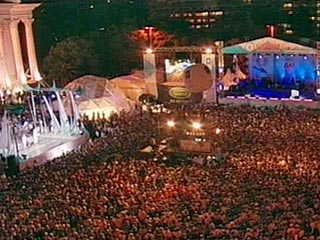
At the 119th session of the International Olympic Committee in Guatemala, a secret vote was held on the election of the capital of the 2014 Winter Olympic Games of the three candidates who passed the tough competitive selection-Russian Sochi, the Austrian Salzburg and Korean Pyeongchang. Salzburg flew out in the first round, in the second the winner was determined - they became a Russian resort. The Winter Olympics will be held for the first time in Russia.
- Sochi presentation at the IOC session in Guatemala
At first, the delegates held a test vote and official ballots were distributed to them. Then, by drawing, the Candidate cities were assigned conditional numbers. Pyeongchang - No. 4, Salzburg - No. 3 and Sochi - No. 5. Voices meters were also assigned, which should bring to the head of the IOC the results of voting in writing, and the regulations of this responsible procedure were announced.
After additional clarifications on the voting technique, the ceremony was announced open. Within a few minutes, the delegates made their choice, and the head of the IOC Jacques Rogge declared a loser of the first circle - they became Salzburg. The defeat of the Austrians was quite expected - the last year they had many problems: both internal ones, in the application committee, and at the international level, in connection with a doping scandal at the Olympics in Turin.
Thus, according to the results of the first circle , the chances of Sochi increased sharply , since the Austrian electorate was supposed to help the Russian city in the second round. It was expected that the voices of Salzburg from the first round would almost automatically move to Sochi. At the same time, they should have been enough for the final victory of the Russians, because in the first round no one gained more than 50 percent.
The alignment of votes according to the results of the first round by the regulations of the ceremony was not disclosed. In the second circle, the number of delegates increased to 100, since one Austrian and two Germans ceased to be interested persons. "Passing point" for the winner increased from 49 to 51 votes.
Immediately a second round of voting took place, according to the results of which the winner of the Olympic race was determined. However, he was announced only at a special ceremony, which began at 03:00 Moscow time. The envelope with the results of the vote was opened by Jacques Rogge, who uttered the cherished word - "Sochi!"
According to preliminary data, the Russian city won four votes with an advantage .
Recall that during the day the delegates of the session heard the presentations of the applicants , as well as the report of the VOC assessment commission, which visited these three years. The choice of the capital of the Games-2014 is entrusted to the delegates of the session. Of the 111 members of the IOC in the first round , only 97 received the right to vote - except for the President of the IOC Jacques Rogge, eight members of the IOC from Russia, Austria, Germany and Korea and five members of the IOC, which, for various reasons, could not take part in the session.
Voting voting should continue until one of the cities gets a simple majority - 50% plus one (in the first round it is 49 votes). As expected, this did not happen in the first round, because the struggle between the three applicants was extremely stubborn and there was no obvious favorite. After the first circle, one of the three candidates eliminated, and in the second circle its representatives already had the right to vote. And the elections continued between the two remaining applications. According to the regulations, in the case of equality of votes, the rounds must be repeated. If equality is preserved, the President of the IOC will decide on further actions. In Guatemala, there were no seniority.
On Wednesday, a member of the IOC from Ukraine and the chairman of the National Olympic Committee of this country, Sergey Bubka, expressed an opinion that coincides with the mood of most delegates - only two candidates of three - Sochi and Pyeongchang actually claimed to win in Guatemala. Moreover, if Sochi passes the first tour, then the Austrians electorate will help him to defeat him. Meanwhile, it was extremely dangerous to consider the candidacy of Salzburg a played card, it could play into the hands of Pyeongchang.
Authoritative world agencies involved in evaluating the chances of participants in the Olympic race, in general, noted equality among candidates for the finish line. So, representatives of Around The Rings generally refused to distinguish a clear favorite - for the first time in their ratingPower Index, all three cities scored exactly the same amount of points - 83. Meanwhile, Gamesbids still preferred Phyenchkhan, whose Bidindex was 64.99. The second place went to Sochi (63.17), and the third - Salzburg (62.62).
The outcome of the vote in Guatemala determined the "human factor". This was noted by the president of the International Olympic Committee Jacques Rogge. According to him, the applications of all applicants looked worthy, but their technical side did not become a decisive factor for the IOC members. "What really matters - the faith that the IOC members have for a candidate, to specific people. The human factor is very important. I think that it will become decisive when choosing from three beautiful applications the best."
Speaking about the "human factor" in voting, one cannot exclude the possibility of a simple mistake, as is known to people. Recall that, the victory of London in the competition for the 2012 Olympics, according to the British themselves, partly brought the thick finger of the Greek Technophobe , which simply pressed the wrong button. This member of the IOC, which was assumed, Lambis Nikolau, in the third round voted for Paris instead of Madrid, and this mistake turned into pleasant consequences for the British.