
Translated material
Hyperion riddles
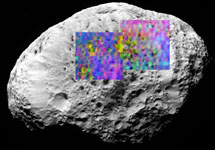
One of the most unusual satellites of Saturn and the entire solar system Hyperion is a kind of giant sea sponge. Its exceptional porosity allows him to absorb small and large cosmic garbage without much harm: meteorites simply fall deep into the satellite, leaving new deep holes. According to the latest estimates, this moon is 42% vacuum, but the remaining interest is mainly water ice ...
The moon, consisting of "holes" and craters, has a very small average density (544 kilograms per cubic meter) and a very wrong form (360x280x225 km). The rotation of the Hyperion (moving in a 21-day orbit) is chaotic, it is turned over in the most unpredictable way, obeying both the gravitational influence of Saturn and its largest satellites.
The surprise that Hyperion previously caused among the astronomers only intensified after four spans perfect near this satellite (eighth largest in the Saturn system) in the Cassini interplanetary station in 2005-2006. In September 2005, during the most successful approach, Kassini became close to Hyperion up to 500 kilometers. It turned out that on this moon not only more craters than on other moons of Saturn, they are also much deeper and better preserved. In some cases, a strange dark material is visible in the “hole” depth, of which the “lower floors” of Hyperion consist.
A group of specialists, headed by Dale Kruikshank from the Amearch Center Research Center ( Ames Research Center , California) analyzed the composition of Hyperion using the data installed on Cassini Ultraviolet spectrometer UVIS (Ultraviolet Imaging Spectrometer) and VIMS spectrometer (Visible-Infrared Mapping Spectrometer), operating in optical and infrared ranges. The results of the new work were published in the Nature scientific journal July 5.
Based on the fact that this moon reflects only 30% of the light falling on it, it was concluded that the “dirty” ice there was sprinkled with some kind of dark red organic material of unclear origin (the presence of hydrocarbons, among other things, may indicate the most wide distribution in the solar system of the main “bricks” necessary for the emergence of life). The same material, apparently, is concentrated in the lower part of the craters of other Saturnian moons - Phoebe and Yapet .
American researchers also found on Hyperion and carbon dioxide (CO2), but not in the usual "pure" form (in which it is present on many other celestial bodies of the solar system) - because such a "dry ice" in this case should evaporate and disappear from the surface of the Hyperion after only a million years ... Instead of this, there are mainly CO2 components annexed to other molecules (possibly to the other Water molecules), which allows carbon dioxide to stay on the lunar surface for a long time - up to the period comparable to the age of Hyperion itself (over 4.5 billion years). This situation is already familiar to scientists in research related to other large satellites (Jupiterian) - Ganyaeda and Callisto.
It is the carbon dioxide Kruykshaank that considers the most critical component that allowed Hyperion so “porous”. Perhaps, at the dawn of the existing of the solar system, when forming this smaller fragments of the celestial body (under the conditions of very modest gravity), it contained extensive reserves of CO2 and other volatile components that were later lost, leaving the voids behind ... It is possible that the small satellites of Saturn have a similar composition and look similar, just Cassinin's photocamers have not yet been selected. him at a fairly close distance ...
In the illustration:
Fragments of the card displaying its composition are imposed on this picture of Hyperion. Blue color symbolizes the presence of frozen water, red means frozen carbon dioxide ("dry ice"), lilac indicates the area where water is present in conjunction with carbon dioxide, but yellow is a compound of carbon dioxide and unidentified material. Image: NASA/JPL/University of Arizona/Ames/Space Science Institute
Sources:
NASA FINDS HYDROCARBONS ON SATurn's Moon Hyperion - NASA
Saturn's Moon: A Dirty Sponge. Snapshots of Hyperion Show Its Holey Nature - Nature - News
Craters Preserved on Spongy Saturn Moon - New Scientist
Saturn's Moon Hyperion Is Porous Like A Sponge. Cassini Data Indicates Saturn's Moon Is Riddled with Holes - Scientific American