
Translated material
From the Holocaust to the Berlin Wall
German films "Fake -Minutes" and "Summer on the balcony" are released on the screens
Stefan Ruzovitsky and the “East Berlinskaya” tragicomedy “Summer on the balcony” of Andreas Drasen are a picture representing different faces of modern German cinema, one of the most interesting in today's Europe.
They started talking about the rise of German cinema before the debut of Florian Henkel von Donnersmark “Life of others” received an Oscar in the category “Best Foreign Film”. On the example of this spy detective, which has won world success, it is clearly visible that the Germans managed to do what the French failed and Russians: it is effective to use Hollywood mechanisms to develop national myths. In the "life of others" we are talking about the Gader regime as a source of terror and lawlessness. There is no gram of nostalgia in the film - unlike the popular German comedy “Goodby, Lenin!”, In which the socialist past was pretty romanticized.
Cinema instead
- Berlin wall -
Germany has long been united, but the symbolic boundaries between the East and the West were not erased, and the path from one edge to another - from socialism to capitalism - is still not easy for many Germans. They remove this from year to year. The most successful and accurately - Andreas Drezen, a social realist (not to be confused with the socialist), the German colleague Ken Louch and Mike Lee.
Non -money and unemployment, social lack of demand and stratification in society - these problems are essential for its films, but are not fatal, revealing a more subtle and complex world of human relations. The uncomfortable everyday life since the time of Fassbinder and Alexander Klyge has served in German cinema a training ground for existential explosions, albeit quiet, drowned out by laughter, as in the tragicomedies of Drezen.
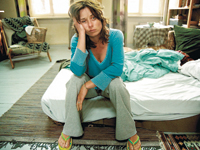
His “summer on the balcony” is the story of two friends. One of them alone brings up his son and, in the hope of finding a job, goes to stupid special courses, where they teach the rules of conduct in interviews. The other cares for lonely old people and leads to the house of a trucker, in which the number of wives and children is equal to the number of cities visited on duty ...
- Another life -
Drezen does not romance everyday life, and everyday life does not turn into a landmark. The lightness of the genre does not abolish his social sensitivity, and critical realism does not roll into crisis. The directorial drive and acting excitement only set off the proletarian - East -berlin - the chaste melancholy. The main thing is that this is an old and seemingly obsolete space is perceived as a relevant, as a reservoir for a new life, completely different from the one that existed before the fall of the Berlin wall.
Active and painstaking, critical and sometimes uncompromising work with its own history is one of the main “trends” of German cinema. Whether it is the Gader Past or World War II, the topic for the Germans is bleeding. Every year they shoot more than one film about fascism, putting a drop in national repentance and atonement of guilt, which largely build a culture of post -war Germany.
For falsification of money
- threw prisoners of Jews -
 |
 |
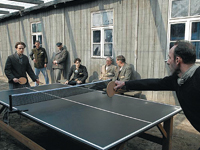
The “counterfeiters” of Stefan Ruzovitsky are based on real events - the secret operation “Bernhard”, when millions of British pounds forged millions of British pounds on the end of the Second World War and shake the enemy’s economy. The falsification of money was thrown by prisoners of Jews. For their secret work, two barracks in the concentration camp of Zasenhausen were isolated, providing prisoners with food, cigarettes, separate beds - conditions unthinkable in “ordinary” dungeons. The main specialist in fake banknotes was appointed a brilliant counterfeiter Solomon Sorovich, whose prototype is the Russian Jew Solomon Smolyanov, the famous pre -war swindler, nicknamed Sally.
The operation "Bernhard" overgrown with legends that would be enough for not one action -packed picture. Of course, this story is tempting to fiction, turning a concentration camp into a platform for a claustrophobic thriller. There are more than enough stress in the “counterfeiters”, but the main thing is that the film is made as if his action was happening here and now, and not there and then.
Everything is shot on close -ups with a manual moving camera. The image is rough, installation is sharp and torn. Ineffective interiors are as close as possible to the viewer. Emotional intensity is provided by actor Karl Markovich in the role of Sorovich. The courageous and at the same time is a hypersensitive, Markovich plays not only the classical confrontation between the victim and the executioner, but also the more pathological conflict between the victim and the victim. Rather - between the survivors and those who died. The main ones in the image of Sorovich are not his adventurism and mind, which allows him to stretch the time until the end of the war, but the hero tormenting the hero, which he, who survived, experiences before the dead.
- Details of the "norm" in hell -
The existential nightmare is expressed not so much by the kanonads of executions that are brought to isolated heroes daily as a show of how prisoners play the Ping Pong, donated to them for dying leisure, how they are forced to dance with each other on New Year's Eve and, depicting women, sing songs in the spirit of Lily Marlene. These details of the “norms” in hell are more strongly than the scenes of death and humiliations, which are at least in the “counterfeiters”.
Of course, as well as the “list of Schindler” by Stephen Spielberg, the “counterfeiters” appeal to memory and compassion in exchange for Saspens and strong emotions during viewing. But, unlike the color ending of the Black and white film of Spielberg with his crowd of jubilant people, a hopeless defect of the film in the “counterfeiters” resolutely refutes the fact that after the Holocaust, a person with a capital letter, like the ideal of humanism, could remain entirely and unharmed.
Having reduced the aesthetic and historical distance, Ruzovitsky achieved the effect of presence - striking for the film about the Holocaust. After all, the compensatory mechanisms of culture have long and reliably guard this topic - humanitarian knowledge, sacred memory and responsibility for "it never repeats." It is impossible to approach the tragedy without these protective mechanisms. All the more unexpectedly, in the mainstream “counterfeiters” the illusion of direct contact with the seemingly tamed past for a second, but still arises.
The active formation of the German film industry began at the end of the First World War. At the turn of the 10s and 20s, German expressionism arose. Its main representatives - Fritz Lang, Friedrich Wilhelm Murnau, Robert Wine - expressed in their films not only the chaos of the post -war period, but also a premonition of the fascist era.
Another current in the German cinema of the 20s is the so-called “mountain films” that sang the beauty of nature and the cult of the human body. In them, in particular, was played by Leni Rifenshtal. In the 30s, with the coming to the power of the Nazis, she will become the chief director of the Third Reich, the author of the Triumph of Volya and Olympia-classic samples of fascist propaganda, which reigned in the German film industry almost until the end of the Second World War. The revolution in German cinema occurred in the late 60s and early 70s. The impetus for it was the Oberhausen manifesto signed by a group of young directors who demanded freedom from the studio system, independence from commercial principles. The German "New Wave" was formed. Its representatives-Folker Schlendorf, Alexander Klyge, Margaret von Trott, Rainer Werner Fassborder, Vim Wenders, Werner Hertzog-determined the development of German and European cinema until the beginning of the 90s. With the unification of Germany, a new generation came, in which there are successful cosmopolitan directors (Tikver, Oliver Hirschbigel), and those who partly inherit topics, motives, style of German cinema of the 60s and 70s (Andreas Drasen, Fatih Akin, Matias Glazner).