
Translated material
Russian recipe for salvation of old European European
In society
 Russian recipe for salvation of old European European
October 4, 2007 Alexey Muravyov
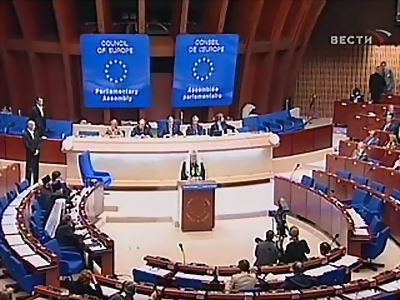
The visit of the Primate of the Russian Orthodox Church MP to France, competently organized by the Bishop of Vienna and Budapest Hilarion (Alfeev), in all obviousness, was conceived to show, on the one hand, who was in the house, and on the other, to enter the world political market with a new offer. Along the way, the Patriarch made several statements, the meaning of which seems to be either banal or foggy at first glance, but in fact they draw up a new proposal to Russia to Europe.
The warrior was preceded by artillery preparation in the form of several statements by Bishop Hilarion, in which he questioned the course of current Europe for secularity as a norm of life. "From unofficial meetings, the participants of which are not responsible to each other, we must come to a completely official dialogue in which European politicians and representatives of churches will participate on an equal footing," said the Ambassador of the Russian Orthodox Church in eurostructures. Behind beautiful words, there is no less than the program of the re-intricate of the European space, and the program is quite brave. Its meaning is approximately as follows: Western churches and denominations are exhausted and can no longer protect Christian values, so now, when Russian hydrocarbons, etc., etc., it is the ROC MP who must take responsibility for these values. To do this, you need to get a carte blanche from the European Parliament and its structures. The bishop complained to the attempts of "many European politicians to oust religion from the public sphere," to create a situation in which religion and the church would be perceived exclusively as a private matter of individual individuals. " Again, the bishop expressed to Europe a rebuke that it “lives incorrectly” and the values that Western European civilization (secularism, tolerance, deconfessionalization) are now based on the realities of the present day and even (this is clearly read between the lines) does not provide the proper level of European security from “threats”. These threats were already specified by the Patriarch himself, outlining the program to strengthen Russian religious structures in Paris and in the French outback, where the Parisian Exarchate of the Ecumenical Patriarchate has traditionally been strong in relation to the Russian MPs.
The demonstration was a success - the political weight of Patriarch Alexy, of course, is far surpassed by the weight of his namesake - the bishop, the head of the exarchate. From these actions it is clear that there will be a difficult competitive struggle for property and the souls of people at the French bridgehead, which has long been held by the weakening forces of Russian emigrants. Having emphasized that the “bleeding 80 years of the wound of the split” is heshed, the patriarch made it clear that the rest of the “wounds” would soon be rusted. In his greeting PACE, the Russian church leader said that the ROC MP "has always sought to unite the Russian people who were outside the fate of the Fatherland." And here she has great advantages: she is invariably the keeper of not only faith, but also the language, culture, spirit of brotherhood and mutual assistance, ”which, as you can understand, are almost lost by Europeans and Russian emigration.
Sensationally , the readiness to meet with the Primate of the Catholic Church by Pope Benedict XVI. Probably, the conservativeness of the pope’s position and his peaceful steps in the radical reduction in the Catholic presence in Russia finally caused a benevolent reaction. Of course, do not feed the unjustified hopes for an imminent meeting. The famous Maxim says that the meetings occur when the partners have something to offer each other. The Patriarch hinted that together the Catholics and Orthodox could fight the polyphonic hydra, whose heads are “aggressive secularism, religious relativism, the crowding out of religion on the side of public life, the propaganda of the consumption culture, and the revision of real norms.” If you discard a lot of epithets, it turns out that the main “threat” to society is relativism and consumerism. It is amazing here, first of all, the fact that these phenomena, really corroding modern civilization, are quite present in Russia, where, as sociologists, consumer motivations gain weight in the behavior and value of citizens, and relativism (the social consequence of the war of the 1940s, the NTR of the 1960s and decommunization) has long become the norm of consciousness. In other words, Russia should be “saved” from exactly the same diseases. The doctor, healed himself, said the ancient Romans ...
The subject of the conversation is as follows: Catholics can change the main partner in negotiations, leave Constantinople and turn to Moscow. And the Orthodox in response will be able to “help” the Catholics to defeat secularism. The catastrophe, which erupted over Europe, was described by the Patriarch as "the breakdown of the relationship of human rights and morality." From this point of view, already familiar to Russians in church affairs, by the numerous speeches of the head of the ACHS, Metropolitan Kirill, “the basics of the social concept of the Russian Orthodox Church”, “Russian doctrine” and other documents, the struggle for human rights has lost its positive meaning and serves now on “justification of immoral acts”. First of all, the head of the Russian Orthodox Church MP had in mind the notorious “gay problem”. But not only. To the questions of journalists intrigued by this topic important for European politics, the patriarch gave an answer more common than you can usually hear in his homeland: “Sin is not only homosexuality, but also marital infidelity, irresponsible sexual intercourse, sexual exploitation of women, many other acts that ... force a human conscience.” But if the gay problem still fits into the conflict of human rights, then what does marital infidel have to do with it?
Having stated that “religious motivation has the right to exist, including in the public sphere,” the patriarch seems to be breaking into the open door. In Europe, Christian (as well as other) motivations are not persecuted, they are simply reformatted during history and liberalized. But to say bluntly: “Your Christianity has exhausted and is not good” somehow incorrectly, so you have to use such complex constructions. The program of the “Russian world for Europe” involves “a serious intercultural dialogue with the most active participation of representatives of traditional religions and the secular world”. The whole question is who and with what means will format this dialogue.
The new proposal of Russia sounds something like this: in view of the cultural and religious catastrophe of the Russian Orthodox Church, with the support of Russian political structures and (possibly) the Vatican, is ready to take up the rid of Europe from the above diseases and vices. The mechanism of this treatment has not yet been specified, but, apparently, the “new dialogue” mentioned repeatedly will have it as it.