
Translated material
Gamsakhurdia-2
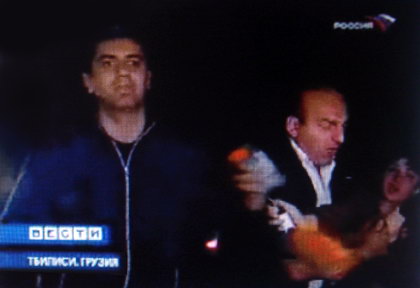
The story of Irakli Okayashvili slightly resembles the events of 1978, when the leader of the Georgian dissident movement Zviad Gamsakhurdia on the air of Soviet television repented of his sins before the authorities. Thus, he struck the strongest blow to the anti -communist forces in his republic. The repentance of Distaashvili also cannot but bring turmoil into the ranks of the already not very strong Georgian opposition, which seemed to finally gained a key figure with charisma, proportionate charisma of Mikhail Saakashvili himself.
Gamsakhurdia for her repentance received a punishment below the lower limit - a couple of years of exile (and not in the Siberian regions) - and then employment in the specialty, a senior researcher at the Institute of Georgian literature, in which he calmly worked before perestroika. Okabashvili, admitting that he had stipulated his former chef, and also confessed to the television cameras in extortion and negligence, he was able to go free before the trial (however, having paid $ 6 million in the form of a guarantee).
Gamsakhurdia was able to again become a hero for Georgians a decade after telepoque (this was different from a number of Russian dissidents - such as Krasin and Yakir - who, after a humiliating procedure, went into private life). In his return, several factors played a role from the famous surname (son of the classic of Georgian literature) to a shortage of bright leaders in Georgian politics of the late 80s. True, his take -off turned out to be short -lived - after him was followed by universal disappointment in the First President, overthrow, emigration and tragic death with subsequent posthumous almost “canonization”.
Now County Caashvili repented. Mikhail Saakashvili was able to drive him into a corner with a series of tough moves. Firstly, he agreed with the Americans that they would not make any approving gestures to the former Ministry of Defense of Georgia. The United States, in principle, strives to diversify the system of their political connections in the post -Soviet space, but in an acute situation they can prioritize.
Secondly, he imprisoned Okhaashvili accused of economic crimes, letting him go on his conditions. Moreover, the sum of the pledge (unprecedented for Georgia) plays no less PR role than the fact of repentance. If before that the Georgians were busyly discussing the question, did Saakashvili want to kill businessman Badri Patarkatsishvili, now on the agenda is completely different - where did the district from the district? The amount of the pledge, we note, for the vast majority of Georgians looks fantastic.
Thirdly, he initiated a consultation of six doctors who vowed that the former minister was not influenced by drugs, psychotropic substances or torture, but almost in good health (except for banal acute respiratory infections). Thus, Saakashvili deprived his former friend and the current enemy of the Martyr Ore.
It is far from the fact that Okhaashvili will be able to rehabilitate themselves in the eyes of both their own supporters and the oscillating part of the Georgian society (that is, those citizens who were disappointed in Saakashvili, but did not go over to one of his opponents). Behind him is not a paternal name - he is just a public leader of the opposition coalition, the main figure of which was Badri Patarkatsishvili. In addition, until the last moment it remained unclear which of them would run for the presidential election, which were scheduled for October-November next year. Much depended on the specific date: if the elections were scheduled for the period after November 6, then Zaashvili would become a candidate. If before, then Patarkatsishvili. The fact is that on November 6, 2008, Okagashvili marks 35 years, and only from that moment he receives the right to be elected to the presidential post.
 Badri has long spread out with Saakashvili-he finances the Imady TV channel, which actively criticizes the current Georgian power (as opposed to Rustavi-2, oriented to the president). He was also called as a possible candidate for the post of mayor of Tbilisi before last year’s elections, but he refused to participate in the struggle, not believing in the possibility of honest competition. Badri was also a significant political resource of Badri by the Georgian Olympic Committee - especially when you take into account the high authority that athletes use in Georgia (not by chance, having launched the struggle against the opposition, Saakashvili achieved his shift from this post).
Conspirologists see the “Moscow hand” in the Georgian political conflict, which is not too likely - all participants in the confrontation are perceived in the Kremlin sharply negatively (and Patarkatsishvili was generally put on the wanted list of the Russian Prosecutor General). In today's Georgia, Russia tried to play on the political field only once-when the opposition from supporters of the cursory ex-state security of Igor Giorgadze and several other small politicians constructed the opposition from supporters of the cursory. Saakashvili defeated this opposition without any problems, with complete indifference of the population. Recently, Giorgadze people were judged and sentenced to various terms of imprisonment - no rallies were observed by the court building (when Okashvili was arrested, thousands of people entered the streets, which indicates its political potential). Another thing is that the Russian elite, to the maximum, tried to use the accusations that sounded from the lips of Okhaashvili, and the fact of his arrest in order to once again reveal the Georgian regime in violation of democratic norms.
Author - Deputy General Director of the Center for Political Technology