
Translated material
The monopoly has died, long live a monopoly!
Russian electric power between two lights
## Monopoly died, long live a monopoly! On October 26, an extraordinary meeting of shareholders of the UES RAO will be held, at which a decision will be made to eliminate the Russian energy monopoly and election of the board of directors of new companies on the site of RAO companies. However, future problems are obvious now
Vladimir Milov
Director of the Institute of Energy Policy
Anatoly Chubais for a long time sought the opportunity to privatize energy acts, and its beginning turned out to be quite successful. To some extent, he managed to rehabilitate himself in the story with the collateral auctions of the 1990s. Conducted sales of shares of generating companies were carried out at very high prices-for example, in September, the German company E.on acquired a state-owned shares of the OGK-4 generating company at a price of more than $ 750 per kilowatts of power, that is, almost at the purchase prices of energy activists in Western Europe.
- Star of stumbling -
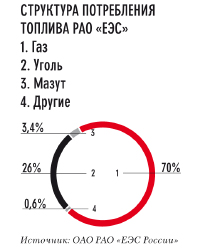 |
We have to state: the main goals of the reform - the creation of a competitive electricity market and the liberalization of the industry - were never achieved, in addition, the process began to unfold in the unexpected direction. Gazprom came to the industry as the main player, actively buying up generating capacities. This turned out to be a completely new turn: when the reforms were only developed, no one suggested the possibilities of such expansion, for the market this is a disaster. In 2000-2001, it was assumed that the gas industry would be reformed along with the electric power and the gas market will also be competition.
But Gazprom, having defended its monopoly status, has already bought up or is in the process of acquiring a number of large electrogenerating companies: Mosenergo, OGK-2, OGK-5, OGK-6, TGK-1-and thus will be able, according to various estimates, to consolidate control over 20-25% of the generating capacities of Russia. Another 5% will be controlled by the coal company of SUEK, with which Gazprom creates a joint venture to manage electric power assets. Add to this 25% of the capacities that remain under state control and which is not supposed to privatize (atomic and hydroelectric power stations), as well as 10% of the capacities that are already controlled by the Oleg Deripaska basic element group, and you get a market where two -thirds of the production facilities are controlled by the state, Gazprom and Deripaska. At the same time, a significant part of the capacities (about 10 percent) will belong to large Russian industrial groups, a very loyal state (Norilsk Nickel, one or two large oil producing companies). In addition, it is highly likely that foreigners who bought some electricity assets - the same German E.on - will soon resell their Gazprom in exchange for participation in gas producing assets.
Thus, less than a quarter of not the best generating capacities will remain other owners.
Gazprom’s expansion alone is already enough to bury all the positive achievements of electric power reform. After the liquidation of RAO UES, Gazprom will most likely require a revision of the current configuration of generating companies and will create the largest generating company in the European part of Russia on the basis of its power plants. Its power can be 50 thousand megawatts, and it will be simply impossible to compete with it. Being the main supplier of fuel at the power plant and at the same time the master of a significant part of them, Gazprom will be able to subsidize its power plants and discriminate against strangers, worsening the positions of competitors in the market and subsequently absorbing them. As it works, it is already visible in the example of the St. Petersburg region: defiantly refusing gas supplies to be launched a year ago, the second power unit of the North-Western TPP, Gazprom builds a southwestern thermal power plant, which will belong to the gas monopolist and for which the gas was safely found.
- The end of competition -
Is it possible to release electricity prices in such conditions? There is no answer. In addition, in reality, no one is going to let go of the price - and this is the second fundamental shortage of the outgoing Chubais. Having started the division of its industry by type of business as a foundation for achieving the main goal - liberalization of electricity prices, he did not bring the industry closer to liberalization. The new model of the wholesale electricity market, launched in 2006, is helpfully indifferent to whether the state of electricity prices will be released by a significant scale or not. This market can work as long as you like in the conditions of maintaining price regulation.
The liberalization schedule adopted by the Fradkov Cabinet kindly left the freedom of action to the new government - until the end of 2008 it is supposed to maintain the regulation of up to 75% of electricity supplies. The new cabinet driven by populism and is influenced by the industrial lobby will most likely throw into the basket even the plan of liberalization of the market that was with incredible labor and, with brutal opposition of the Kremlin’s power tower, was approved by former Prime Minister Mikhail Fradkov.
- citizens will pay. -
It is unlikely that it makes sense to blame only on Chubais guilty for the fact that everything turned out just like that. Chubais did what he could in the conditions in which he was placed. Such is the objective reality of the model of monopoly hospitalism in Russia. When and if oil prices fall, we will understand how dear to us this model costs.