
Translated material
A nurse from the palace
The October Revolution through the eyes of people from the other side - from the inside of the Winter Palace. The New Times is the first to publish excerpts from the diary of the sister of mercy, who on the days of the coup on duty in the hospital of the Winter Palace
Julia Kantor
Leading researcher
State Hermitage,
Doctor of Historical Sciences
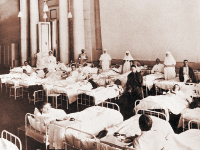 |
| Wounded and nurses in the Field Marshal Hall of the Winter Palace, October 1917 |
The stormed ones shot the howitzers at the actually unarmed palace: after all, the Cossacks and drummers of the female battalion had already left the white cloths in their hands in their hands. It made no sense to shoot from guns from guns into several dozen junker boys. Most likely, it was a mental attack. In Smolny, at that time, the II All -Russian Congress of Soviets was going on. The guns from the Peter and Paul Fortress did not shoot at the citadel of the monarchy, but at the hospital wards. The revolutionary detachments of the Bolsheviks on October 25, 1917 did not break into the palace, but into the hospital for seriously wounded - the number of lying here was an average of 85–90%. Both Smolny and Palace were well known about this.
For many decades about the hospital, located in the Winter Palace and created by the decision of Emperor Nicholas II and his family, it was not customary to recall. In publications on the history of the palace, the hospital was mentioned at best with one line. Meanwhile, in the archive of the State Hermitage there is a documentary fund that allowed to restore the history of the hospital. One of the most striking evidence of those days is the memoirs of the former nurse of the hospital in the winter palace of Nina Galanina, transferred to the Hermitage in the 1970s (the decision to make such a “seditious” document to the museum demanded from the director Boris Piotrovsky professional and civil courage). These memoirs are sharply different from not only from the ideologies in Soviet times about the assault, but also from the myths replicated in the last one and a half decades about almost an idyllic situation in the palace and on October 25, 1917.
An equally interesting document is the never -published notes of the head of the Petrograd Red Cross, a deputy of the IV State Duma and the provincial leader of the nobility of Lev Zinoviev. Fragments of these notes, located in the family archive, are published with the permission of his grandson, Honorary Consul of Australia in St. Petersburg Sebastian Zinoviev-Fitzlaion. We are used to looking at the events of “days that shocked the world” through the eyes of those who were on Palace Square and on the Neva embankment. The two unique documents published today provide an opportunity to look at the situation of 90 years ago-from the winter.
***
From the memoirs of Nina Galanina:
“The day of October 25, 1917 was my weekend after night watch. Having slept a little, I went to walk along the central streets of Petrograd - I looked and listened. There was a lot of unusual. On the streets, shots were heard in some places, and institutions stopped working. They stubbornly said that the bridges were about to be divorced. Fighters of the female battalion lined up on the Palace Bridge.
... By night, rifle and machine -gun shooting no longer stopped.
... As soon as the morning 26/X came, I ... hurried into the city. First of all, I wanted to get to the hospital of the Winter Palace.
It was not so easy to get there: from the palace bridge to the Jordanian entrance stood a triple chain of Red Guards and sailors with rifles at the ready. They guarded the palace and did not miss anyone to it.
After the 1st chain, explaining where I am going, went relatively easily. When I passed the second, I was detained. Some Sailor shouted evil to his comrades: "What do you look, do not know that Kerensky will be dressed in a sister?" Demanded the documents. I showed a certificate issued in my name back in February, with the seal of the Hospital of the Winter Palace. It helped - they missed me. Something else shouted after him, but I did not disassemble and went on.
The third chain no longer delayed.
I entered, as it happened hundreds of times earlier, to the Jordanian entrance.
There was not in the place of the usual Swiss. At the entrance stood a sailor with the inscription "Dawn of Freedom" on a dishevefant. He allowed me to enter.
The first thing that caught my eye and struck was a huge amount of weapons. The whole gallery from the lobby to the main staircase was littered with him and looked like arsenal. Armed sailors and Red Guards went throughout all rooms.
In the hospital, where there was always such an exemplary order and silence, where it was known where the place should stand, everything is turned upside down, everything is upside down. And everywhere - armed people.
The older sister sat under arrest: she was guarded by two sailors. ”
***
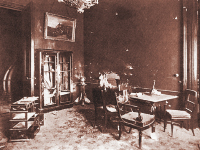 |
| One of the premises of the Winter Palace after the assault, the end of October 1917 |
From the notes of Leo Zinoviev:
“The uprising broke out on November 7th of a new style.
As always, in the morning I went to my Red Cross control (located on the engineering st., 4, a five -minute walk from Nevsky Prospekt and twenty - from Palace Square. - Yu. K.).
At about 11 a.m. ... against the windows of our control, suddenly, the workers armed with guns suddenly appeared, interspersed with sailors. The shootout began - they shot towards Nevsky Prospekt, but their enemy was not visible. Not far ... Starting machine guns began to shoot.
A few bullets hit our windows. One random bullet, breaking the window, tore the ear to one poor girl, our driver. In an outpatient clinic, which was immediately in the building of our administration, they began to bring the wounded and the dead.
They brought the murdered owner of the neighboring bench, which traded stationery, with whom I, before going to the department, exchanged several words. He was already without a jacket and without boots, someone had already managed to steal them.
This shooting lasted two hours, and then everything calmed down, shooting workers and sailors disappeared somewhere.
But soon it was possible to turn out that the uprising was successful everywhere, the telephone station, water supply, railways and other important points of the city were already in the hands of the Bolsheviks and the entire St. Petersburg garrison joined them.
The palace on all sides was surrounded by the Bolsheviks, soldiers and sailors.
When in the evening, about 6 hours, I walked home, in that part of the city through which I had to go, everything was quiet and calm, the streets were empty, there were no movements, I did not even meet pedestrians.
The house in which we lived was very close to the Winter Palace - about five minutes walk, no more ... In the evening, after lunch near the Winter Palace, lively shooting began, at first only rifle, then the crackle of machine guns joined it.
... By the 3rd in the morning, everything calmed down.
Early in the morning, at six hours, I was informed from my Red Cross department that the Winter Palace was taken by the Bolsheviks and that the sisters of the mercy of our infirmary, who were in the palace, were arrested.
Having dressed in a hastily, I immediately went to the Winter Palace.
They let me in immediately, without any difficulties, no one even asked why I arrived. Inside, the palace was little like what I used to see there.
Everything was in a mess, the furniture was broken and turned upside down, everything was a clear trace of the just ended struggle. The guns, empty cartridges were scattered everywhere, in the large front and on the stairs lay the bodies of the dead soldiers and cadets, in some places lay the wounded, whom they had not yet managed to take to the infirmary.
I walked for a long time on the halls of the Winter Palace so familiar to me, trying to find the head of the soldiers who captured the palace. The malachite hall, where the empress usually accepted the represented by her, was all as the snow was covered with torn pieces of paper. These were the remains of the archive of the Provisional Government, destroyed before the fact that the palace was captured.
In the infirmary, they told me that the sisters of mercy were arrested for hiding and helping the junkers who defended the palace. This accusation was completely true. Many junkers at the very end of the struggle rushed into the infirmary, asking sisters of mercy to save them - obviously, the sisters helped them hide, and thanks to this, many of them managed to escape.
After a long search, I managed to achieve who was now the commandant of the palace, and I was led to him. He was a young officer of the Guards of the Moscow Infantry Regiment ... I explained to him what was the matter, said that about 100 wounded soldiers were lying in the infirmary and that sisters of mercy were necessary for caring for them. He immediately ordered them to be released under my receipt that they would not leave from St. Petersburg to trial over them. This ended, there was never any trial of the sisters, and no one else bothered them, while the Bolsheviks had more serious concerns. ”
The hospital in the Winter Palace was opened in 1915 for soldiers of the First World War. The hospitals, the eastern gallery, most of the Field Marshal hall, the stamp, picket and Alexander halls, as well as the Nikolaev hall, accommodating two hundred beds, were allocated to the hospital wards. The Petrovsky Hall was turned into a ward for the wounded who underwent particularly difficult operations. Part of the Field Marshal hall occupied the dressing room, the second dressing and the operating room were located in the column hall. The 1812 gallery served to store linen, and in the part where the portrait of Alexander I hung, the X -ray cabinet was placed.